London is hosting UNITAR’s CIFAL Global Network for the first time, drawing senior delegates from across the globe as GEDU Global Education unveils a new cross-network sustainability plan ahead of its inaugural group report
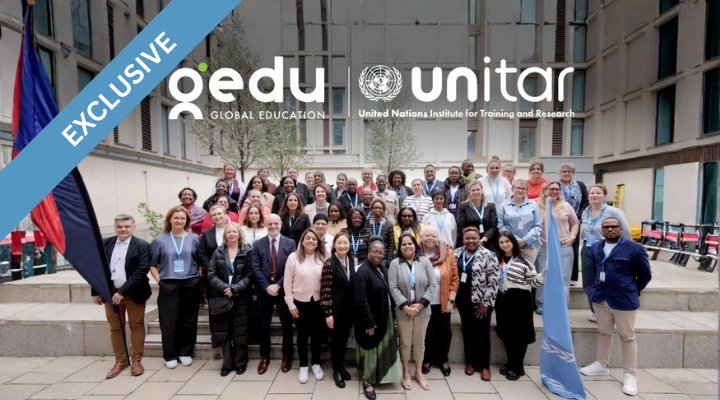
More than 60 delegates from the United Nations Institute for Training and Research (UNITAR) affiliated training centres that form the CIFAL Global Network (CGN) are meeting in London this week as UK-based GEDU Global Education hosts the XXII CGN Annual Steering Committee Meeting.
The gathering brings together CIFAL Centres from every continent to review progress towards the UN’s 17 Sustainable Development Goals (SDGs) and to agree on a consolidated capacity-building programme for 2026 and beyond.
GEDU is hosting in its capacity as the home of CIFAL London, one of 33 international training centres established by the United Nations Institute for Training and Research (UNITAR).
With more than 20 years of history, the event marks the first time the CGN Annual Meeting has taken place in London. It comes as the network prepares for a period of intensified SDGs implementation as we approach 2030, the deadline for achieving the Goals initially set in 2015.
Throughout the week, delegates are due to finalise a joint framework aimed at strengthening institutional capacity to deliver the SDGs at national and local levels.
The agenda includes sessions on UN 2.0 priorities, cross-sector and global partnerships, and the alignment of training programmes with the post-2030 development landscape.
An agreement formalising an ongoing training partnership between GEDU and UNITAR is expected to be signed during the meeting.
GEDU’s Managing Director for External Relations and Sustainability, and Director of CIFAL London, Kevin McCole, described the meeting as “a critical week for all involved”, adding: “This week, we want to identify areas for collaboration in 2026. It will also be important to lift our heads beyond the immediate horizon and consider how UN 2.0 and the Pact for the Future will shape our capacity-building initiatives to achieve the UN’s development agenda beyond 2030.
“We’re also going to release our inaugural GEDU sustainability report at an event in the House of Commons. The report will detail the work being done by all our institutions to address all of the SDGs, including the SDG that they have adopted and lead on for GEDU. It will also outline our ambitions for 2026 and beyond.
“Of the 32 Centres across the world, most are led by universities. In London this week, there will be senior figures from York University in Canada, Newcastle University in Australia, and more from all continents in between. GEDU’s contribution to UNITAR is global too — it’s not limited to London. With 13 institutions across 15 countries — from Toronto and Tampa in the Americas, across Europe and the Middle East and India, to Brisbane in Asia-Pacific — we are able to bring a global perspective and have a global impact.”

GEDU’s Sustainability Report, being launched alongside the meeting, sets out for the first time how teaching, governance and community work across the group feed directly into the UN’s development agenda.
The report, previewed by The European, says each GEDU institution has taken charge of a specific SDG, with progress reviewed twice a year. The plan reflects GEDU’s focus on SDG 4 -Quality Education -,delivered through more than 75,000 learners, and SDG 17 – Partnerships for the Goals, through its stewardship of CIFAL London and a wide array of partnerships with governments, businesses, academia, and NGOs across the world.
The Australian Performing Arts Conservatory (APAC) will lead on Sustainable Cities and Communities; École de Management Appliqué (EMA) on Clean Water and Sanitation; English Path on Peace, Justice and Strong Institutions; Global Banking School Malta (GBS Malta) on Good Health and Well-being; and Global Banking School Dubai (GBS Dubai) on Affordable and Clean Energy and Life on Land.
ICN Business School (ICN), meanwhile, will oversee Responsible Consumption and Production, while Global Banking School UK (GBS UK) takes Zero Hunger, Decent Work and Reduced Inequalities.
GlobalU, MetaGedu Apprenticeships and GEDU Services in India cover innovation and poverty reduction.
According to McCole, the report underlines how the group’s sustainability work is already converging across its institutions and how it sets a clearer, network-wide direction for the years ahead.
He told The European that it highlights shared priorities — sustainability in teaching, stronger community links, wider access through scholarships and expanded wellbeing support — alongside MLA College’s 17 byte-sized only SDGs learning modules already in use.
It also places this activity within GEDU’s footprint across more than a dozen countries, delivered through a decentralised network coordinated by CIFAL London.
“This is the first time we’ve brought all of this activity together in one place, and it shows the scale of what our institutions are doing day to day,” he added.
“Our aim now is to turn that momentum into measurable progress, with each institution leading on a specific goal and reporting back every six months.”
READ MORE: ‘Private sector set to overtake government as main driver of corporate sustainability in 2026, report suggests‘. A new CSO Futures analysis predicts consumer pressure, supply-chain resilience and expanded use of data and AI will shape next year’s sustainability agenda as regulatory momentum weakens in the US and Europe.
Do you have news to share or expertise to contribute? The European welcomes insights from business leaders and sector specialists. Get in touch with our editorial team to find out more.
Main image: The XXII CIFAL Global Network Steering Committee Meeting brings more than 60 UNITAR-affiliated delegates together in London to review progress on the SDGs and shape the network’s capacity-building programme for 2026 and beyond.