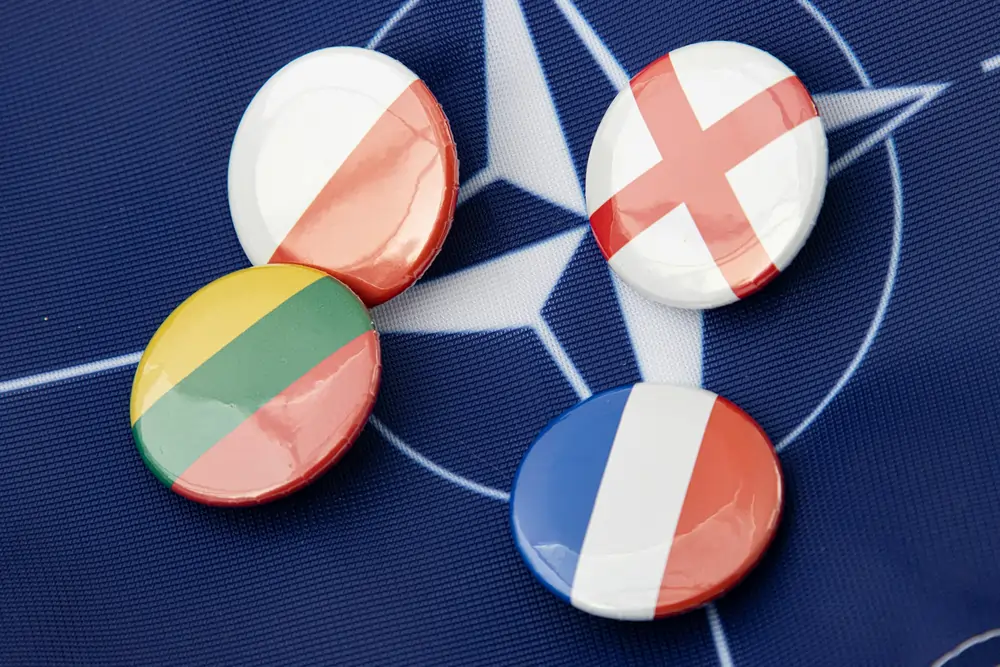
America’s scathing attacks on NATO this month has left European leaders fearing the collapse of the defence alliance. But it may have outlived its purpose already, writes political analyst Mike Bedenbaugh
If Europe takes one thing from the Munich Security Conference earlier this month, it must surely be that the possibility of the United States dramatically scaling back its involvement with NATO, if not outright withdrawing from the pact altogether, is no longer a distant theory but a very real prospect.
Ever since his first term of office, President Trump has repeatedly questioned the value of the North Atlantic Treaty Organization, viewing it as an outdated alliance that unfairly burdens America with the cost of defending the UK and the other 29 European member countries while the US’s NATO allies continually fail to thrust their hands deep in their pockets and pull their weight.
But while Western leaders, their ears still ringing from US Vice President JD Vance’s unprecedently savage criticism of NATO in Munich, worry about the alliance collapsing, perhaps this is a moment to pause and consider if it’s not actually a crisis in the making but a long overdue and necessary correction.
NATO was formed in 1949 as a defensive alliance to counter the Soviet Union. Its entire rationale was to prevent Soviet aggression and ensure the security of Western Europe as it sought to rebuild itself after the Second World War.
The formation of the alliance, led by the US, was hailed by President Harry S. Truman, who said that he hoped NATO would “create a shield against aggression”. When the Soviet Union collapsed in 1991, NATO’s mission was, in effect, complete. The Warsaw Pact – the military alliance between the USSR and its Eastern European satellites during the Cold War – had disbanded and a era of freedom and peace seemed to blooming.
But instead of dissolving as well, NATO continued. Moreover, it expanded, absorbing former Soviet territories and placing Western military infrastructure ever closer to Russia’s borders. Some argued this was necessary for maintaining peace, but others – including American Cold War strategist George Kennan – warned that it would provoke unnecessary conflict.
And since the beginning of the ’90s, NATO’s role shifted. What was once a defensive pact became a mechanism for military intervention far beyond its original intent. The 1999 bombing of Serbia, conducted without UN approval, set a precedent for unilateral NATO military action. The 2011 intervention in Libya, justified as a humanitarian mission, resulted in regime change and left behind a failed state. In Afghanistan, NATO became entangled in the longest war in U.S. history, a campaign that ultimately collapsed the moment Western forces withdrew.
This pattern raises a crucial question: has NATO truly prevented conflicts in the past three decades, or has it, instead, contributed to the conditions that have led to them?
Russia’s full-scale invasion of Ukraine in 2022 was, without question, an act of aggression. But wars do not happen in isolation. While Russia pulled the trigger, it is worth asking: who built the gun? NATO expanded eastward despite verbal assurances to Mikhail Gorbachev that it would not move “one inch eastward” if Germany were allowed to reunify. The 2014 Euromaidan protests, supported by Western governments, led to the ousting of Ukraine’s pro-Russian president, an event Moscow saw as a coup backed by foreign interests. The push to integrate Ukraine into NATO, even without full membership, signaled to Russia that the West was tightening its grip on its sphere of influence.
None of this justifies Putin’s invasion. But to ignore how Western actions helped construct the environment that made it possible is to ignore the complexity of history. Wars are rarely caused by one event. They are the culmination of decades of miscalculations, provocations, and, sometimes, outright hubris.
America’s growing political divide is reflected in its reassessment of NATO. Figures like Trump favourite Tulsi Gabbard, Director of National Intelligence, represent a rising tide of leadership that questions a system of perpetual military commitments. For many Americans, NATO’s survival beyond the Cold War looks like a prime example of this flawed system at work. In their eyes, the alliance, rather than ensuring security, has become a means for justifying endless interventions largely benefitting others while the US shoulders the majority of its funding, military strength, and strategic leadership.
America was founded on principles of limited government, individual liberty, and a cautious approach to foreign intervention. The expansion of NATO – and the expectation that America will continue to bear the cost of European defence – contradicts these founding values. And the lessons of history show that these values have merit. Time and again, defence alliances have often become the opposite, drawing nations into conflicts they were never meant to fight. The Delian League, originally formed to defend ancient Greece against Persia, eventually became a tool of Athenian dominance, leading to the Peloponnesian War. The alliances of early 20th-century Europe were meant to maintain peace but instead ensured that a single assassination in Sarajevo spiralled into World War I.
Looking at NATO today, many see a similar trajectory.
History’s cyclical nature is something the West has often failed to appreciate. I visited Yalta in Ukraine in the summer of 1990, during the dying days of the Soviet Union. One Russian acquaintance I met during my travels shared a perspective that has stayed with me ever since. He remarked that Americans see history as a ladder – always progressing, always improving, always rising – while Russians know it to be a wheel. It turns forward, though sometimes in a different direction, but its cycles are inescapable.
At the time, I thought he was being too cynical. The Russia I saw was full of hope, eager to move beyond its past. But today, I see the truth in his words. The wheel has turned again. Russia has reverted to its age-old trajectory – authoritarian rule buttressed with prideful nationalistic fervor – and the US’s recent leadership for NATO has, it seems, helped push that wheel in the wrong direction.
So, should the alliance have ended after the Cold War? Perhaps. But the real question is what comes next? If Europe desires to avoid continually repeating the mistakes of the past, NATO’s future must urgently be rethought. As Trump’s America increasingly look inwards, that moment of opportunity for Europe has finally arrived.

Author and political thinker Michael Bedenbaugh is a respected voice in constitutional principles and American governance. Based in South Carolina, he is deeply involved in his home state’s development while contributing to national discussions on governance and civic engagement, most recently as standing as an independent candidate for Congress. He is the author of Reviving Our Republic: 95 Theses for the Future of America and the host of Perspective with Mike Bedenbaugh.
Main image: Courtesy Marek Studzinski/Unsplash