Global fraud summit told AI scams and sextortion are driving industrial-scale crime

John E. Kaye
- Published
- News, Technology
INTERPOL and the UN are bringing together more than 1,300 officials, police, tech firms and private-sector leaders this week amid growing alarm over AI-enhanced fraud, worldwide scam centres and the mounting human cost of financial crime
More than 1,300 officials, police, tech firms and private-sector leaders gather for the Global Fraud Summit today as INTERPOL warns that AI-enhanced scams, sextortion and worldwide scam centres are accelerating financial crime on an industrial scale.
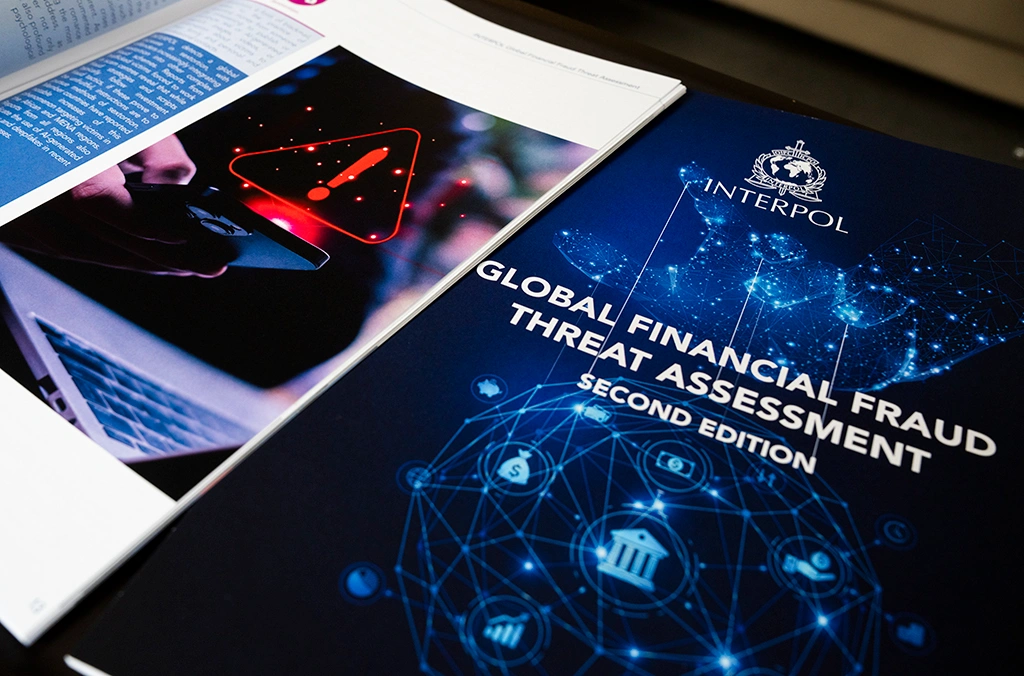
The two-day summit, held on 16 and 17 March and jointly organised by INTERPOL and the United Nations Office on Drugs and Crime, comes alongside the release of INTERPOL’s 2026 Global Financial Fraud Threat Assessment.
The report says financial fraud has become one of the world’s fastest-growing and most damaging forms of transnational crime, with direct links to organised crime, cybercrime, human trafficking and, in parts of Africa, terrorist financing.
INTERPOL estimates global losses from financial fraud reached US$442 billion in 2025 and ranks the worldwide threat as high, with further escalation expected over the next three to five years.
It says criminal networks are using artificial intelligence, cheap digital tools and specialist money-laundering partners to expand operations across multiple jurisdictions.
Among the assessment’s most worrying findings is that AI-enhanced fraud is now estimated to be 4.5 times more profitable than conventional methods.
According to INTERPOL, so-called ‘agentic AI’ systems can autonomously run major parts of a fraud campaign, from reconnaissance and credential harvesting to target selection, ransom calculations and tailored messages to victims.
Dark web marketplaces are also selling voice and face cloning tools created from only seconds of genuine audio or video, allowing criminals to impersonate trusted contacts or public figures with growing realism.
The report says sextortion is increasingly being used within romance and investment scams, with deepfakes and AI-generated content helping offenders adapt their tactics. Workers trafficked into scam centres have reported being told to switch to sextortion when other fraud methods fail.
INTERPOL says scam centres, once seen mainly as a South East Asian problem, now represent a global criminal model. It also warns that hybrid fraud tactics are becoming more common, with investment scams, impersonation fraud and romance schemes combined in layered operations that can target victims repeatedly. Those who lose money may later be approached by fake recovery agents, bogus law firms or sham investigators and defrauded again.
The organisation says financial fraud now sits among the top five global crime threats facing law enforcement.
INTERPOL has now launched Operation Shadow Storm, a new international task force funded by the UK Home Office aimed at targeting the criminal networks behind large-scale fraud.
The initiative will reportedly focus on the infrastructure supporting scam centres and the organised crime groups linking online fraud with cybercrime and human trafficking for forced criminality.
INTERPOL says the operation will draw on its global policing network and tools such as the I-GRIP stop-payment mechanism to help authorities identify fraudulent transactions and intervene before stolen money disappears across borders.
Valdecy Urquiza, its Secretary General said: “Enabled by artificial intelligence, low-cost digital tools and increased global criminal collaboration, we are witnessing the industrialization of fraud.”
Urquiza said stronger cooperation between law enforcement, the private sector and public awareness efforts would be central to tackling the threat.
He added: “It is vital to remember that the cost of financial crime is not just money – it is people’s life savings, their dignity, and in the worst case, their life.”
READ MORE: ‘How AI agents are supercharging cybercrime‘. AI agents capable of acting on their own are being deployed to scan networks, launch attacks, and bypass traditional security systems. Steve Durbin of the Information Security Forum explains how this technology is reshaping the cyber threat landscape — and what organisations need to do to stay ahead.
Do you have news to share or expertise to contribute? The European welcomes insights from business leaders and sector specialists. Get in touch with our editorial team to find out more.
Main image: INTERPOL
TOP STORIES
-
 British Chambers unite against 'Made in Europe' rules amid fears for UK industry
 -
Bouncy castle firms urged to sign new safety pledge following child deaths
-
Remembering Matthew Jukes, The European’s Wine & Fine Drinks Correspondent
-
Michael Dell becomes world's fourth-richest person as Forbes reveals the ten wealthiest billionaires
-
Scientists develop new chemicals to tackle devastating oil spills at sea
-
Closing women's health gap could boost global economy by $1tn a year, leaders say
-
World's first luxury theme park to open in Mexico with £1.1bn of rides, fine entertainment and deliberately limited crowds
-
Dutch court orders Lidl to stop selling Birkenstock sandal lookalikes
-
Giant wind turbine with 252-metre rotor could mean fewer machines and cheaper offshore power
-
Poorly designed workplaces ‘cost UK economy £71bn a year’
-
Rescuers scramble to protect pod of 25 whales in Thames Estuary
-
‘Talent hushing’ blamed as four-in-10 workers say they contribute less than they could
-
Spain leads Europe for expats as Panama tops global poll
-
Menopause may make women leaders more empathetic – even as it leaves them drained
-
Your biggest rival could be your best technology partner, research finds
-
British Museum bans photos of Bayeux Tapestry after visitors hold up queues
-
China unveils giant crane capable of lifting 9,300 family cars
-
Edinburgh Airport launches £500m expansion as terminal footprint grows 60%
-
Chris Packham urges PM to ban ‘frankenchicken’ from schools and hospitals
-
Loch Lomond’s 'Bonnie Banks at risk’ from major road upgrade
-
LED lights could be ‘the new asbestos’, UCL scientists warn
-
MPs tune in to Britain’s Eurovision ‘nul points’ problem
-
MPs tell Government to reject Thames Water creditors as utility nears insolvency
-
Only 14% of companies can show supply chain safeguards are working, study finds
-
OpenAI admits AI models hid mistakes, invented data and acted without permission