Electric air taxis move closer after aircraft completes key in-flight switch

Emma Strandberg
The idea of electric air taxis zipping passengers between cities and airports moved closer to reality this week after a test aircraft pulled off one of the hardest tricks in aviation
A new test flight has brought electric air taxis a step closer after an aircraft switched successfully from vertical lift to forward flight.
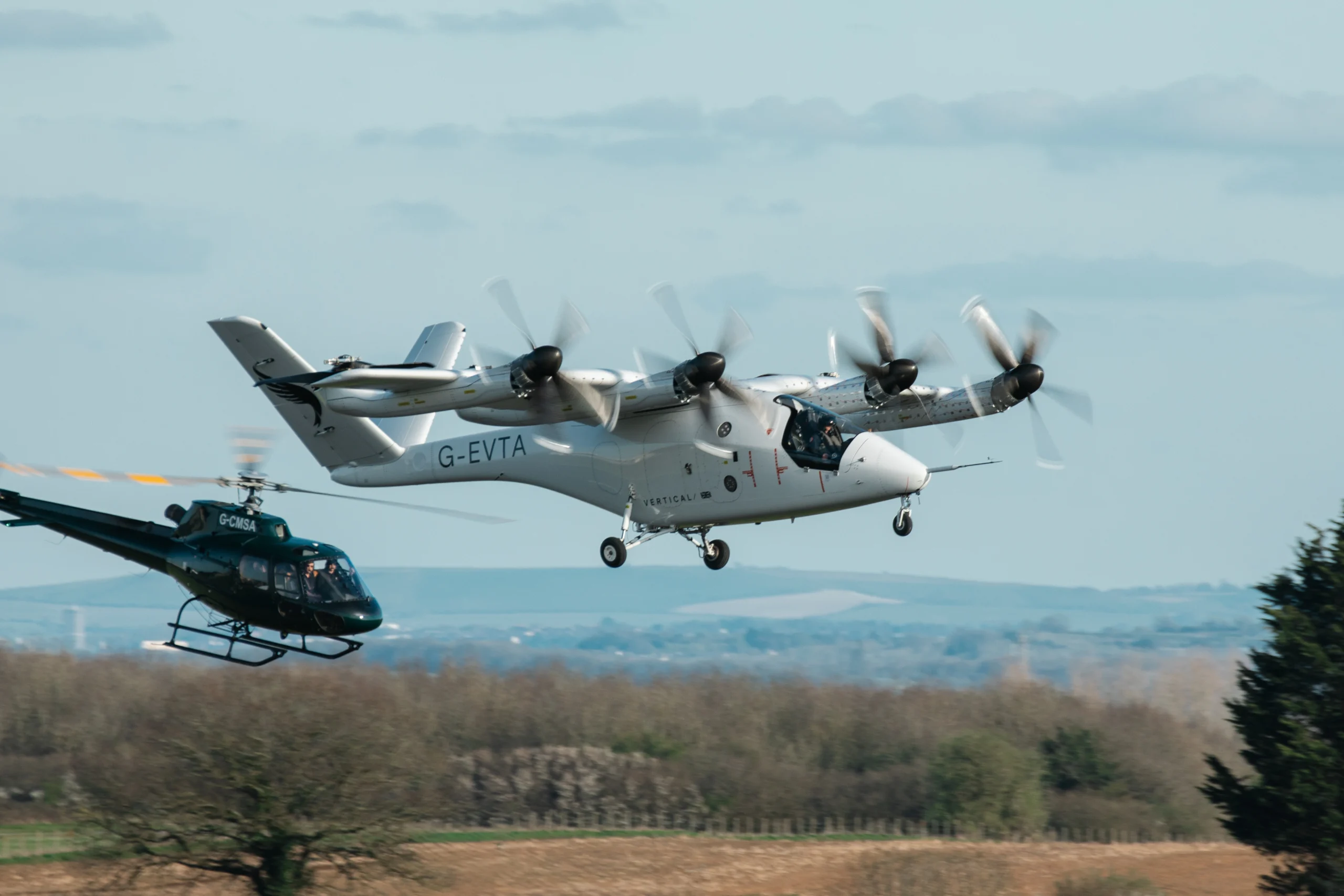
The aircraft, known as Valo, is being developed by Bristol-based Vertical Aerospace and is designed to take off and land like a helicopter before flying on the wing like a conventional plane.
Its design resembles the V-22 Osprey, the military tiltrotor used for missions including troop transport, rescue and medical evacuation. Like the Osprey, it lifts vertically, then tilts its propellers forward in flight so it can move into forward cruise.
But the transition between vertical and forward flight is one of the biggest technical hurdles facing the sector. Before aircraft of this kind can carry passengers commercially, they have to prove they can make the change smoothly, at full scale, under pilot control and under regulatory oversight.
In the latest test at Cotswold Airport, Valo lifted off vertically, its front propellers tilted forward and it accelerated into wingborne flight before making a conventional runway landing.
Vertical said the demonstration completed the “thrustborne transition” stage – the first half of the wider two-way transition sequence needed for point-to-point flying from helipads, vertiports and rooftops without relying on a runway at both ends.
The flight was carried out under the oversight of the UK Civil Aviation Authority, which the company said is working in close collaboration with the European Union Aviation Safety Agency as it moves towards certification of the aircraft.
Vertical described the test on April 2 as the first time a piloted, full-scale aircraft of its class had achieved thrustborne transition under CAA oversight.
The aircraft had already demonstrated hover, vertical take-off, wingborne flight and vertical landing during nearly two years of piloted flight testing. Earlier milestones included what it described as the first winged eVTOL flight in open European airspace and an airport-to-airport flight at the Royal International Air Tattoo.
Stuart Simpson, Chief Executive Officer at Vertical Aerospace, said: “This marks a turning point not just for Vertical Aerospace, but for the entire advanced air mobility industry. Achieving piloted thrustborne transition under active regulatory oversight — alongside the recently announced financing package — demonstrates that we have solved the hardest engineering challenges, have the regulatory relationships to complete certification, and now have the financial foundation to see this through to commercial service.”
David King, Chief Engineer at Vertical Aerospace, said: “Completing this piloted transition milestone is a profound achievement and the result of years of engineering innovation and disciplined test execution. The aircraft performed exactly as designed, transitioning smoothly and under full control — proving the core elements of Vertical’s distributed electric propulsion and tiltrotor technology at full scale, in real flight conditions. This is not yet final mission accomplished, but it is a pivotal technical proof point on our path to two-way transition.”
Paul Stone, Test Pilot at Vertical Aerospace, who carried out the transition test flight, added: “This aircraft was made to transition. From the moment the front propellers tilted and the aircraft began to accelerate, the response was exactly as the simulation predicted — smooth, stable, and fully under control throughout. What the engineering team has built here is genuinely extraordinary. The aircraft handled the transition with a level of confidence that gives me great optimism for everything that comes next.”
The announcement came days after the company said it had agreed in principle a financing package of up to $850 million to help fund certification and the push towards commercial operations.
It said the next step in the programme was completing the second half of the transition sequence – slowing from wingborne flight back into a vertical landing.
“This milestone unlocks the defining capability of eVTOL aviation and places Vertical at the forefront of the global advanced air mobility industry,” the company said.
READ MORE: ‘Electric air taxis take step towards passenger reality after San Francisco Bay flight‘. A piloted electric aircraft has flown from Oakland International Airport across San Francisco Bay and around the Golden Gate Bridge in a public demonstration of how short urban air taxi journeys could soon operate in some of the world’s most congested cities.
Do you have news to share or expertise to contribute? The European welcomes insights from business leaders and sector specialists. Get in touch with our editorial team to find out more.
Main image: Vertical Aerospace
TOP STORIES
-
 Russia takes control of more European corporate assets amid Ukraine tensions
 -
EU leaders resist calls to delay carbon rules as energy costs soar
-
‘A big step forward’ – PM Andy Burnham hails plans for Great British Railways HQ in Derby
-
UK economy grows just 0.1 per cent as construction falls and services stall
-
Germany risks losing €155bn a year under tighter AI data rules, new study warns
-
Pope Leo XIV diagnosed with lung cancer after surgery in Rome
-
France faces freezer meltdown as hackers strike supermarket chains
-
Bumble shares soar 50% amid $1bn takeover talks
-
China slump drives Volkswagen to sharpest quarterly fall in more than four years
-
Hollywood mega-powerhouse created as Paramount completes Warner Bros Discovery takeover
-
Gamers face gridlock as latest Grand Theft Auto download 'nears two days'
-
Samsung profits soar ninefold to record £61bn amid AI chip boom
-
New Springer books put the UN’s struggling sustainability goals to the real-world test
-
Europe’s solar boom set for two-year slowdown after record growth
-
Let it pea. Musicians turn vegetables into instruments at Beatles' Abbey Road studios
-
Golden naked Trump statue unveiled at European Parliament
-
Jaguar puts controversial rebrand on the road with £130K 1,030PS Type 01
-
Deepfakes and identity fraud drive new wave of post-hire background checks
-
Spain crowned Europe’s top retirement destination
-
More than half of UK professionals report workplace burnout
-
More than 1.2m English drivers may have eyesight too poor for the road, study finds
-
David Reuben, Britain’s second richest person, leaves London for Monaco
-
UK prisoner release plan faces a major lag as tougher rules risk sending inmates back to jail
-
Brits trust AI with their health but not their money
-
Britain still hungry for Italian food as exports hit €4.56bn despite Brexit