Europe and UK lag behind in global giving as low-income nations lead

John E. Kaye
News & Features
- Published
- News
The Charities Aid Foundation’s World Giving Report 2025, published today, shows Europe and the UK near the bottom of global generosity rankings, with donations trailing far behind those in Africa and low-income countries
Europeans donate a smaller share of their income to good causes than those in almost every other part of the world, new research has found.
The Charities Aid Foundation’s (CAF) World Giving Report 2025 reveals that people in Europe donate an average of 0.64% of their income, which is less than half the average of 1.45% recorded in low-income countries.
Its report analyses donations as a proportion of income, offering a direct comparison of generosity between countries with different income levels.
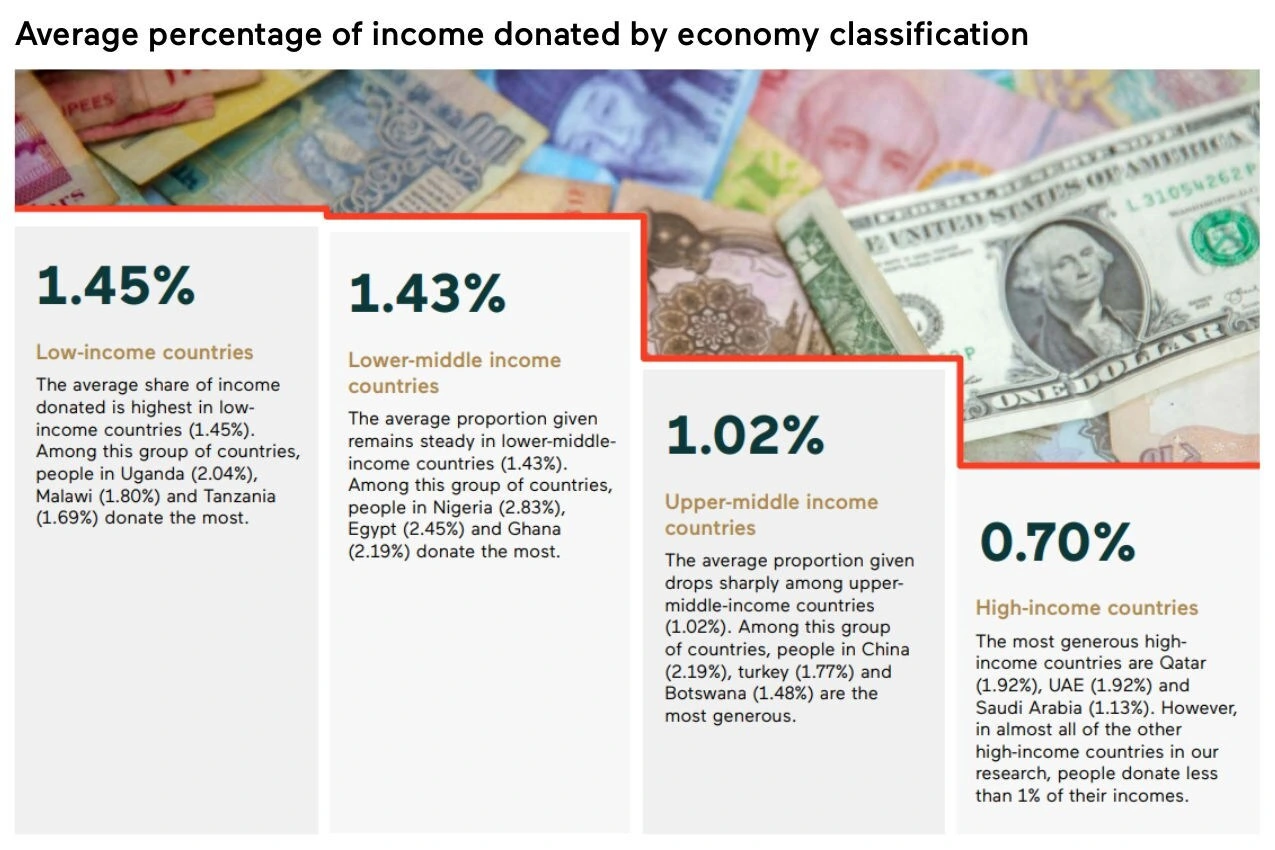
Africa is the most generous continent, with an average of 1.54% of income donated to charitable, religious or humanitarian causes. By contrast, high-income countries, which include the UK, average just 0.7%.
Nigeria ranks as the single most generous nation in the study, with donations equivalent to 2.83% of income.
In comparison, France (0.45%) and Germany (0.39%) donate among the smallest shares of income globally, while Japan (0.16%) has the lowest proportion of all 101 countries surveyed.
The research is based on responses from more than 50,000 people worldwide. It shows that the most commonly supported cause across every continent is children and young people, with 29% of donors contributing to such initiatives.
Humanitarian aid and disaster relief is backed by 26% of people globally, while in Asia 16% of donors prioritise environmental causes.
CAF’s findings also show significant variation between age groups. Those aged 35 to 44 donate 1.18% of their income on average, compared with 0.83% among people over 65. Donors are most often motivated by a personal connection to a cause (65%), while 18% are influenced by news reports and 14% by social media. Local charities are the most trusted, followed by national and international organisations.
Neil Heslop, Chief Executive of CAF, said: “Around the world, social purpose organisations are facing severe financial headwinds. Traditional funding models need to change as patterns of behaviour evolve and governments cut back on their aid and development spending with philanthropy seeking to respond.
“Individual giving remains the cornerstone of generosity. Yet there is wide disparity, with the most dynamic cultures of giving often in countries where the populations are also much in need.
“It is notable that giving does not necessarily correlate with wealth or even security, but rather on the perception of necessity – and very often we perceive those closest to us to be most in need.”
The report, released today, also looks at the different ways people give. Globally, 38% of people give directly to families or individuals in need, 36% donate to charities, and 25% make donations for religious purposes. In terms of the value of donations, 40% goes directly to individuals, 36% to charities and 24% to religious organisations.
Europe’s giving levels are among the lowest across all continents, both in terms of participation and income share.
While 72% of people in Africa reported giving money in 2024, the equivalent figure for Europe is 59%. Among low-income nations, Uganda (2.04%), Malawi (1.80%) and Tanzania (1.69%) are the most generous.
In lower-middle-income countries, Nigeria leads with 2.83%, followed by Egypt (2.45%) and Ghana (2.19%). Among high-income countries, Qatar (1.92%) and the UAE (1.92%) are the most generous, with their levels far above those of most European countries.
The report highlights the influence of social norms on giving. In countries where cultural or religious expectations to give are strong, the average share of income donated is 1.61%. Where such social norms are weaker, the average falls to 0.56%.
Volunteering is also measured. Only 26% of people globally volunteered in 2024, with Europe contributing the lowest average of 6 hours 30 minutes per person compared to 14 hours 30 minutes in Africa.
“During these challenging times, there is much we can learn about the power of connection, and the nature of compassion for our fellow citizens, whether they be across the street or around the world,” Heslop added.
Main image: The average share of income donated to good causes by economy classification, CAF World Giving Report 2025. Photo: CAF
TOP STORIES
-
 We're talking to almost twice as many people on the phone as a decade ago, study finds
 -
TalkTalk sells majority stake in Telecom Acquisitions as founder Nigel Barnett regains control
-
Company closures soar ahead of tax rises as new Budget looms
-
France calls in army after riots sweep cities
-
An Italian affair – Stanley Johnson takes London's society set on the Silk Road
-
Himalayan mountainside moved 40cm before avalanche killed 1,451 in Nepal, scientists reveal
-
Scientists and engineers quitting jobs as AI changes roles ‘beyond recognition’, study finds
-
UK profit warnings hit near two-year high as businesses struggle with rising costs
-
Microsoft pulls out of major UK AI data centre project amid power grid delays
-
Russia takes control of more European corporate assets amid Ukraine tensions
-
EU leaders resist calls to delay carbon rules as energy costs soar
-
‘A big step forward’ – PM Andy Burnham hails plans for Great British Railways HQ in Derby
-
UK economy grows just 0.1 per cent as construction falls and services stall
-
Germany risks losing €155bn a year under tighter AI data rules, new study warns
-
Pope Leo XIV diagnosed with lung cancer after surgery in Rome
-
France faces freezer meltdown as hackers strike supermarket chains
-
Bumble shares soar 50% amid $1bn takeover talks
-
China slump drives Volkswagen to sharpest quarterly fall in more than four years
-
Hollywood mega-powerhouse created as Paramount completes Warner Bros Discovery takeover
-
Gamers face gridlock as latest Grand Theft Auto download 'nears two days'
-
Samsung profits soar ninefold to record £61bn amid AI chip boom
-
New Springer books put the UN’s struggling sustainability goals to the real-world test
-
Europe’s solar boom set for two-year slowdown after record growth
-
Let it pea. Musicians turn vegetables into instruments at Beatles' Abbey Road studios
-
Golden naked Trump statue unveiled at European Parliament