Coming to a shoe spore near you: the world’s first mushroom-made trainers

John E. Kaye
- Published
- News, Sustainability
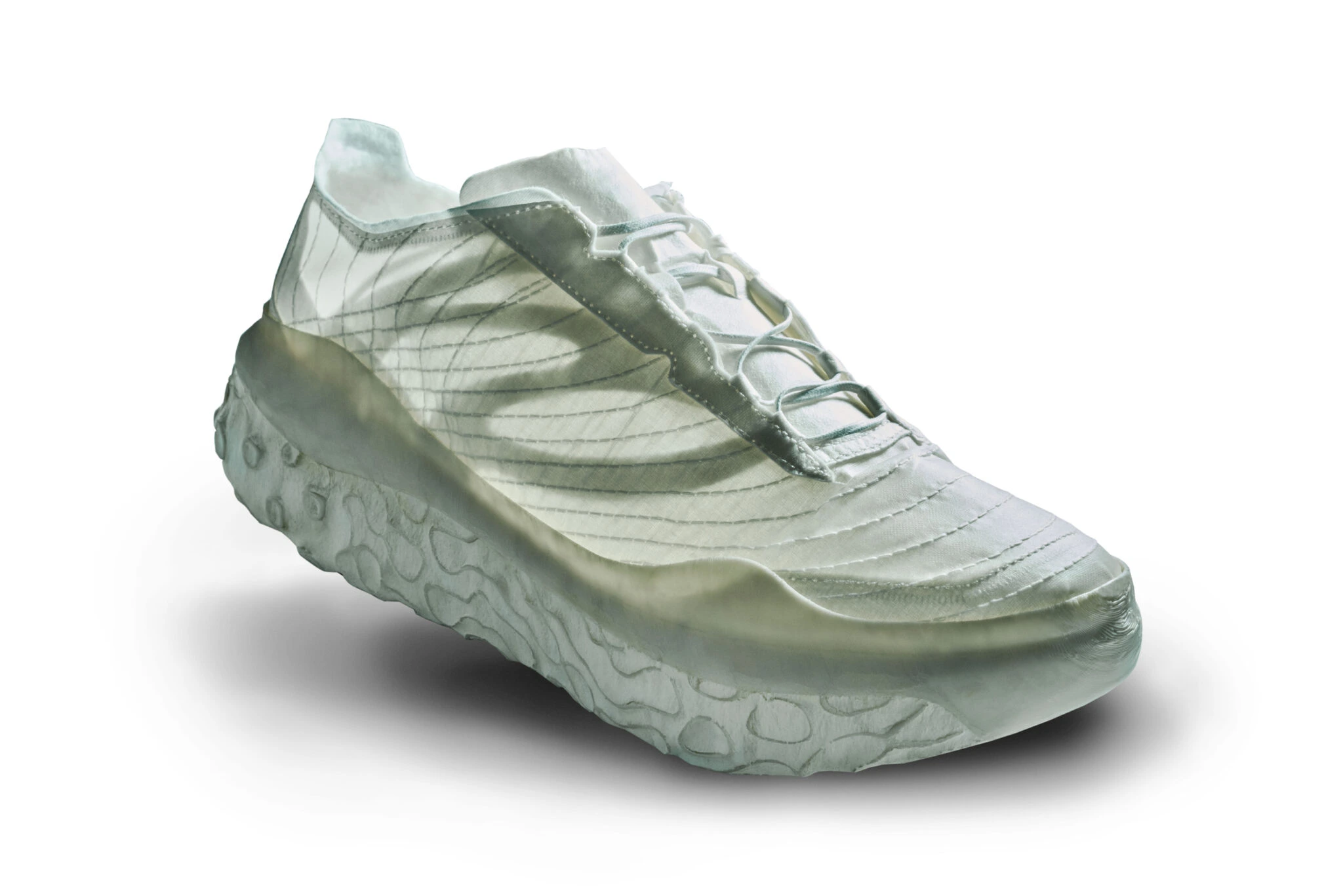
Made without plastics, foam or fossil fuels, this prototype trainer uses only five biodegradable materials — including a sole grown from fungi in just seven days
The world’s most environmentally friendly trainers have taken root in London – with soles made from mushrooms.
Unlike most trainers, the “groundbreaking” shoes are made entirely from natural and biodegradable materials, including fungi, lab-grown bacteria and plant-based fibres.
Their soles are formed from mycelium, the root-like structure of mushrooms, which is cultivated using solid state fermentation and grown around a PHA scaffold in just seven days.
The rest of the shoe is built from bacterial nanocellulose – a strong, flexible material produced through fermentation – while the laces and lining are made from cotton and lyocell.
The design, created by the Korvaa Consortium – a collaboration of biomaterial innovators, designers and filmmakers – is intended as a proof of concept to show how complex consumer products can be made without fossil fuels or synthetic inputs.
Traditional trainers can contain more than 30 materials, many of them petroleum-based. But the Korvaa design uses just five – all selected for their biodegradability, renewability or compostability.
It was unveiled this week at the Future Fabrics Expo in London.
Jen Keane, CEO and co-founder of Modern Synthesis, which developed the shoe’s upper, said the design shows how biologically grown materials could shape the future of footwear, offering new creative and manufacturing possibilities that go beyond traditional methods.
“By combining materials the way nature does – not by adding more, but by choosing better – we’re creating radical design possibilities for the industry.
“This unlocks unparalleled creative freedom, introducing novel functionalities and forms that simply couldn’t be achieved through conventional means.
“We’ve developed an artefact that is a tangible blueprint for the future of manufacturing.”
The shoe’s sole was developed by Ecovative, a U.S. company specialising in mushroom-based materials. Using solid state fermentation, the firm grows mycelium – the fibrous root system of fungi – through a scaffold made from polyhydroxyalkanoates (PHAs), a bio-based and biodegradable polyester.
The result is a sole grown in just seven days without synthetic foams, plastics or chemical processing.
The PHA scaffold was developed by Ourobio, a company that uses microbes to produce PHAs. It 3D-printed the base structure of the shoe, replacing conventional petroleum-derived materials such as EVA foam.
The upper was created by Modern Synthesis, a UK-based company using bacterial nanocellulose – a byproduct of fermentation – which it transforms into textile and coating materials. The result is a strong, lightweight alternative to leather or mesh.
The shoe was constructed using traditional string-lasting techniques by footwear specialists. The laces and internal lining were made from cotton and lyocell.
“This shoe demonstrates what becomes possible when three distinct biological processes work together,” Eben Bayer, co-founder and CEO of Ecovative, said.
“Each material was chosen for what it does best – and together they show that biology can manufacture complex products that traditionally require dozens of synthetic inputs.
“Collaboration like this is how we grow the material support system for a planet that works in harmony with humans.”
The project is being documented in Planet of the Microbes, a feature-length film by Finnish science communication studio Photino, which has followed the collaboration from the beginning. The documentary is expected to premiere at a leading film festival later this year.
The Korvaa Consortium is now encouraging other brands to explore similar biomaterial collaborations, positioning the shoe as a blueprint for sustainable design across the industry.
Nina Pulkkis, Documentary and Production Lead at Photino, added: “The first step is developing the technology, the second step is getting the story out there.
“Documenting this project from the beginning reveals the immense potential that arises when we align nature’s intelligence with human innovation – this is the kind of collaboration that makes you want to be part of the change.”
Main image: Korvaa Consortium
TOP STORIES
-
 Scientists and engineers quitting jobs as AI changes roles ‘beyond recognition’, study finds
-
UK profit warnings hit near two-year high as businesses struggle with rising costs
-
Microsoft pulls out of major UK AI data centre project amid power grid delays
-
Russia takes control of more European corporate assets amid Ukraine tensions
-
EU leaders resist calls to delay carbon rules as energy costs soar
-
‘A big step forward’ – PM Andy Burnham hails plans for Great British Railways HQ in Derby
-
UK economy grows just 0.1 per cent as construction falls and services stall
-
Germany risks losing €155bn a year under tighter AI data rules, new study warns
-
Pope Leo XIV diagnosed with lung cancer after surgery in Rome
-
France faces freezer meltdown as hackers strike supermarket chains
-
Bumble shares soar 50% amid $1bn takeover talks
-
China slump drives Volkswagen to sharpest quarterly fall in more than four years
-
Hollywood mega-powerhouse created as Paramount completes Warner Bros Discovery takeover
-
Gamers face gridlock as latest Grand Theft Auto download 'nears two days'
-
Samsung profits soar ninefold to record £61bn amid AI chip boom
-
New Springer books put the UN’s struggling sustainability goals to the real-world test
-
Europe’s solar boom set for two-year slowdown after record growth
-
Let it pea. Musicians turn vegetables into instruments at Beatles' Abbey Road studios
-
Golden naked Trump statue unveiled at European Parliament
-
Jaguar puts controversial rebrand on the road with £130K 1,030PS Type 01
-
Deepfakes and identity fraud drive new wave of post-hire background checks
-
Spain crowned Europe’s top retirement destination
-
More than half of UK professionals report workplace burnout
-
More than 1.2m English drivers may have eyesight too poor for the road, study finds
-
David Reuben, Britain’s second richest person, leaves London for Monaco