Give the Dog a Bone: Robotic World First at UK Fusion Energy Plant

John E. Kaye
- Published
- Home, News, Technology
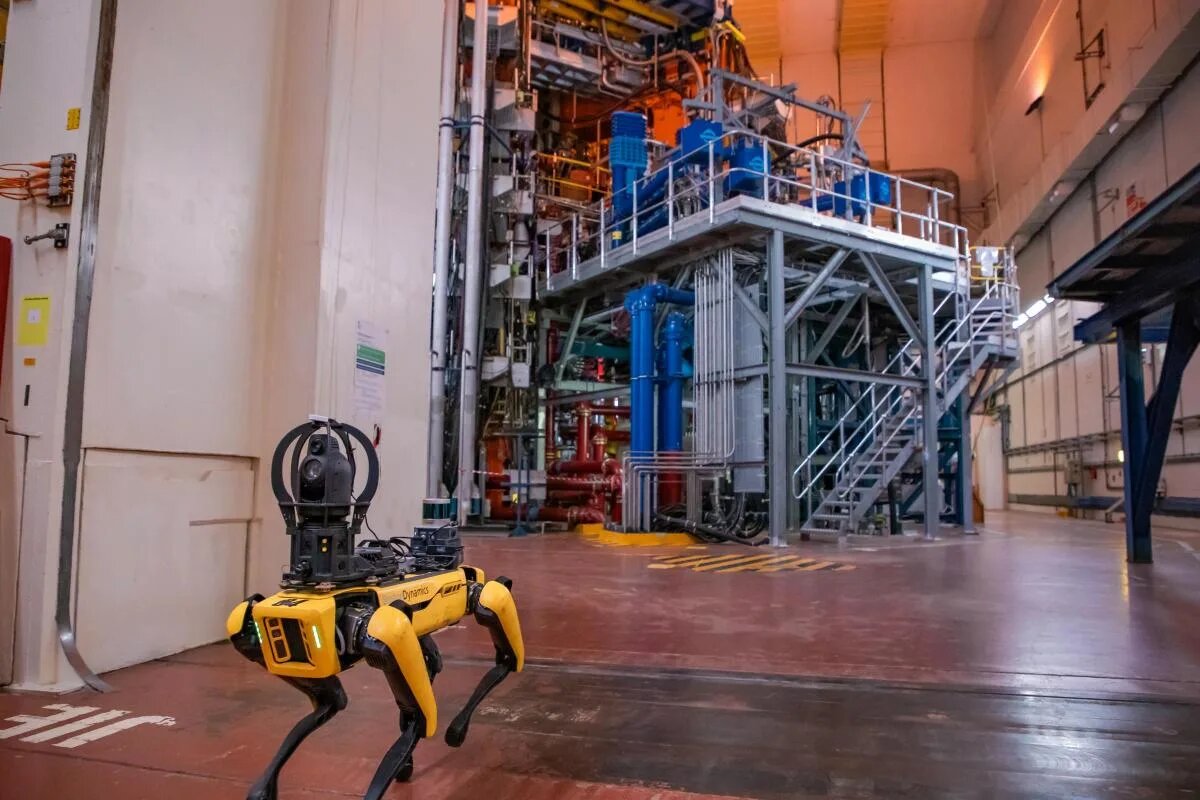
A dog-like robot has achieved a world-first by inspecting the inside of a fusion energy facility autonomously, it emerged this week
The four-legged ‘Boston Dynamics Spot’ took sensor readings and collected other data inside the Joint European Torus (JET) facility in Oxford, England, without human assistance.
Until its closure last year, JET was one of the largest and most powerful fusion research machines in the world.
Its purpose was to pave the way for future nuclear fusion grid energy.
The complex, part of The Culham Centre for Fusion Energy (CCFE), the UK’s national laboratory for fusion research, is now being decommissioned and remains hazardous to human health.
But in a joint collaboration with the Oxford Robotics Institute (ORI), the United Kingdom Atomic Energy Authority’s (UKAEA) demonstrated that maintenance can be carried without human intervention.
The development paves the way for autonomous maintenance and decommissioning in other facilities where the risk of radiation, vacuum-level pressure and extreme temperatures are too great for human operators.
In a statement, UKAEA said the 35-day trial at the JET plant provided the “ideal opportunity” to test the robot’s capabilities.
Dr Robert Skilton, of UKAEA’s Remote Applications in Challenging Environments division, said: “The project aimed to validate the reliability of autonomous robotic technology and instil trust and confidence in their use for safe and efficient inspections in fusion facilities over extended periods.
“This deployment demonstrates that autonomous robots can enhance safety and cut costs. These ‘next generation’ solutions are becoming ready to be used in other industrial facilities such as nuclear decommissioning, environmental clean-up, and disaster relief.”
Professor Nick Hawes, Professor of AI & Robotics at the University of Oxford, added: “Projects like this demonstrate the value of autonomous robots – robots that can do things themselves without direct control of humans.
“They also ground our science in real use cases, and provide requirements and constraints that drive us to invent new AI and robotics algorithms.”
The results will assist planning for the next stages of the JET decommissioning programme, which is expected to continue until 2040.
Main image: Spot the robotic dog returning after deployment at UKAEA’s Joint European Torus (JET) facility.
Credit: United Kingdom Atomic Energy Authority
TOP STORIES
-
 France calls in army after riots sweep cities
 -
An Italian affair – Stanley Johnson takes London's society set on the Silk Road
-
Himalayan mountainside moved 40cm before avalanche killed 1,451 in Nepal, scientists reveal
-
Scientists and engineers quitting jobs as AI changes roles ‘beyond recognition’, study finds
-
UK profit warnings hit near two-year high as businesses struggle with rising costs
-
Microsoft pulls out of major UK AI data centre project amid power grid delays
-
Russia takes control of more European corporate assets amid Ukraine tensions
-
EU leaders resist calls to delay carbon rules as energy costs soar
-
‘A big step forward’ – PM Andy Burnham hails plans for Great British Railways HQ in Derby
-
UK economy grows just 0.1 per cent as construction falls and services stall
-
Germany risks losing €155bn a year under tighter AI data rules, new study warns
-
Pope Leo XIV diagnosed with lung cancer after surgery in Rome
-
France faces freezer meltdown as hackers strike supermarket chains
-
Bumble shares soar 50% amid $1bn takeover talks
-
China slump drives Volkswagen to sharpest quarterly fall in more than four years
-
Hollywood mega-powerhouse created as Paramount completes Warner Bros Discovery takeover
-
Gamers face gridlock as latest Grand Theft Auto download 'nears two days'
-
Samsung profits soar ninefold to record £61bn amid AI chip boom
-
New Springer books put the UN’s struggling sustainability goals to the real-world test
-
Europe’s solar boom set for two-year slowdown after record growth
-
Let it pea. Musicians turn vegetables into instruments at Beatles' Abbey Road studios
-
Golden naked Trump statue unveiled at European Parliament
-
Jaguar puts controversial rebrand on the road with £130K 1,030PS Type 01
-
Deepfakes and identity fraud drive new wave of post-hire background checks
-
Spain crowned Europe’s top retirement destination