Ukraine joins European environment network in major conservation step after war damage to land and wildlife

John E. Kaye
- Published
- News, Sustainability
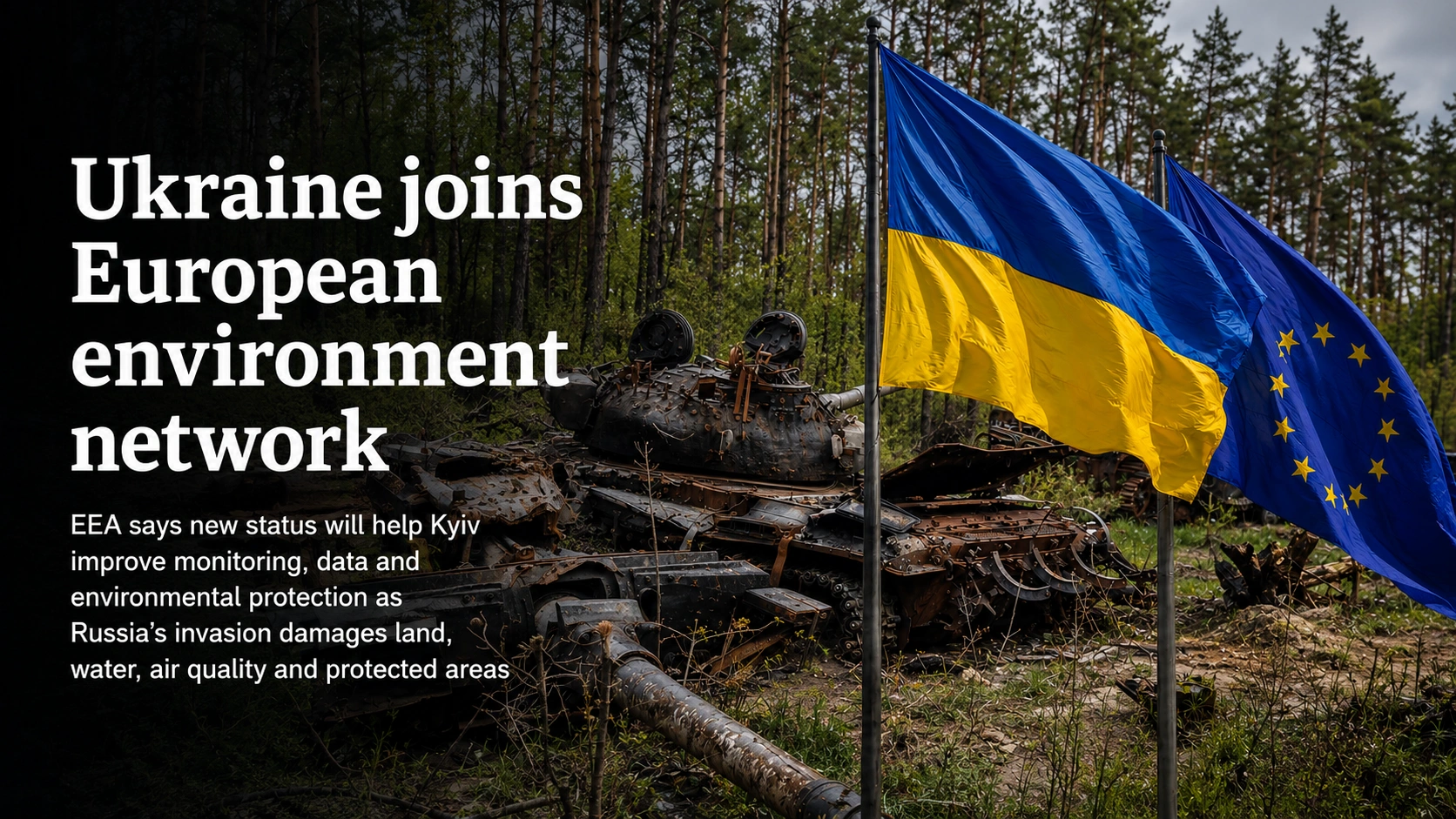
European Environment Agency says new status will help Kyiv improve monitoring, data and environmental protection as Russia’s invasion damages land, water, air quality and protected areas
Ukraine has joined Europe’s main environmental monitoring network in a major step for conservation, as the war continues to ravage land, water systems, air quality and protected areas.
The European Environment Agency (EEA) and its European Environment Information and Observation Network, known as Eionet, formally welcomed Ukraine as a co-operating country on Thursday, extending the network to 32 member countries and eight cooperating countries.
The move gives Ukraine a formal place inside Europe’s main environmental data system as the country works to record, monitor and eventually restore areas damaged by Russia’s invasion.
Ukraine’s accession also brings into the network a country whose environmental recovery is now closely tied to wider European monitoring and conservation planning, with data on land, water systems, pollution and protected areas feeding more directly into continent-wide assessments.
The EEA said the destruction of livelihoods and of the natural environment were “inseparable consequences of the conflict”, with damage to land, water systems, air quality and protected areas now treated as a shared European concern.
The agency also said the impacts did not stop at national borders.
Oleksii Sobolev, Ukraine’s Minister of Economy, Environment and Agriculture, said: “Today is an important day for Ukraine. We are pleased to join the European Environment Agency and the Eionet network as a coperating country and become part of the European environmental community.
“This comes at a particularly important moment, as Ukraine moves forward in its EU accession negotiations and confidently continues on its path toward European integration.”
He said Ukraine was continuing environmental reforms and strengthening its institutions despite “the enormous challenges caused by ongoing Russian aggression”.
“Cooperation with the EEA will help us improve our environmental monitoring and information systems, implement EU environmental legislation, and deepen Ukraine’s integration into the European space,” he added.
Ukraine becomes the eighth EEA cooperating country, joining Moldova and the Western Balkan partners Albania, Bosnia and Herzegovina, North Macedonia, Montenegro, Serbia and Kosovo.
The decision was endorsed by the EEA Management Board and is supported by dedicated European Commission funding.
The cooperation is grounded in the EU–Ukraine Association Agreement and the EU enlargement framework. Ukraine applied for EU membership in February 2022 and was recognised as a candidate country in June that year.
The EEA said the new arrangement would help Ukraine build the institutional and technical foundations for future Eionet integration.
It will also provide a roadmap for environmental data reporting in line with EU environmental law and support Ukraine’s gradual participation in EEA systems, networks and knowledge platforms.
Jessika Roswall, European Commissioner for Environment, Water Resilience and a Competitive Circular Economy, said Ukraine’s path towards European integration was “one of the most powerful demonstrations of European values we have seen in recent years”.
She said: “Welcoming Ukraine into the EEA/Eionet family is a recognition of that commitment and a practical investment in the environmental resilience of the whole continent.”
Roswall said Ukraine faced a large volume of work after the formal opening of accession negotiations, with the country’s resources already strained by war.
“A country that continues to advance its alignment with EU environmental standards while enduring the devastation of war deserves our full support,” she added.
Leena Ylä-Mononen, the EEA’s executive director, said Ukraine’s participation would build on earlier project-based cooperation between 2010 and 2020, as well as its role as a contracting party to the Energy Community since 2011.
She said: “The environmental damage caused by the war is a concern for all of us, and joint work on monitoring, data and assessment will be an important part of what this cooperation delivers.”
READ MORE: China offers UK coastal rescue lessons as Yancheng wetlands hailed by conservation figures. China’s ambassador says Yancheng can help deepen cooperation with Britain and Europe on biodiversity and climate resilience, as Stanley Johnson and international conservation figures urge governments to treat coastal protection as a strategic priority.
Do you have news to share or expertise to contribute? The European welcomes insights from business leaders and sector specialists. Get in touch with our editorial team to find out more.
Main image: Burned-out tanks lie in a scarred woodland landscape behind Ukrainian and EU flags, illustrating the environmental damage caused by Russia’s invasion as Ukraine joins Europe’s main environmental network. Picture: The European. Photo: Igor Francyshyn via Pexels.
TOP STORIES
-
 Russia takes control of more European corporate assets amid Ukraine tensions
 -
EU leaders resist calls to delay carbon rules as energy costs soar
-
‘A big step forward’ – PM Andy Burnham hails plans for Great British Railways HQ in Derby
-
UK economy grows just 0.1 per cent as construction falls and services stall
-
Germany risks losing €155bn a year under tighter AI data rules, new study warns
-
Pope Leo XIV diagnosed with lung cancer after surgery in Rome
-
France faces freezer meltdown as hackers strike supermarket chains
-
Bumble shares soar 50% amid $1bn takeover talks
-
China slump drives Volkswagen to sharpest quarterly fall in more than four years
-
Hollywood mega-powerhouse created as Paramount completes Warner Bros Discovery takeover
-
Gamers face gridlock as latest Grand Theft Auto download 'nears two days'
-
Samsung profits soar ninefold to record £61bn amid AI chip boom
-
New Springer books put the UN’s struggling sustainability goals to the real-world test
-
Europe’s solar boom set for two-year slowdown after record growth
-
Let it pea. Musicians turn vegetables into instruments at Beatles' Abbey Road studios
-
Golden naked Trump statue unveiled at European Parliament
-
Jaguar puts controversial rebrand on the road with £130K 1,030PS Type 01
-
Deepfakes and identity fraud drive new wave of post-hire background checks
-
Spain crowned Europe’s top retirement destination
-
More than half of UK professionals report workplace burnout
-
More than 1.2m English drivers may have eyesight too poor for the road, study finds
-
David Reuben, Britain’s second richest person, leaves London for Monaco
-
UK prisoner release plan faces a major lag as tougher rules risk sending inmates back to jail
-
Brits trust AI with their health but not their money
-
Britain still hungry for Italian food as exports hit €4.56bn despite Brexit