In Berlin, the humble Trabant 601 has outlived the system that built it. Mark G Whitchurch takes the wheel of East Germany’s most unlikely motoring icon and discovers that its smoke, simplicity and stubborn character offer something modern cars rarely deliver: the pure, unfiltered pleasure of driving slowly through history
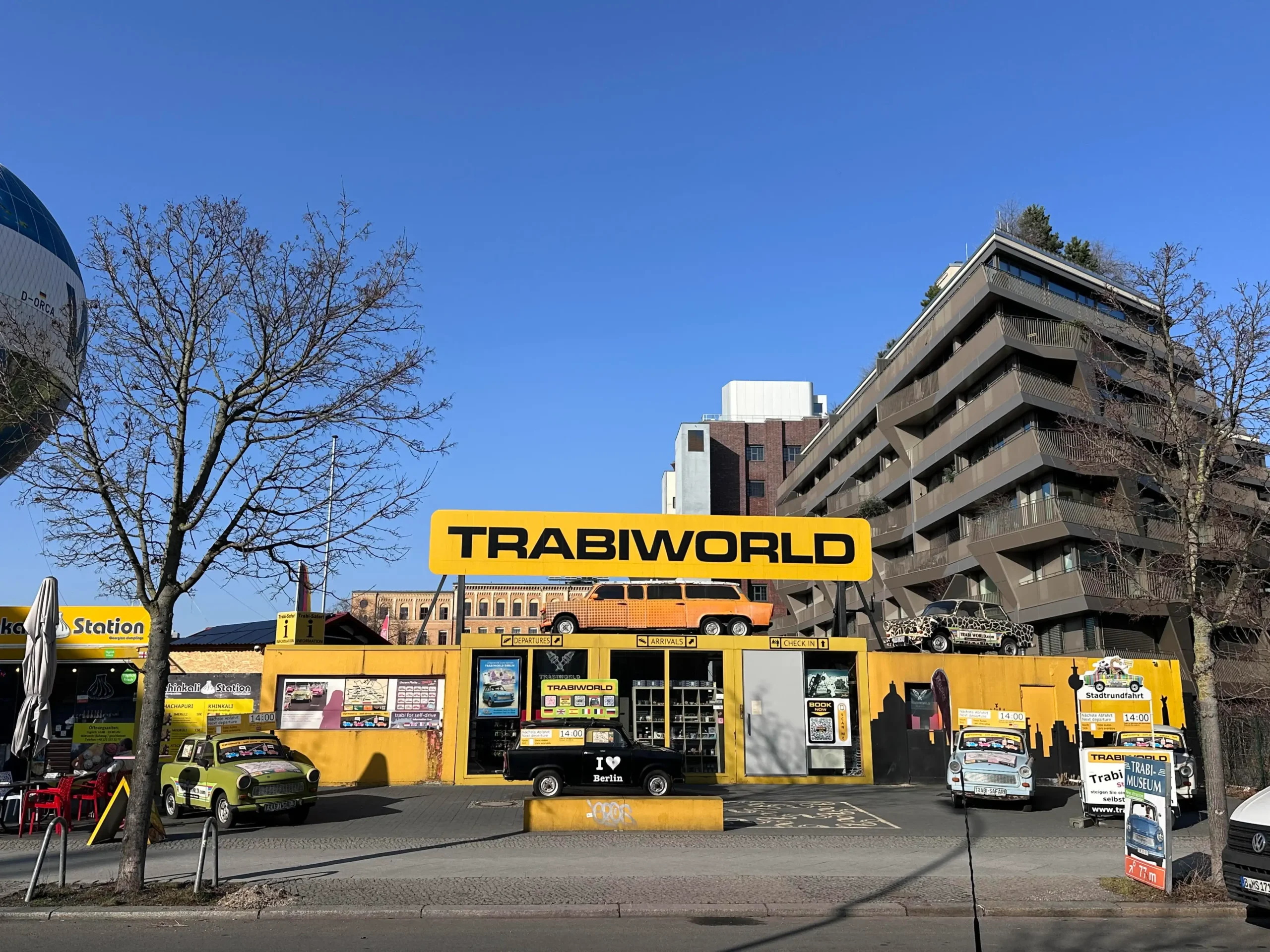
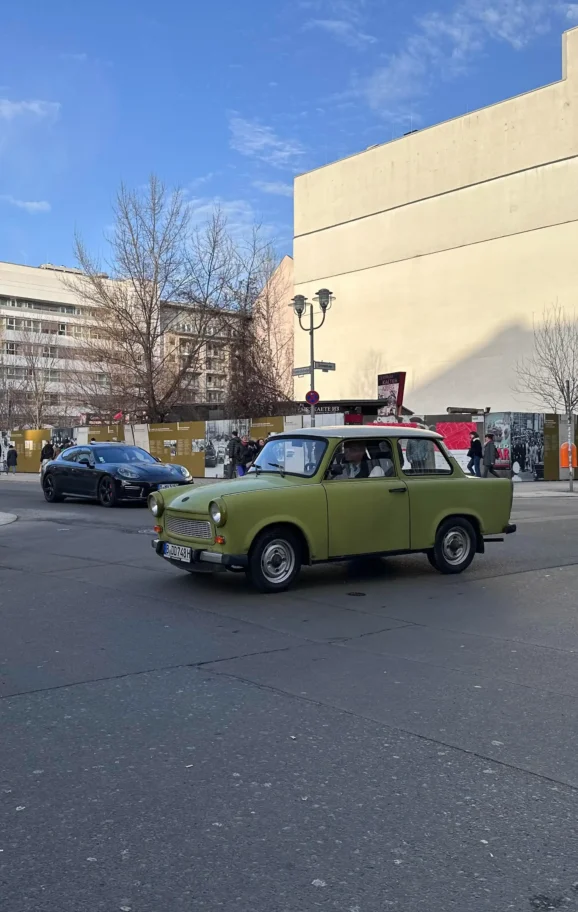
There are moments in motoring when logic simply steps aside and lets delight take the wheel. My moment arrived on a bright Berlin morning, standing in front of a row of pastel-coloured Trabant 601s outside Trabi-World, the city’s most cheerful shrine to East German automotive optimism. The cars looked like props from a Cold War cartoon: tiny, square-shouldered, and painted in colours that suggested a child had been given free rein with a box of crayons. And yet, as I approached my assigned machine, once a sky-blue 601 repainted in khaki green — I felt something I haven’t felt in years when approaching a modern car: anticipation.
Not the anticipation of horsepower or torque figures, nor the smug expectation of a heated massage seat and a 17-speaker sound system. No. This was the anticipation of character — that elusive, unquantifiable quality that modern cars, for all their brilliance, have largely engineered out of existence.
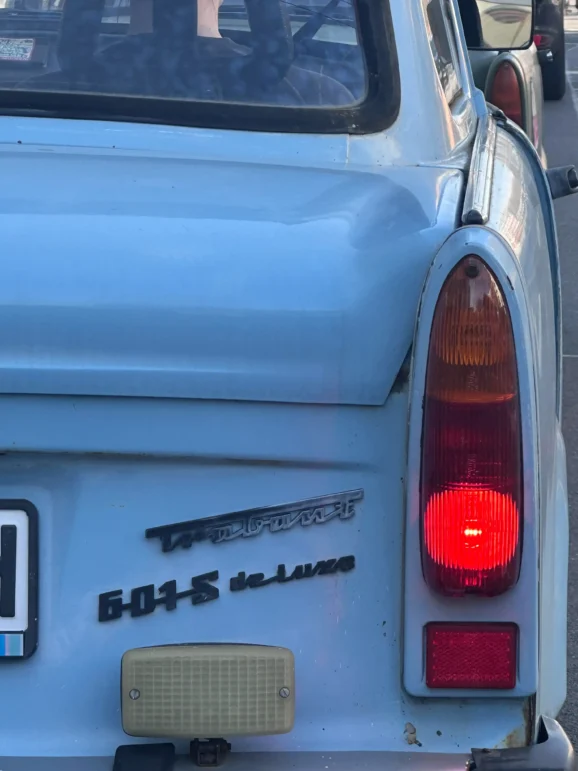
The Trabant 601, built from 1964 until 1990 in the East German city of Zwickau and is the antithesis of modern automotive excess. It is light, simple, noisy, smoky, and unapologetically basic. It is also, as I discovered while puttering through Berlin’s most historic streets, one of the most entertaining driving experiences left on the planet.
To understand why the Trabant is so much fun today, you first need to understand what it meant then.
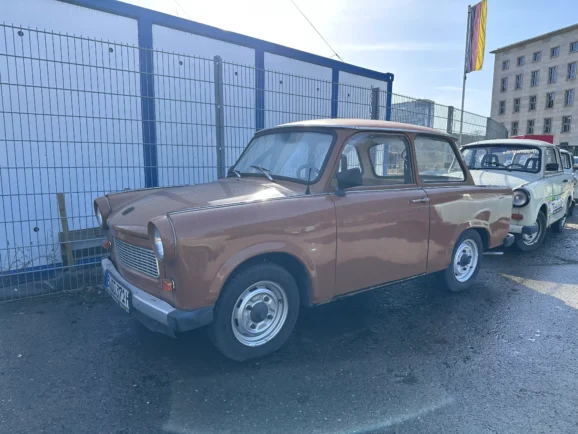
The 601 was the third major iteration of the Trabant line, a car conceived as East Germany’s answer to the Volkswagen Beetle. But where the Beetle was a triumph of industrial might, the Trabant was a triumph of making do. Due to post wartime restrictions, walled off and Soviet controlled East Germany lacked steel, so the body panels of the Trabants were made of an early type of composite called Duroplast.
Invented by the East German through adversity by mixing cotton waste and phenolic resin. Yes, the Trabant is literally made of recycled cotton, but contrary to the western jokes – they don’t dissolve in the rain.
Under the bonnet sits a tiny 594cc two-stroke engine producing 26 horsepower on a good day, and on a bad day, something closer to a determined wheeze all whilst producing clouds of smoke.
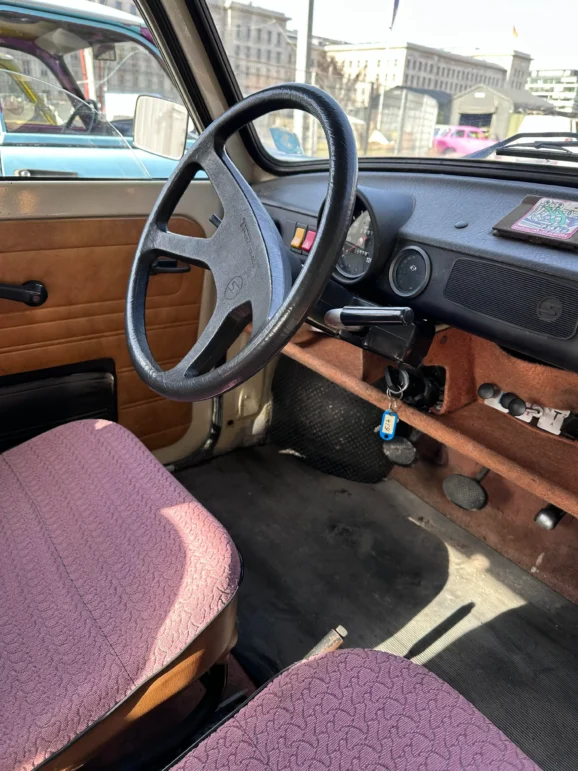
It runs on a petrol-oil mixture that you had to blend yourself at the pump, like a bartender mixing a cocktail for a chainsaw. The gearbox is a four-speed manual with a column-mounted selector that felt like operating a piece of farm equipment. Selecting first gear rather than reverse was more a case of luck!
The suspension is equally as simple, the brakes were adequate, for speeds up to 30mph and the emissions were… well, let’s just say the Trabant was not designed with Greta Thunberg in mind…
And yet, East Germans waited up to 15 years for one. Between 1957 and 1991, across all variants, more than three million Trabants were built. For decades they were the default family car of the German Democratic Republic (GDR) — symbols of mobility, aspiration, and the modest freedoms available behind the Iron Curtain.
Then, in November 1989, the Berlin Wall fell — and the Trabant became obsolete overnight. West German cars flooded the market, and the humble Trabi, once a prized possession, suddenly looked like a relic from another century. Many were abandoned at border crossings. Others were sold for the price of a good lunch. A few were lovingly kept alive by enthusiasts who understood that the Trabant was as much a cultural artefact as it was a practical vehicle.
Today, those enthusiasts have given the Trabant a second life and that’s how I found myself behind the wheel of one, ready to drive through Berlin on a tour that promised history, humour, and a surprising amount of two-stroke smoke.
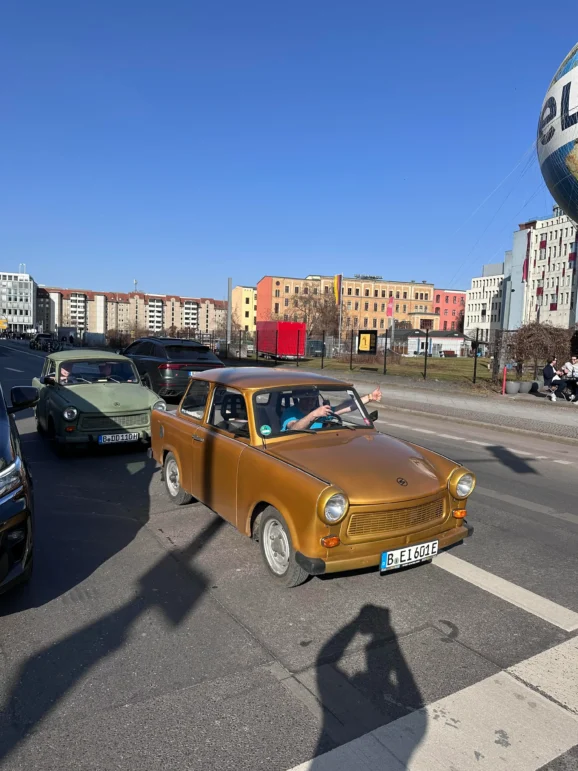
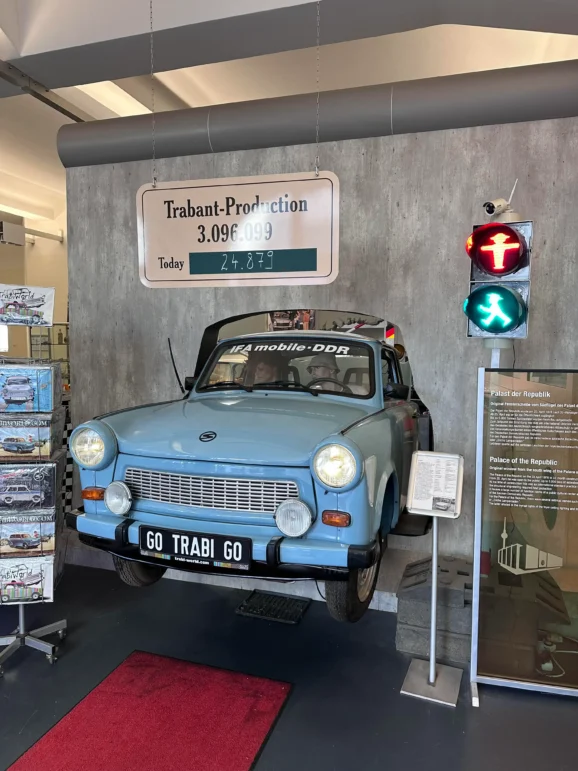
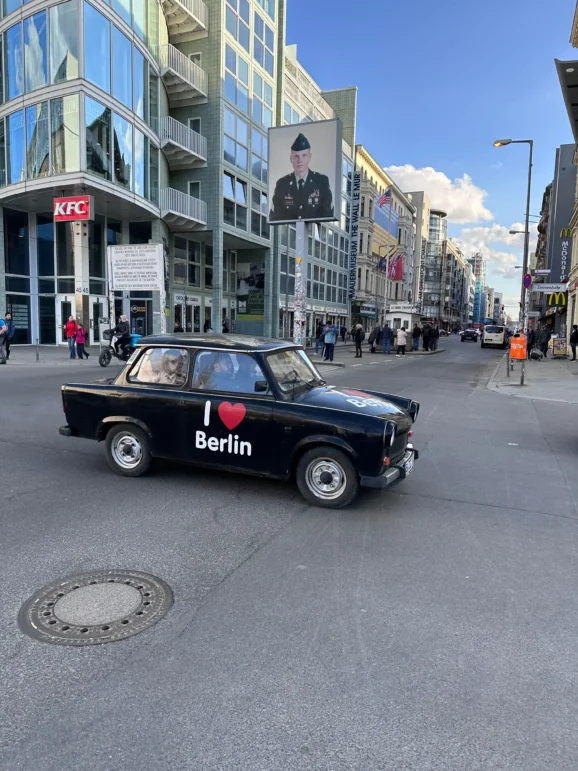
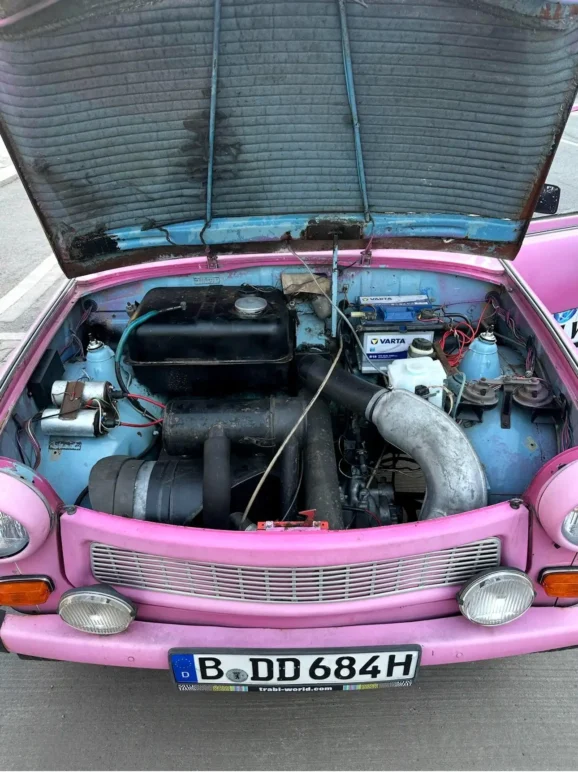
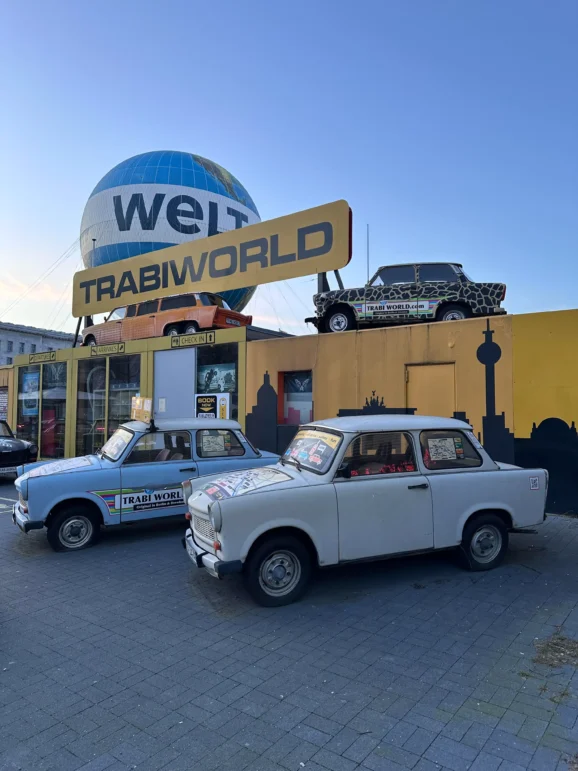
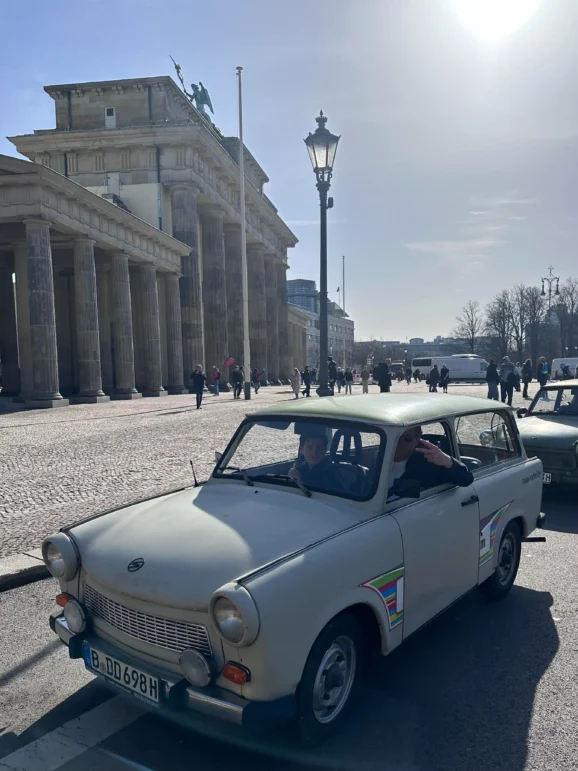
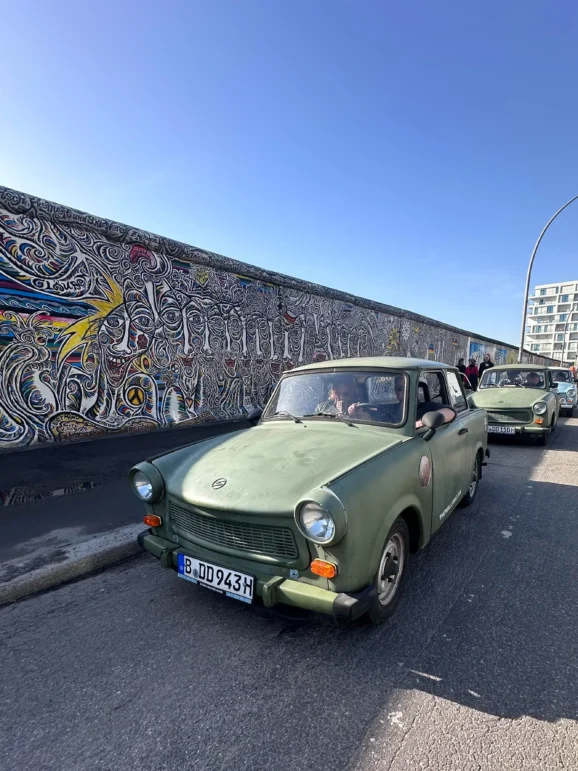
Trabi-World is one of Berlin’s most distinctive, good-humoured tourist experiences, part living museum, part driving school, part Cold-War time machine and it has become the unofficial headquarters of the city’s enduring affection for the Trabant. The experience, hosted by the quick whited Thomas blended hands-on driving, guided storytelling, and a surprisingly rich cultural backdrop, all delivered from a one-way radio built into the dashboard of our Trabi.
Starting a Trabant is a ritual that involves the right combination of choke (manual) and prodding of the accelerator whilst twisting a key buried under the dashboard. Get it right and the engine coughs into life like an elderly man clearing his throat. The whole car shudders, the steering wheel trembles and the exhaust emits an alarming plume of blue oil-rich smoke that smells faintly of lawnmower.
The clutch pedal has the weight of a loaf of bread. The column shifter moves with the vague enthusiasm of a wooden spoon in a jar of honey. First gear engages with a gentle clunk, and with a solid and sustained boot of the accelerator suddenly you are rolling—not quickly, not quietly, but with a sense of occasion that no modern car can replicate.
Thanks to an array of gadgetry, most modern cars isolate you. The Trabant, on the other hand, involves you in every possible way. Every vibration, every sound, every mechanical gesture is a conversation between you and the machine. It is the difference between listening to a symphony on vinyl versus streaming it through noise-cancelling headphones.
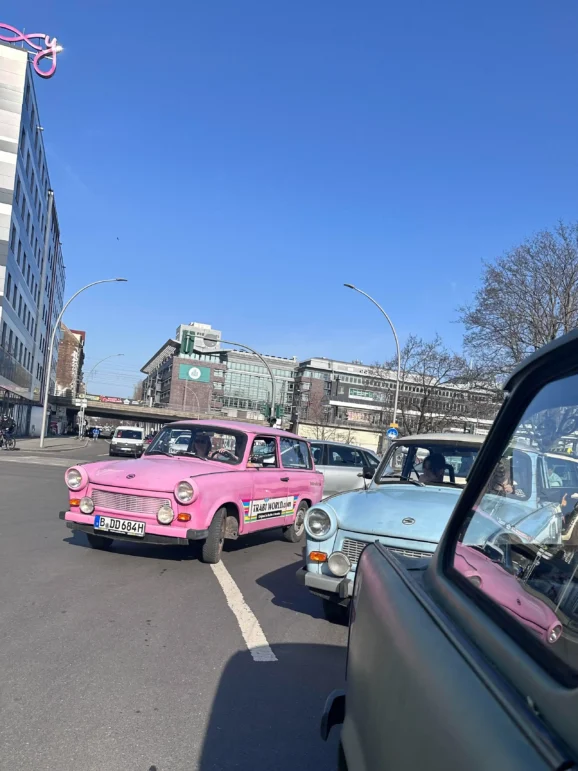
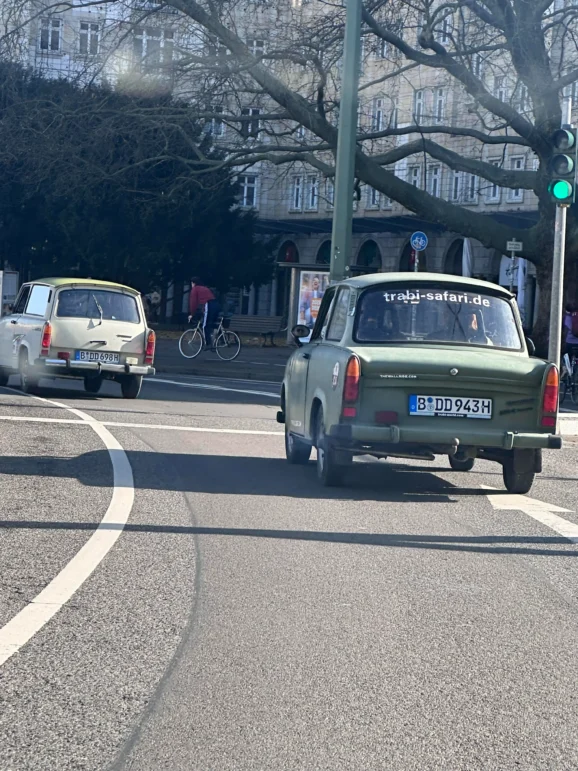
Our eye-catching convoy of Trabis set off from Trabi-World like a cheerful parade of Cold War survivors. Berliners smiled, tourists waved, and children pointed as we cruised through a fast city in the proverbial slow lane.
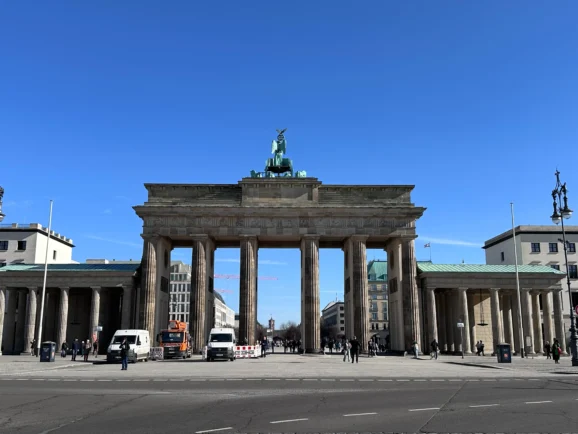
We spluttered toward the Brandenburg Gate, the little two-stroke engine buzzing like an enthusiastic wasp. The joy was immediate. The Trabant forces you to slow down, to look around, to engage with the city rather than blast through it. And Berlin rewards that attention.
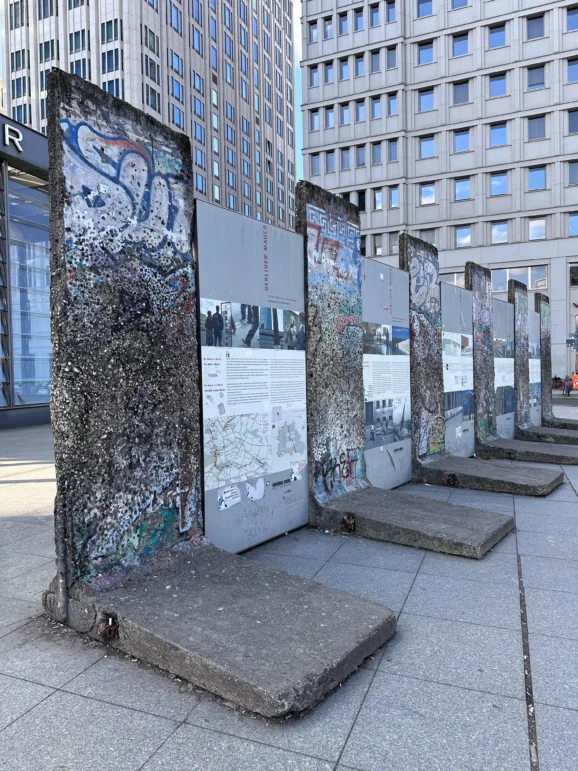
Potsdamer Platz, once a wasteland between two worlds, now a gleaming district of glass and steel. The little Trabant looked absurd here against this modern backdrop, in contrast, driving a Trabant past the Brandenburg Gate felt like time travel.
Once a symbol of a divided city, inaccessible to West Germans, this monument is now a backdrop for tourists and on this particular morning, a convoy of cotton-bodied cars chugging proudly beneath its columns.
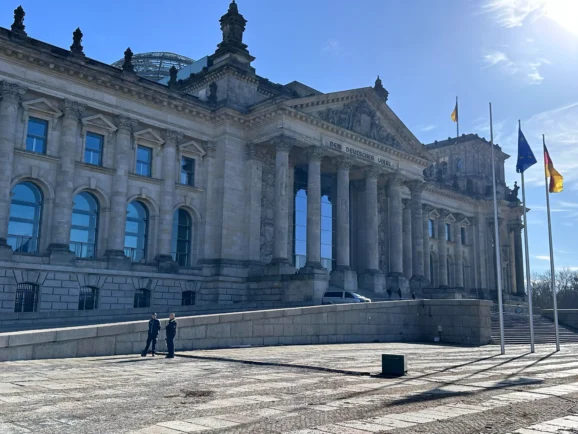
We continued past the Reichstag, its glass dome gleaming in the sun. The contrast was striking: a modern, transparent parliament building beside a car designed in an era of secrecy and surveillance. And yet the Trabi felt oddly at home — a reminder of how far Germany has come, and how much of its past it still carries with grace.
With a kerb weight of around 600kg, the Trabant is hilariously light. It corners with the enthusiasm of a terrier chasing a tennis ball. Body roll? Yes. Precision? Not really. But the sense of motion, of momentum, of physics happening in real time — that is something modern cars, with their electronic nannies and 2-tonne mass, simply cannot replicate.
The 601’s steering is unassisted, feather-light at low speeds and surprisingly communicative once you’re rolling. There is play in the wheel, sometimes a lot, however that looseness becomes part of the experience. You guide the car rather than command it.
The suspension is soft, bouncy, and occasionally comedic. Hit a bump and the whole car reacts like a waterbed. But again, this is part of the charm.
Performance of a Trabi is very much a matter of perspective. In 1988, Thomas the tour guide travelled from East German to Hungary in his parent’s Trabant so I guess long distances are possible. 0–60mph? Eventually. Top speed? Theoretically 100 km/h, though I suspect that’s downhill with a tailwind and a prayer and I’d want better brakes before giving it a go.
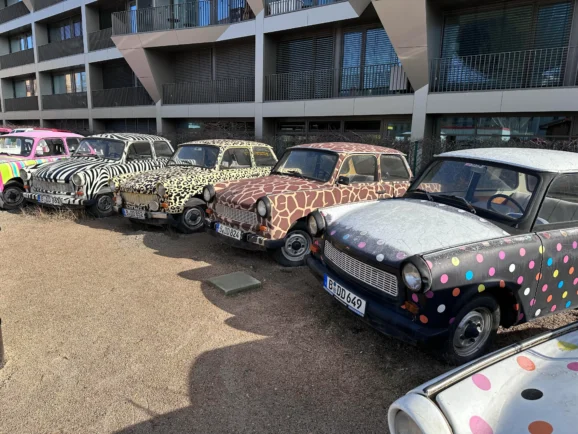
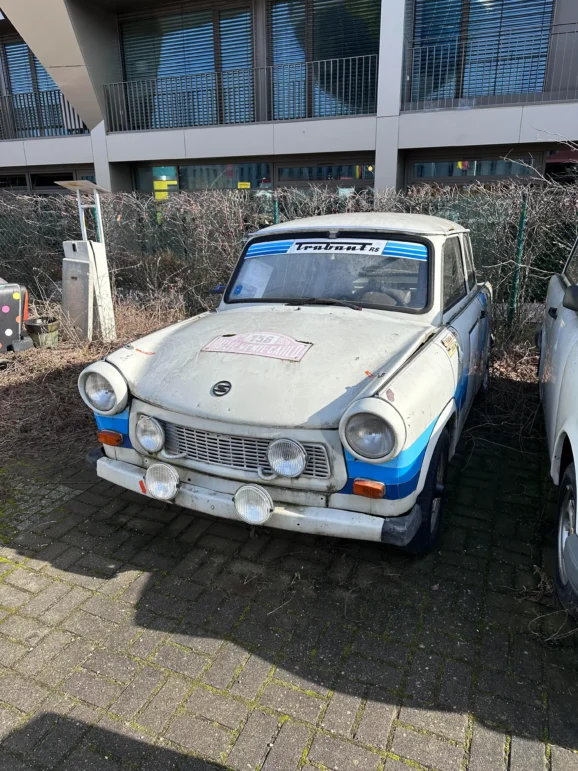
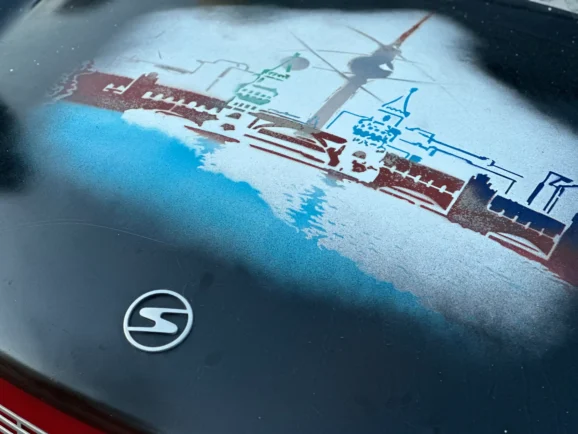
By the time we reached Alexanderplatz, the city’s great concrete expanse, with the iconic TV Tower looming above us like a silver rocket, I had fallen completely in love with the Trabi’s charm. Not ironically. Not nostalgically. Genuinely.
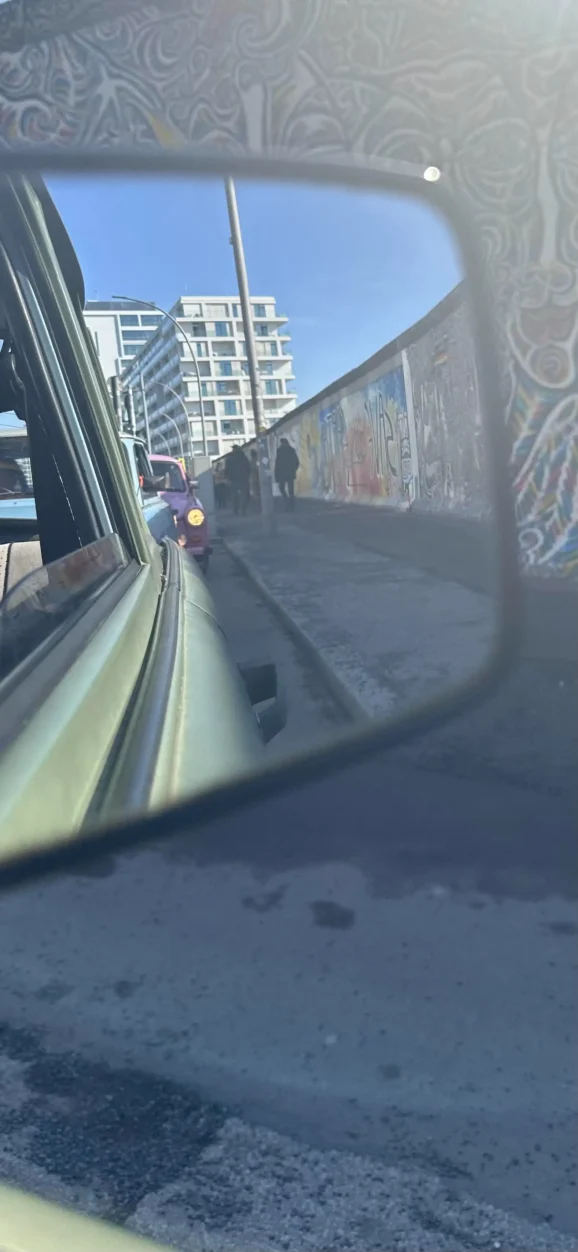
At Café Moscow, the Trabant seemed to perk up, as if recognising an old friend from the Eastern Bloc. From there, we headed toward the East Side Gallery, the longest surviving stretch of the Berlin Wall, now covered in murals. The Trabant’s engine echoed off the concrete, a sound that would have been familiar to anyone who lived in East Berlin before 1989.
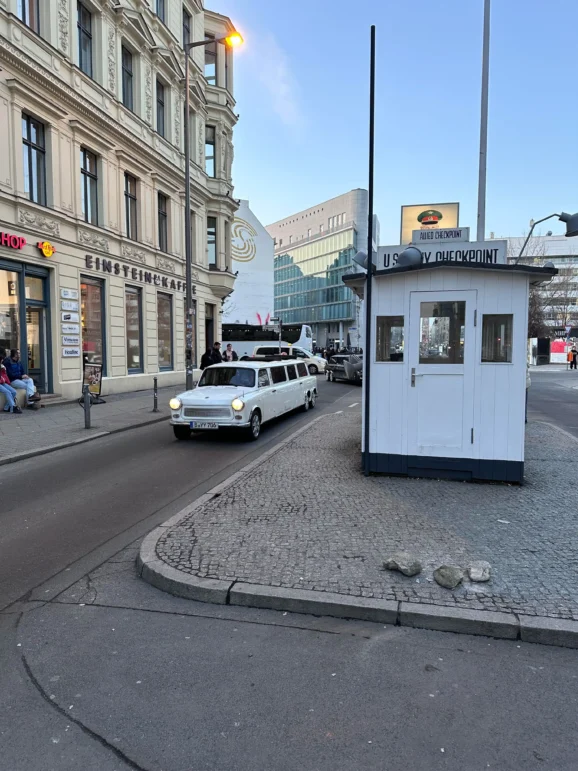
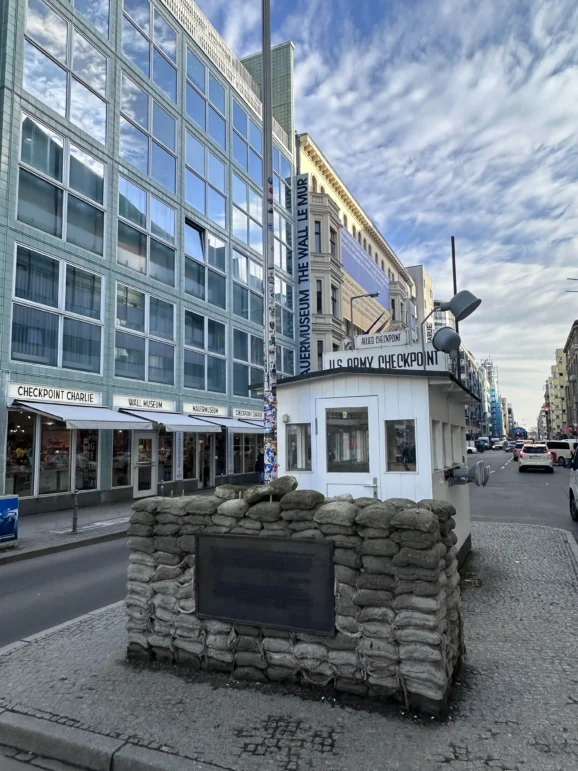
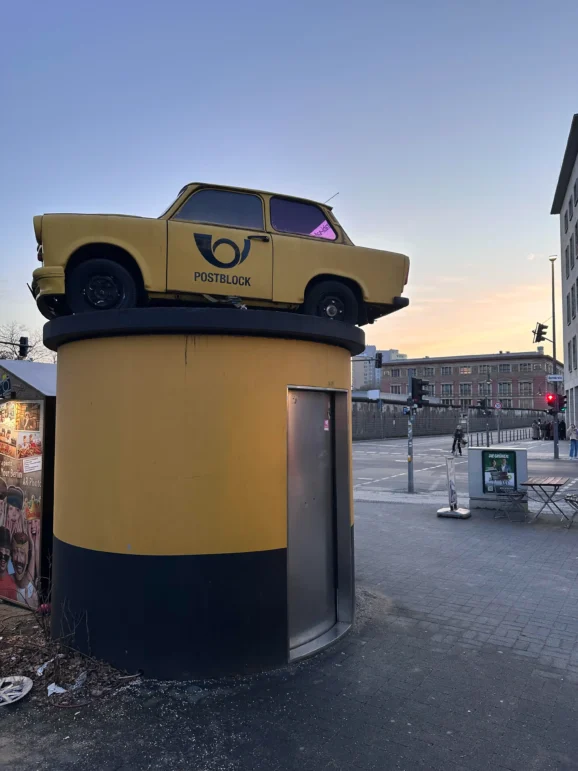
Crossing the Oberbaum Bridge, with its twin towers and sweeping arches, the Trabi felt almost heroic. The wind whistled through the cabin. The engine hummed. The whole car seemed to be enjoying the view as much as I was. Finally, we cruised past Checkpoint Charlie, where tourists photographed us as if we were part of the attraction!
By the time I returned to Trabi-World and switched off the engine, which stopped with a final shudder, as if sighing after a long day, I realised that the Trabant had given me something no modern car has given me in years: joy.
Not the joy of speed or luxury or technology. The joy of connection. Connection to the machine. Connection to the city. Connection to history. Connection to the simple, unfiltered pleasure of driving.
The Trabant 601 is not a great car. But it is a great experience, it becomes a lens through which the city’s history comes into focus. And because the Trabant forces you to slow down, you have time to absorb that history. You are not rushing from one landmark to another. You are experiencing the city at the pace of memory.
The Trabant is often mocked by the West but for East Germans, the Trabant meant freedom. It was the car that took families on holiday to the Baltic Sea, and which lined the streets of East Berlin. It was the car that, in November 1989, carried thousands of East Germans through the newly opened border crossings, their engines buzzing like a swarm of jubilant bees.
The Trabant became a symbol of the fall of the Berlin Wall, not because it was a great car, but because it was their car and for that reason it has a charm position in the history of motoring.
Electric cars are brilliant. Autonomous cars will be transformative. But neither will ever replicate the feeling of coaxing a two-stroke engine to life, guiding a feather-light chassis through a historic city, and laughing as the car bounces over cobblestones like a happy terrier.
The future of mobility is bright. But the past still has something to teach us.

Mark G. Whitchurch is a seasoned motoring journalist whose work—covering road tests, launch reports, scenic drives, major races, and event reviews—has appeared in The Observer, Daily Telegraph, Bristol Evening Post, Classic & Sports Car Magazine, Mini Magazine, Classic Car Weekly, AutoCar Magazine, and the Western Daily Press, among others. He won the Tourism Malaysia Regional Travel Writer of the Year in 2003 and is a member of The Guild of Motoring Writers.
READ MORE:‘A new green dawn: inside Aston Martin’s turbulent start to Formula 1’s 2026 revolution‘. F1’s sweeping 2026 reset roared into life under the Bahrain floodlights, where lighter cars and new power units sent the competitive order back to the grid. Aston Martin’s ambitious new works era with Honda and Adrian Newey spluttered through a bruising test, while rivals found early traction. Motoring Editor Mark G. Whitchurch separates the front-runners from the also-rans as the sport heads flat-out towards a season already on pole for drama.
Do you have news to share or expertise to contribute? The European welcomes insights from business leaders and sector specialists. Get in touch with our editorial team to find out more.
Main image: TrabiWorld in Berlin, the starting point for the city’s “Trabi Safari” tours, where visitors can climb behind the wheel of a classic East German Trabant and drive through the capital in convoy. (Supplied)