
Alain Goudey of NEOMA Business School describes the launch of the school’s all new virtual campus, and its positive impact on motivation and engagement
The Covid-19 crisis has dramatically impacted the mobility of students around the world due to numerous lockdowns, with distance learning made mandatory in some countries and the various restrictions placed on international travel. However, the pandemic has also increased the pace of evolution within the higher education sector, with the coronavirus accelerating digital transformation across educational institutions worldwide.
Based on my experience, there have been two major improvements in education since the start of the pandemic – the various services that have been adapted and become available for students, and of course, the growing amount of distance learning options within business schools.
Indeed, the pandemic meant that, in a very short amount of time, there was an urgent need for business schools to reprocess all their student services so that students would feel fully supported and continue their education during an unprecedented time, whilst also being remote.
We have seen a huge transition of lectures being moved online thanks to various digital tools that have allowed professors to teach via videoconferencing and to communicate with their class using different platforms. However, despite the rapid response from business schools to transform the way they teach and communicate with their students, I’ve witnessed some restraint with the switch to digital. Most prominently, I noticed that human interaction between students and professors was perhaps less fluid, and as a result I saw a need to reengineer the lecture to increase the engagement, the motivation, and the communication between teacher and student.
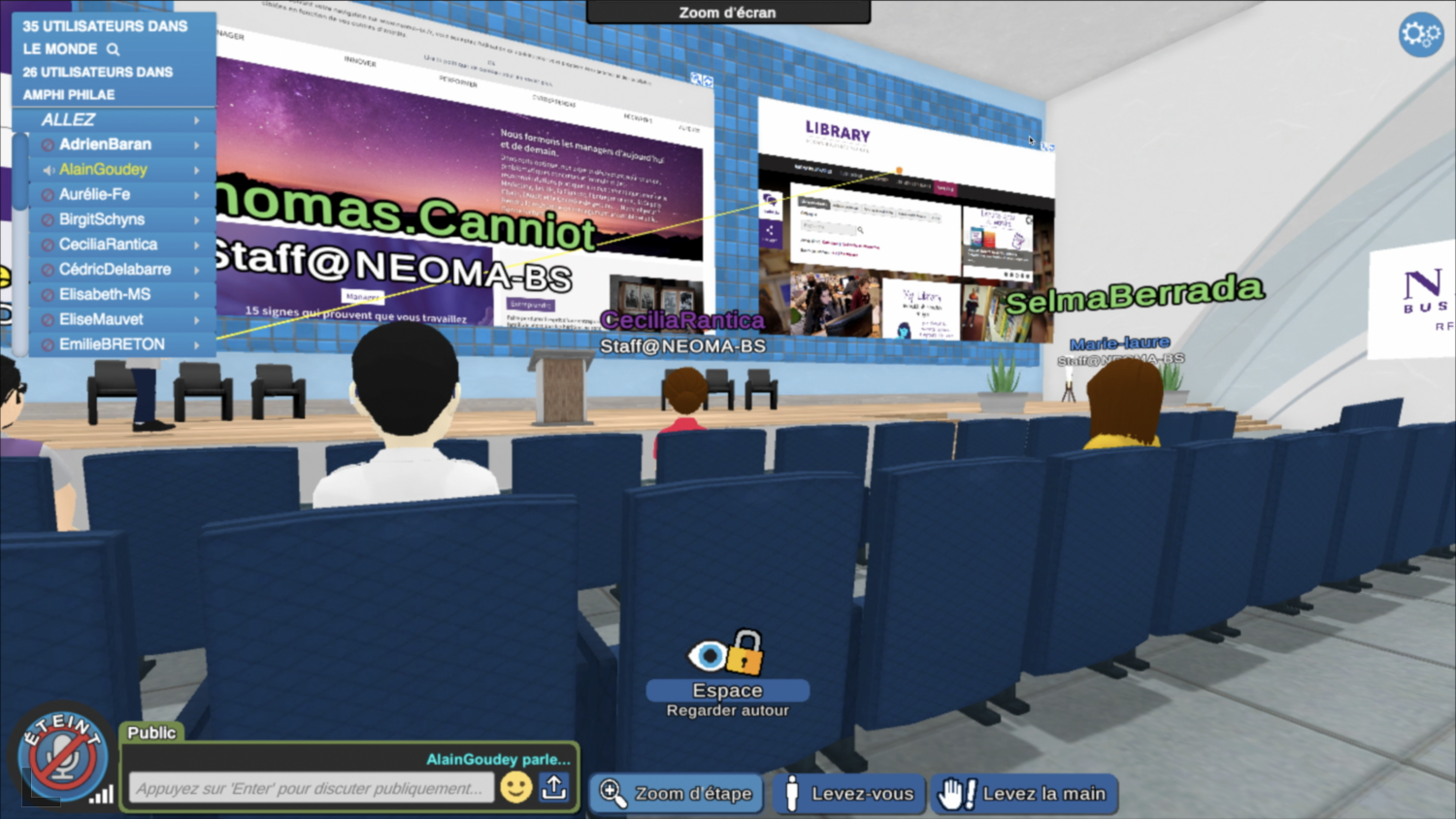
As a result, in early September we launched the fourth campus of NEOMA – which is entirely virtual. Represented by avatars, students, staff members and faculty members can walk inside our virtual building to meet in a small office, a meeting room, or a giant auditorium. They can gather inside the virtual building of the school to run seminars, classes, conferences, or simply discuss in corridors. This is all as if they were on a real campus, yet without the previous constraints of stilted videoconferencing. I see this is as a new way of working, by learning and collaborating as best we can whilst being physically apart. There is no doubt that other business schools will follow with these new virtual settings as we adapt to new ways of working.
Through the use of their personalised avatar, students can also share post-it notes, documents, ideas and even express emotions. Indeed, I think expressing emotions from a student perspective is something that has been overlooked as a necessity throughout the pandemic, especially as it is seemingly harder to express emotion through online platforms. This is why business schools have also had to consider adapting their wellness services in order to work hand-in-hand with new digital platforms. At NEOMA we decided to pay special attention to psychological welfare by providing online workshops on how to face difficult situations, by organising regular meetings with psychologists, and by setting up distanced yoga and mindfulness sessions.
Technology has enabled students to continue their education throughout the pandemic, however there is a danger that through lack of physical mobility, engagement and wellness can be compromised. As such, business schools should ensure that they create platforms and adapt their services so that they can maintain meaningful links between the members of their community as we continue to navigate this new learning environment. ν
Further information