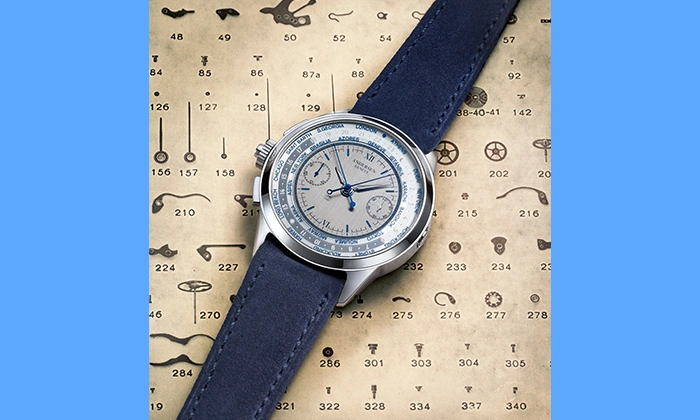
Andersen Genève presents the Rattrapante Mondiale, the first wristwatch in history to fuse two of horology’s most sophisticated complications: the split-seconds (or ‘rattrapante’) chronograph and the worldtimer
The 38.8mm platinum case houses a Venus 179 split-seconds chronograph movement, a celebrated 1940s calibre used most famously by Breitling, as well as a handful of other historic makers. This is paired with Andersen Genève’s brand new worldtime module, an ultra-thin component designed and made in-house. The pairing of these two complications is unprecedented. The concept was devised by founder Svend Andersen and Pierre-Alexandre Aeschlimann in 2017, and has been prototyped and refined over the last two years by Andersen Genève’s in-house watchmaking team. Innovative design choices, technical ingenuity and immaculate hand-finishing rank this among the most accomplished creations to emerge from the brand’s Geneva and La Chaux-de-Fonds Ateliers.
Clarity, artistry, complexity
The case, crafted using traditional techniques and without the use of CNC machines, is made from 950 platinum, with a slim, three-part construction and softly curved lugs. Measuring 38.8mm across and 11.95mm in height, it is expertly hand-polished to a mirror-finish in Andersen Genève’s traditional case-making Atelier in La Chaux-de-Fonds.
Unusually, the chronograph pushers and crown are positioned on the left side of the case – a configuration requested by collectors and echoing certain unique pieces made by Andersen Genève in the past. While not intended specifically for left-handed wear, this arrangement allows the chronograph to be operated with the thumb, and provides a point of difference from standard layouts. A second crown, recessed into the case contours on the right flank, is used to adjust the city disc.
The central dial features hour and minute hands, and a classical chronograph display with subdials at 3 and 9 o’clock, for the 30-minute counter and running seconds respectively. Surrounding this are the elements for the worldtime function – a rotating 24-hours ring, and an adjustable city disc in sapphire to denote the 24 time zones.
For Andersen Genève’s team of watchmakers it was essential to prioritise readability without compromising the discreet, classical proportions of the watch. To achieve this, the Rattrapante Mondiale introduces an innovative variation on the classical worldtimer layout.
Rather than the usual arrangement of a 24-hour ring encircled by a peripheral city ring, the two are combined, with the 24-hour ring seemingly integrated between the outer and inner tiers of the city disc. In reality, the city names are printed on the underside of a sapphire disc, just 0.5mm thick, which sits directly above the 24-hour ring. This construction allows both elements to remain clearly legible while functioning independently, without adding unwanted bulk to the watch.
To this distinctive layout, a suite of subtle yet beautifully executed artisanal techniques has been applied to enhance legibility and visual richness.
The central chronograph dial is made from solid white gold, vertically brushed, and adorned with classical hour markers, minute tracks, and chronograph scales—all hand-applied in blue grand feu enamel, a process requiring exceptional precision and control.
The 24-hour ring, crafted from silvered brass, is divided into day and night sections using delicate texture rather than colour: the nighttime half is black-polished with contrasting matte numerals, while the daylight half is satin-finished. These surface textures create delightful changes in appearance as light hits the dial from different angles.
The steel hands for the chronograph indications are hand-blued by Andersen Genève’s watchmakers, while the Alpha-shaped hands of the time display are in mirror polished white gold.
Two complications expertly combined
At the heart of the watch is a vintage Venus 179 calibre – a hand-wound column-wheel chronograph movement of exceptional beauty and craft, that was produced between the 1940s and 1960s. A variation on Venus’s 175 calibre, the 179 incorporates the highly complex split-seconds function, which allows measurement of intermediate times via a second chronograph hand that can be stopped and re-synchronised.
Each vintage calibre, sourced in New Old Stock (NOS) condition, has never been previously assembled, and is carefully inspected, refined and regulated by Andersen Genève’s watchmakers, before being paired with the brand’s proprietary worldtime module. Originally developed by founder Svend Andersen in the late 1980s, this slim and sophisticated module has formed the basis for the brand’s expertise in worldtimers ever since its first Communication 24 model in 1990.
‘AAA’ watchmaking – a new Andersen Genève standard
The Rattrapante Mondiale marks the debut of a new category within Andersen Genève’s watchmaking: the ‘AAA’ tier, for watches combining complex complications with the most extensive hand-finishing and decorative techniques. While all Andersen Genève timepieces are crafted to the most exacting standards, the ‘AAA’ designation signifies the brand’s highest level of complexity and artisanal intensity. It is engraved discreetly inside the back bezel, alongside the names of the contributing team members.
Accordingly, the Venus 179 movement in this watch has been elevated to a ravishing haute horlogerie finish. Decorative techniques include black polishing of multiple components, such as the sinewy arms of the split-seconds clamp; the column wheel and screw heads, and the ultra-refined balance-adjustment elements (swan-neck regulator, setting index, and Geneva stud plate).

Satin finishes are applied to selected surfaces using pierre de Paris stone – a fine shellac now rarely used in watchmaking, but prized for the refined texture it imparts. Sinks are polished with ruby cutters, and even the arms of gear wheels are delicately angle-polished with great precision.
The flanks of bridges and plates are delicately drawn with fine emery buffs, before attention turns to the art of anglage: the perfectly angled chamfering and finessing of edges. The angles are shaped, buffed and smoothed by hand to absolute consistency, then polished to a uniform mirror finish – work of utmost skill and care.

This ‘AAA’ tier will be reserved for only a handful of watches, owing to the extraordinary time investment and specialised techniques each requires.
Continuing a legacy in worldtime watches
Worldtime complications have been a defining part of Andersen Genève’s identity since 1990. Svend Andersen, the brand’s founder, developed one of the first independent ultra-thin worldtime modules after working on complex timepieces at Patek Philippe. His first worldtime wristwatch, the Communication 24, launched in 1990, and set a precedent for future editions, combining practical utility with deep craftsmanship.
Since then, Andersen Genève has produced several limited worldtimer models, including the Mundus – the world’s thinnest worldtimer, at only 4.2mm (1994) – the 1884 (2004), the Tempus Terrae (2015), and the Celestial Voyager (2021), each expanding on the technical and aesthetic possibilities of the worldtimer format.
The Rattrapante Mondiale builds on this lineage, integrating new complexity without compromising the clarity, proportions, or artisanal ethos that characterises the brand’s work.
Milestones in time: key dates in Andersen Genève’s worldtimer journey
- 1942 – Svend Andersen is born in Padborg, Denmark
- 1969–79 – Works at Patek Philippe; restores original Louis Cottier-made worldtimers
- 1979 – Founds Andersen Genève as an independent maker of bespoke timepieces
- 1990 – Launches Communication 24, with 24 pieces by subscription; followed by a series-made edition, called simply Communication
- 1991 – Chronograph; series-made edition requested by Italian collectors, called OM21 (Oro Mundi)
- 1992 – Christophorus Columbus – worldtimer showing map of Columbus’s 1492 voyage
- 1994 – Mundus, sets record for the world’s thinnest worldtimer of only 4.2mm (still holding in 2025)
- 2004 – 1884, celebrating 120 years of global time zones
- 2005 – Voyage World Time (Shellman collaboration)
- 2015 – Tempus Terrae, celebrating 25 years of worldtimer by Andersen Genève
- 2022 – Heures du Monde (Asprey collaboration)
- 2021–2024 – Celestial Voyager enamel editions with BCHH
- 2025 – Launch of Communication 45
- 2025 – Launch of Rattrapante Mondiale split-seconds worldtimer
Andersen Genève has also made several special worldtime series on request, as well as bespoke commissions for unique pieces. These have on occasion seen worldtime paired with other complications including minute repeaters, chronographs, perpetual calendars, retrograde displays and alarm functions.
Watchmaking’s global citizen – Q&A with Svend Andersen
What was your first experience of the worldtime complication?
I moved from Denmark to Switzerland in 1963, and because I could speak good English, I got a job at Gübelin [the Swiss high-end watch retailer] in Lucerne. There, I had the chance to repair some of the original worldtime watches, with Louis Cottier’s mechanism. That was my first real encounter with the complication, and it stayed with me.
In the 1970s, you were part of the three-man team in Patek Philippe’s Grand Complications workshop, alongside Roger Dubuis and Max Berney. Did you encounter many worldtimers there?
Absolutely. Louis Cottier had died in 1966 and Patek Philippe stopped making worldtimers after that. But we would repair them, and once someone came to me with trays of parts from the old Cottier worldtime watches from the 1950s. They asked, “Can we make watches from these?” I looked at them carefully and said, “I think we can save three movements from this.” The parts went to another workshop, they made three gold cases, and that was that. But it taught me something important: how special this concept was, how beautiful, and how rare.
You went solo in 1979, and spent the 1980s making first pocket-watch cases and then one-off bespoke watches. What led you eventually back to the worldtime?
Some Italian collectors were asking me for something more interesting than just hours, minutes and seconds. I remembered those old Cottier watches, and I thought, why not a worldtimer? So I began developing my own version. I designed a completely new module, much thinner than what was around at the time. Mine was just 0.9 millimetres, everything included. There weren’t many others around, and those that were used modules that were thicker, like the one from Lemania, and that made the whole watch too bulky. For me, slimness and elegance are very important, especially for a worldtimer.
The Communication started off as a subscription edition of 24 watches. What was the response from collectors like, and how did you get the word out?
When I developed the prototype version, in 1989, I presented it to a German journalist. He published an article, and within two weeks we had 18 subscriptions – out of a planned edition of 24. The other six came soon after. The subscription model meant that people paid 50 percent in advance, and that gave me the funds to buy gold for the cases and to begin production. We actually made 25 cases – the 25th, which had no lugs at all, I kept. It’s my wife’s watch to this day.
From there, you made the series-produced Communication, as well as a handful of special versions with different dial designs. Why do you think there was such a market for it?
Well of course I was very happy about that. It was very pleasing that so many good people, really committed collectors who loved watches, wanted it. Patek Philippe wasn’t making worldtimers at that time, so in a way, there was a gap in the market. Ebel and a few other brands were doing them, but not really refined. I was going back to what Cottier had invented.
The different dials were made according to the different requests from my retail partners. For example, a cream colour dial with gold map was requested by Yoshi Isogai of the Shellman Boutique in Tokyo. He sold dozens of such Communication with white dials to high-end Japanese collectors. There was also a black dial version which was requested by Mr Fagnola of the Fagnola boutique in Turin, for one of his long time Italian clients.
About Andersen Genève
Founded in 1980 by master watchmaker Svend Andersen, Andersen Genève has become one of the most exclusive Ateliers in Swiss watchmaking. A founding member of the Académie Horlogère des Créateurs Indépendants (AHCI) – an organization co-instigated by Svend – it is one of the few brands to specialise in bespoke haute horlogerie, working one-on-one with collectors around the world. It is known for its imaginative complications, refined worldtime watches and artistic craftsmanship, bringing a deeply artisanal approach to every creation.
Since 2015, Andersen Genève has been owned and directed by Pierre-Alexandre Aeschlimann, working in close collaboration with Svend Andersen (83 years old), Marco Poluzzi (83 years old), and a small, in-house team of talented watchmakers. Operating from its original workshop overlooking the Rhône in the historic Saint Gervais area of Geneva – once home to the city’s famed cabinotiers watchmakers – and since 2022 with a second Atelier for case-making in La Chaux-de-Fonds, Andersen Genève creates around 50 watches per year, each one a rare and lasting work of art. In fact, fewer than 1,400 timepieces have been manufactured since 1980.

Specifications
- Case Diameter: 38.8 mm
- Case Height: 11.95 mm
- Case Material: 950 Platinum, hand-finished
- Dial: Solid white gold with vertical brushing; blue enamel indexes and tracks
- Hands: 18ct Gold mirror polished; blued steel chronograph hands
- Worldtime Display: City disc (sapphire) with printed names; 24-hour ring in silvered brass, with black-polished and satin-finished halves
- Movement: Base: Venus 179 NOS rattrapante chronograph movement, manual wind
- Functions: Split-seconds chronograph with 30-minute counter and small seconds; New Andersen Genève ultra-thin worldtime module specially developed for this timepiece
- Extensive hand finishing of every component, including black and mirror polishing, pierre de Paris, satin finishes, mirror-polished anglage, perlage
- Power Reserve: 42 hours
- Glasses: Domed sapphire crystal treated with anti-reflective coating on both sides
- Strap: Handmade suede strap with platinum pin buckle
- Edition: Limited to eight individually made pieces
Further information
www.andersen-geneve.ch
READ MORE: ‘Germany’s Jewellery Museum in Pforzheim unveils landmark exhibition on dining culture‘. A major exhibition now open in Pforzheim charts how eating evolved from raw instinct into a disciplined cultural act, and how tableware, etiquette and design came to define civilisation, hierarchy and social behaviour. Dinner Is Served brings together objects ranging from gold-plated bowls and a shoe-shaped drinking cup to a Roman pocket knife to reveal a global history of dining customs, showing how the simple act of bringing food to the mouth became loaded with meaning. Here, its curator Katja Poljanac explores what our tables say about who we are.
Do you have news to share or expertise to contribute? The European welcomes insights from business leaders and sector specialists. Get in touch with our editorial team to find out more.