Britain’s £700m AI spending plan ‘risks making cyber threats worse’

John E. Kaye
- Published
- News, Technology
A single cyberattack on Jaguar Land Rover cost the British economy an estimated £1.9bn. Now, one of the world’s leading cybersecurity experts warns that the government’s multimillion-pound drive to accelerate AI adoption could create even more security problems unless properly managed
Britain’s £700m-plus investment in artificial intelligence could worsen the country’s cybersecurity problems if ministers encourage widespread adoption of the technology without adequate safeguards, the chief executive of the Information Security Forum (ISF) has warned.
Steve Durbin, a leading international authority on cybersecurity, said the sums pledged in Chancellor John Healey’s Budget paled in comparison with the billions being spent on AI development by private technology companies.
Speaking to Juliette Foster on Business Matters, he said last year’s cyberattack on Jaguar Land Rover (JLR) alone had cost the UK economy an estimated £1.9bn – almost three times the government’s AI investment.
The attack halted vehicle production for five weeks, disrupted supply chains and affected more than 5,000 UK organisations.
Durbin said ministers now needed to demonstrate how the money would be spent and what it would achieve.
“I think it raises the question as to how that money is going to be spent,” he said.
“If it’s spent in encouraging adoption without governance, without awareness, without understanding, then I think we’re exacerbating the problem.”
Among the measures announced in the Budget are £60m for a national Cyber Shield and £70m for a National Exposure and Real-Time Vulnerability (NERV) Centre.
According to the government, the Cyber Shield will use AI to detect and counter threats more quickly, with £25m earmarked for British companies developing new AI and cybersecurity technologies.
The NERV Centre, which will operate within the National Cyber Security Centre (NCSC), will identify weaknesses in Britain’s critical infrastructure and alert organisations at risk of attack.
But Durbin, who welcomed both initiatives, warned that government bureaucracy could undermine their effectiveness.
With AI enabling hackers to identify and exploit security weaknesses more quickly, delays in public-sector procurement risk leaving Britain’s defences one step behind its attackers, he said.
“Attackers are not sitting there waiting for something to happen. They can move very, very quickly, and AI speeds that up,” he said.
“There is urgency every single minute of the day in this kind of operation.”
He said the government would also need to win the trust of private companies responsible for essential services, including water and electricity, to ensure vital security intelligence was shared in real time.
“We have to trust that the inputs and the outputs are going to be used appropriately, and only time will tell with that,” he added.
Durbin also drew attention to the gulf between public and private-sector spending on AI. Anthropic, the U.S tech firm behind the AI platform Claude, spent US$19.2bn on research and development in the first nine months of this year, according to its latest stock market flotation prospectus.
Almost half of that sum – US$9.5bn – was spent between July and September alone, bringing the company’s total research and development expenditure since the beginning of 2024 to US$27.8bn.
“So you have to be exceptionally careful as to how you’re going to get a return on that level of investment,” Durbin said of the government’s spending plans.
“And that is something that I think I have questions about when I look at money being made available. Well, fine, but how exactly are you going to use it? What difference are you going to make?”
Ministers are also exploring plans for a regulatory sandbox, which would allow companies to trial new AI-powered cybersecurity tools in a controlled environment and give regulators a better understanding of how the technology should be governed.
But Durbin warned that AI was developing so rapidly that lengthy trials could leave new regulations outdated before they even came into force.
“We can’t sit around testing things for a couple of years, because the market will have moved on, and what we’re bringing out is worthless,” he added.
Watch the full interview with Steve Durbin, chief executive of the Information Security Forum, on Business Matters at 8.30am on Sunday 29 November on Bloomberg TV, available on Sky 502, Sky Glass 505, Virgin 609 and Freesat 208.
VIEW MORE: Hackers could bring Britain’s essential services to a standstill, security chief warns after global website shutdowns. Government, council and healthcare websites were taken offline after critical software vulnerabilities sparked an international security alert. In a new Business Matters interview with Juliette Foster, Information Security Forum chief executive Steve Durbin warns that attackers are increasingly targeting the systems on which everyday life depends.
Do you have news to share or expertise to contribute? The European welcomes insights from business leaders and sector specialists. Get in touch with our editorial team to find out more.
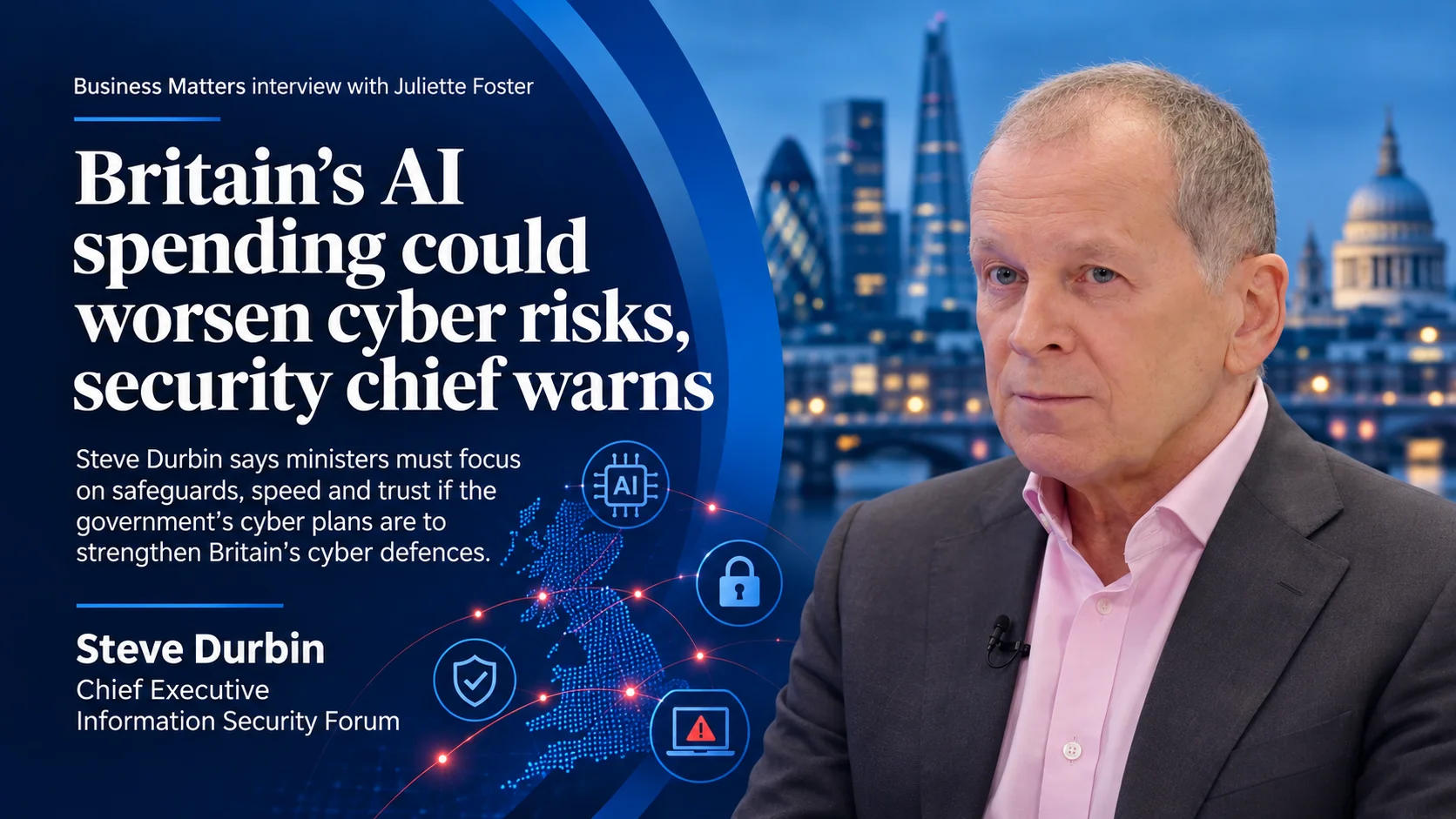
Main image: Steve Durbin, chief executive of the Information Security Forum, discusses the risks surrounding Britain’s £700m AI investment and the growing threat of AI-powered cyberattacks in an interview with Juliette Foster on Business Matters, broadcast on Bloomberg TV.
TOP STORIES
-
 Britain's £700m AI spending plan ‘risks making cyber threats worse’
-
Siemens technology could slash cost of making car microchips
-
Cancer treatment technology firm sees orders jump 24% to €242m
-
Cambridge and Edinburgh beat London for investment in high-growth businesses
-
British AI tool halves cancer assessment time as it wins European approval
-
New hope for Parkinson’s patients as €15m secured for experimental treatment
-
Trump prepares new tariffs on EU, China and other major trading partners
-
ING buys back €111m in shares as €1.65bn programme gathers pace
-
Siemens-backed project aims to cut green hydrogen costs by 20%
-
French drug giant Sanofi strikes €37.6bn deal to buy US biotech firm
-
NHS begins world's biggest AI breast cancer screening trial involving 700,000 women
-
German shipping group's pre-tax profits jump 20% to €23.7m ahead of major acquisition
-
Partners Group buys New Zealand ferry operator in major infrastructure deal
-
Vår Energi strikes $4.4bn deal to buy ConocoPhillips' Norwegian oil business
-
The sky’s the limit for flying cars but expert warns of deadly risks
-
Meet the seven Anthropic founders worth $23bn each after record-breaking stock market debut
-
World's robotics leaders to gather in Germany in race to put AI to work
-
Britain's most expensive seaside resort dominates £2m property sales
-
Beavers return to Loch Ness after 500 years
-
Swiss data centre to heat homes using waste energy from AI servers
-
Uzbekistan attracts $44.1bn in foreign investment and loans in nine months
-
Serko raises revenue forecast as Booking.com business travel bookings surge
-
Air India and Airbus unveil India's first corporate green aviation fuel scheme
-
Best Western loyalty scheme to be scrapped in major hotel rewards shake-up
-
First class delivery: China's postal service puts humanoid robots to work across eight cities