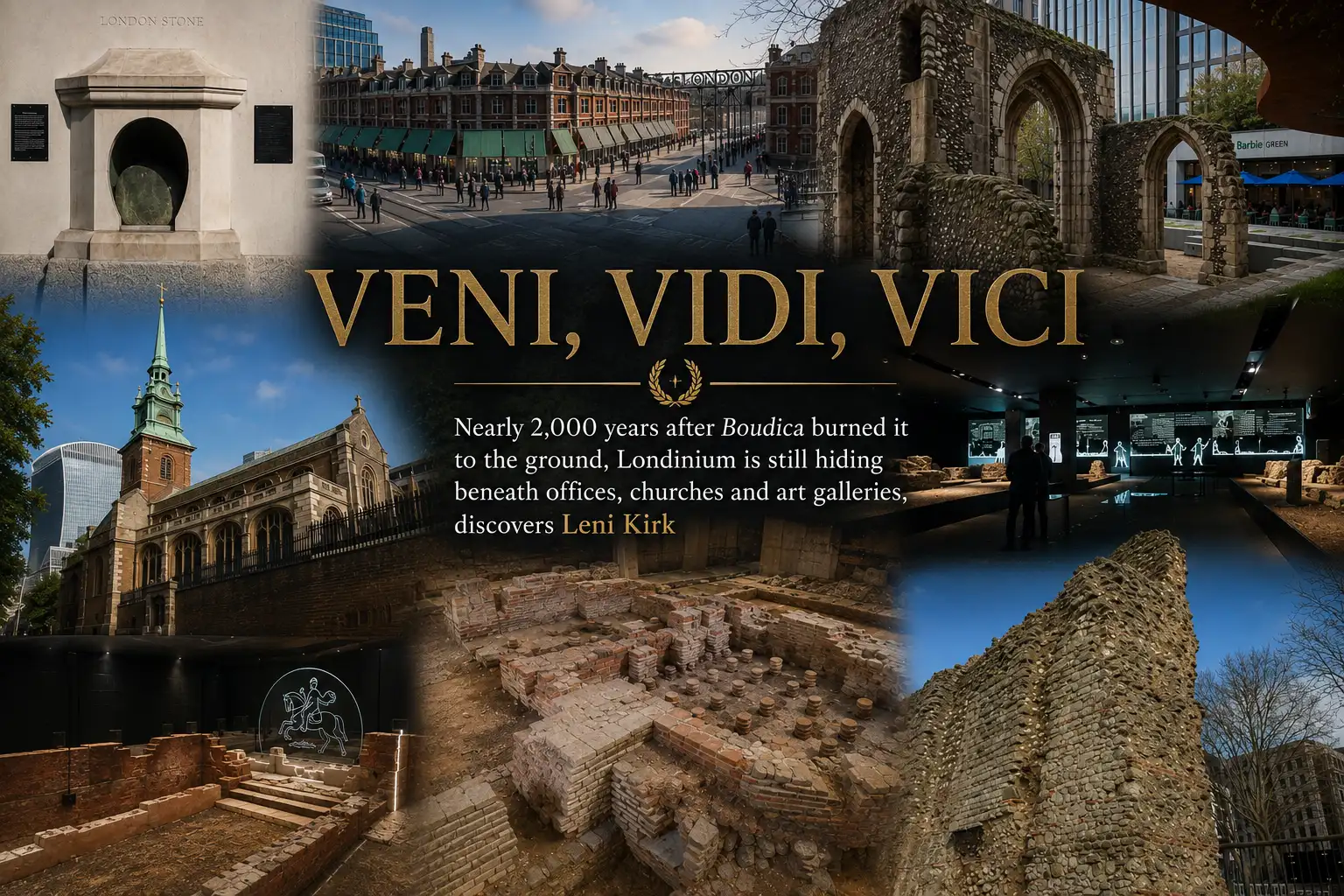
Nearly 2,000 years after Boudica burned it to the ground, Londinium is still hiding beneath offices, churches and art galleries. Ahead of London Museum’s 50th-anniversary reopening, Leni Kirk reveals how to trace the lost Roman city through the streets of modern London
London’s Roman past will return to centre stage on 28 November, when London Museum opens its new home in Smithfield’s restored General Market.
The opening marks the museum’s 50th anniversary and will bring many of the capital’s Roman treasures back into public view. Its free permanent galleries will include writing tablets preserving some of London’s earliest surviving voices, together with a Roman floor mosaic and painted wall plaster being displayed for the first time in around 2,000 years.
The anniversary provides a good excuse to search for the city the Romans left behind.
Londinium was founded between AD 47 and 50 beside the Thames, where ships could reach the settlement and a bridge could connect it with the area that became Southwark. By AD 60, it had around 10,000 residents and a busy port importing wine, olive oil, pottery, glassware and fish sauce from across the empire. Boudica and her forces burned the settlement in AD 60 or 61. The Romans rebuilt it and Londinium became the capital of Roman Britain, complete with temples, public baths, a forum, an amphitheatre and defensive walls.
Much of that city remains beneath the modern streets. Some of its finest surviving buildings lie below offices and galleries, while other fragments have become part of church crypts, gardens and the Barbican estate. The principal sites are concentrated within the Square Mile and can be linked on foot.
Here are the best places in the capital to see what survives of Londinium.
Tower Hill city wall
Where: Tower Hill, London EC3N 4DJ
Nearest station: Tower Hill
Current access: Free and open at reasonable times during daylight hours
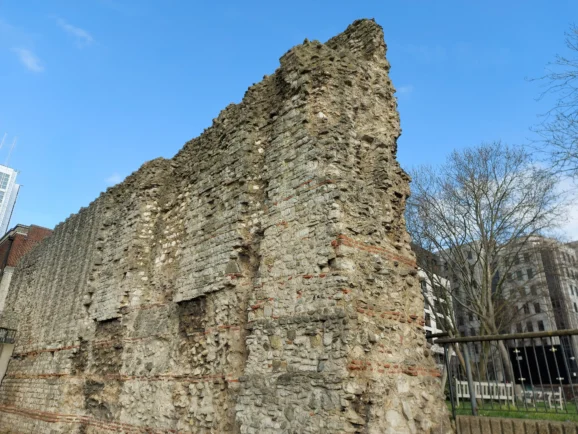
The Roman wall at Tower Hill is part of the great stone fortification built around the landward sides of Londinium from about AD 200. It ran for roughly two and a half miles between Tower Hill and Blackfriars, enclosing about 134 hectares. The original wall was more than six metres high and up to 2.6 metres thick at its base, and was built with a rubble-and-mortar core faced with squared stone. Horizontal bands of red tiles helped bind the structure together and remain the easiest way to distinguish its Roman fabric.
The wall initially enclosed the northern, eastern and western sides of the city. A separate riverside wall was added between about AD 250 and 270, completing the circuit along the Thames. After Roman rule ended, the wall continued to shape London. Medieval builders repaired it, increased its height and incorporated parts of it into later fortifications and buildings.
The Tower Hill section is one of its most substantial surviving stretches. To see it, leave the station towards the Tower of London and follow the path towards the underpass. The wall stands beside a small garden halfway down the steps. Its lower courses are Roman and marked by the distinctive red bonding tiles. Medieval masonry above them raises the surviving structure to more than ten metres.
The wall is outdoors, free to see and requires no booking. English Heritage advises visiting during reasonable daylight hours.
All Hallows by the Tower
Where: Byward Street, London EC3R 5BJ
Nearest station: Tower Hill
Getting there: Cross Byward Street from the Tower Hill wall
Current access: Monday to Friday, 8am–5pm; Saturday, 10am–5pm. Sunday visitor hours should be checked before travelling.
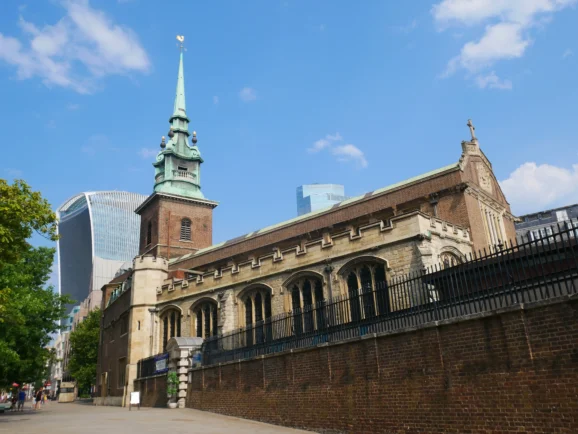
All Hallows is the oldest church in the City of London, but the Roman attraction lies beneath it: part of the floor of a private house that occupied the site during the late second century.
The church was founded by Barking Abbey in AD 675, several centuries after the Romans had left Britain. Its crypt preserves evidence of the homes that once stood in this part of Londinium. The Roman pavement was discovered in 1926 and remains at its original level in the undercroft. It consists of plain red tesserae and has a narrow gully thought to mark the position of a wall, with traces of plaster surviving at its edges.
The foundation of the original Saxon church cuts across the Roman floor, allowing visitors to see two periods of London’s history in the same small space. The pavement provides a rare glimpse of domestic Londinium. It belonged to a house in which Roman Londoners lived rather than a temple, arena or military building. The crypt museum also contains Roman and Saxon objects and a model of ancient London.
Entry is free. The church is closed on bank holidays and can occasionally close for services or private events. Opening times may also vary because of staff availability, so visitors should check the church’s website before travelling.
Billingsgate Roman House and Baths
Where: 101 Lower Thames Street, London EC3R 6DL
Nearest stations: Monument or Tower Hill
Getting there: Walk west from All Hallows along Lower Thames Street
Current access: Pre-booked guided tours only, on Saturdays between 11 April and 28 November 2026
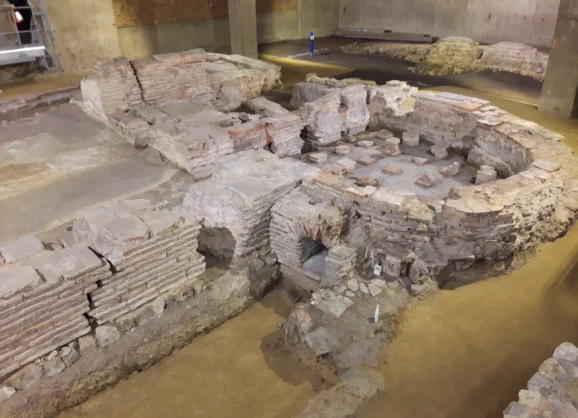
Billingsgate Roman House and Baths contains the remains of a substantial late second-century building and the private bathing suite added to it during the third century.
The riverside property may have been a wealthy townhouse or a mansio, an inn used by travellers and Roman officials. Its position placed it close to Londinium’s waterfront and commercial district. The bath suite, known as a balneum, was built within the property’s yard. It contained a frigidarium, or cold room, a tepidarium, or warm room, and a caldarium, or hot room. Furnaces fed a hypocaust system, circulating hot air beneath raised floors. Parts of the hypocaust pillars, floor tiles, furnace and flues survive in place.
The remains were first discovered in 1848 during construction of the Coal Exchange. Further excavations took place between 1967 and 1970 when the exchange and neighbouring buildings were demolished to widen Lower Thames Street.
Partial excavation indicates that the bath complex and associated building remained in use into the early fifth century, making the site an important survival from the final years of Roman London. The archaeological remains are preserved beneath a modern office block. Visitors view the house walls, courtyard and bathing rooms from raised walkways.
Tours take place at 11am, noon and 1pm every Saturday between 11 April and 28 November 2026 and last about an hour. Tickets must be booked in advance because places are limited. Adult admission currently costs £16.96, including the booking fee. Concessionary tickets for children aged eight to 14 cost £11.55. Children under eight are not admitted. The site is reached by a staircase and has no step-free access.
London Stone
Where: 111 Cannon Street, London EC4N 5AR
Nearest station: Cannon Street
Getting there: Continue west along Lower Thames Street, turn north at Monument and follow Cannon Street
Current access: Visible from the pavement without charge or booking
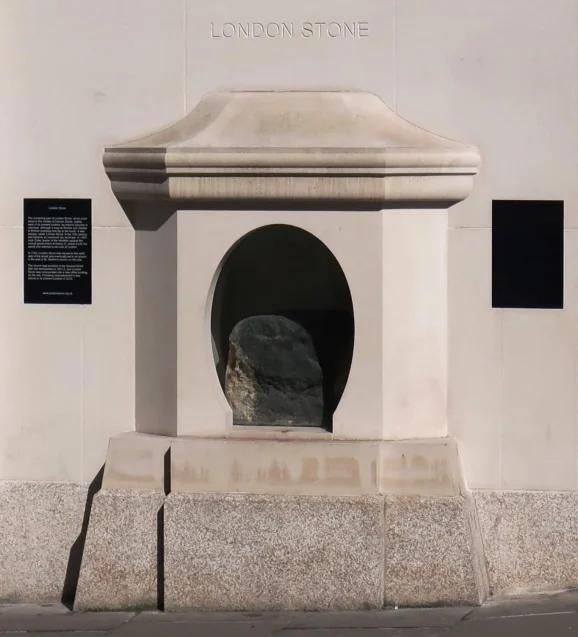
London Stone is an irregular block of limestone whose age, original size and purpose remain unknown.
It has been recorded in the area since at least the 12th century and was once part of a considerably larger object. Although it is often described as Roman, no conclusive evidence has established when it was created. One theory holds that it was a Roman milestone from which distances across Britain were measured. It has also been described as a Druidic altar and linked to Brutus of Troy, the mythical founder of Britain. None of these explanations has been proved, adding to the mystery.
The surviving stone was formerly displayed in the wall of St Swithin’s Church. After the church was badly damaged during the Second World War and later demolished, it was incorporated into the building that replaced it. It is now displayed behind glass in a Portland stone enclosure built into the frontage of 111 Cannon Street, opposite the railway station.
London Stone is a brief roadside stop rather than a conventional archaeological attraction, but its uncertain origins have made it one of the capital’s most enduring historical mysteries. It can be viewed from the pavement at any time without charge or booking.
London Mithraeum
Where: 12 Walbrook, London EC4N 8AA
Nearest stations: Bank or Cannon Street
Getting there: Continue west along Cannon Street and turn right into Walbrook
Current access: Temporarily closed until 16 July 2026; normally open Tuesday to Sunday
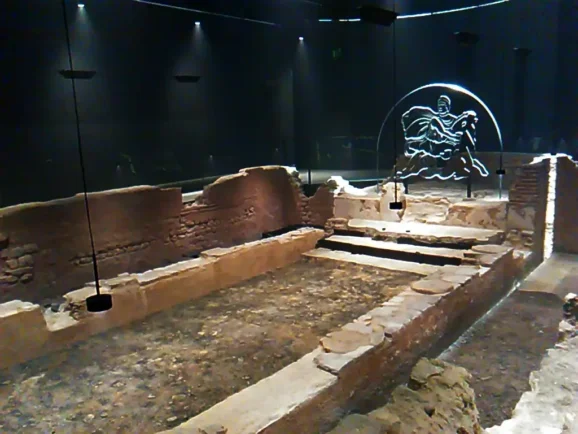
London Mithraeum occupies the site of a temple dedicated to Mithras, a mysterious god worshipped by members of a secretive Roman religious cult.
The temple was built beside the River Walbrook in about AD 240 and remained associated with the worship of Mithras until about AD 350. Mithraism was a male-only cult popular with soldiers, merchants and civil servants. Worshippers were organised into seven ranks and gathered to share meals and conduct ceremonies whose precise nature remains uncertain. The original temple was a narrow, windowless and cave-like structure lit by lamps and torches.
Remarkably, its remains were discovered in 1954 during construction work in the bomb-damaged City. Tens of thousands of people queued to see the excavation, prompting the government to allow more time for archaeological work. The ruins were subsequently dismantled and reconstructed nearby to make way for development. They have since been returned to the location where the temple was discovered beneath Bloomberg’s European headquarters.
Visitors begin with displays of coins, jewellery, footwear, pottery and writing tablets recovered from the waterlogged ground around the Walbrook. Downstairs, light, sound and haze gradually reveal the reconstructed temple and evoke the dark, enclosed atmosphere of the original building.
Admission is free, although advance booking is recommended to guarantee entry. London Mithraeum is temporarily closed from 5 to 16 July 2026 while a new art installation is prepared. Its normal opening hours are Tuesday to Saturday, 10am–6pm, and Sunday, noon–5pm. On Wednesdays during term time, it opens from 12.30pm to 6pm. It remains open until 8pm on the first Thursday of each month and is closed on Mondays.
London’s Roman Amphitheatre
Where: Guildhall Art Gallery, Guildhall Yard, London EC2V 5AE
Nearest stations: Bank, Moorgate or St Paul’s
Getting there: Walk north through Bank and follow King Street into Guildhall Yard
Current access: Monday to Sunday, 10am–5pm; last admission at 4.45pm
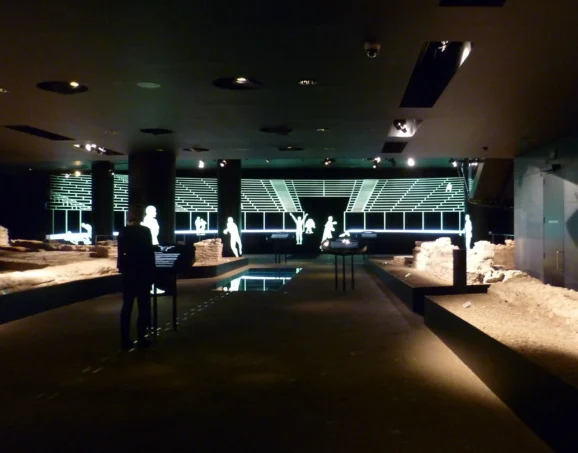
London’s Roman Amphitheatre was Londinium’s public arena, where thousands of people gathered for gladiatorial contests, public executions, boxing, athletics, music and religious ceremonies.
The first amphitheatre was built in timber in about AD 70. Around AD 100, it was enlarged and rebuilt with a stone wall surrounding the central arena and stone-lined entrances. When Londinium’s defensive wall was constructed around AD 200, the amphitheatre was enclosed within the city. This was unusual because Roman arenas were generally built beyond urban walls. The amphitheatre eventually disappeared beneath later buildings and remained lost until 1988, when archaeologists discovered a section of its arena wall during construction of Guildhall Art Gallery.
A curved line of dark paving across Guildhall Yard now marks the position of the arena’s outer wall. Inside the gallery, visitors can descend several metres below the modern City to see the surviving eastern entrance, sections of stone wall and parts of the wooden drainage system. The waterlogged ground preserved some of the Roman timbers for almost 2,000 years. Lighting and projections help reveal the original shape of the structure.
Entry to Guildhall Art Gallery and the amphitheatre is free. The attraction is normally open daily from 10am to 5pm, with last admission at 4.45pm. Advance booking is encouraged, although walk-in visitors are admitted when capacity allows. Note that the gallery occasionally closes for civic and private events, so visitors should check its website before travelling.
St Alphage Garden and London Wall Place
Where: St Alphage Garden, London Wall, London EC2Y
Nearest stations: Moorgate or Barbican
Getting there: Leave Guildhall Yard through Aldermanbury, turn into Love Lane and follow Wood Street across London Wall
Current access: Free outdoor public space; no booking required
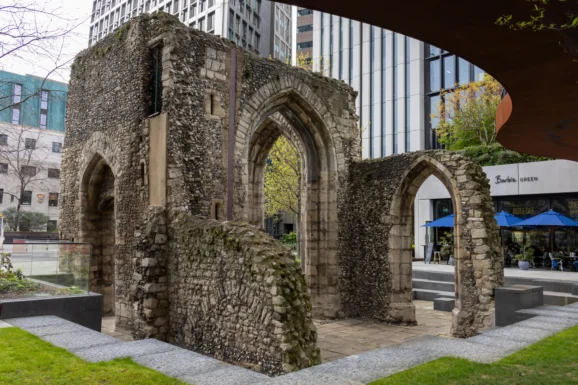
St Alphage Garden stands on the line of the northern wall of the Roman fort at Cripplegate, which was later incorporated into Londinium’s wider city defences.
The fort was built between about AD 120 and 150 at the north-western corner of the city. When the main London Wall was constructed towards the end of the second century, the fort’s existing northern and western walls were thickened and absorbed into it.
The Roman masonry at St Alphage Garden no longer survives above the present ground level. Archaeological excavations have shown that the Roman fort wall and city wall remain buried beneath the medieval structure. The masonry visible in the garden is medieval rebuilding constructed over the earlier Roman defences. Several periods of repair can be identified in its rough ragstone, flint and reused tile.
Its brick crenellations are thought to date from major repairs ordered by Lord Mayor Ralph Jocelyn in 1477 during the Wars of the Roses. They are the only surviving medieval crenellations on London Wall. The site also contains the remains of the medieval church of St Alphage, which was built against the wall and used it as its northern side. The surviving central tower is constructed from flint and rubble masonry.
From the garden, visitors can continue through London Wall Place and its raised walkways. The modern Corten-steel bridges were completed as part of the development in 2018 and reinterpret the network of highwalks planned for the City during the 1960s. The bridges pass through landscaped gardens and provide elevated views of the wall, the church ruins and the surrounding Barbican district.
The gardens and walkways are free public spaces and require no booking.
The Roman fort at Noble Street
Where: Noble Street, London EC2V 7EE
Nearest stations: Barbican, Moorgate or St Paul’s
Getting there: Follow the highwalk west from St Alphage and descend towards Noble Street
Current access: Outdoor remains are free to view; the underground fort gate is accessible only through selected pre-booked tours
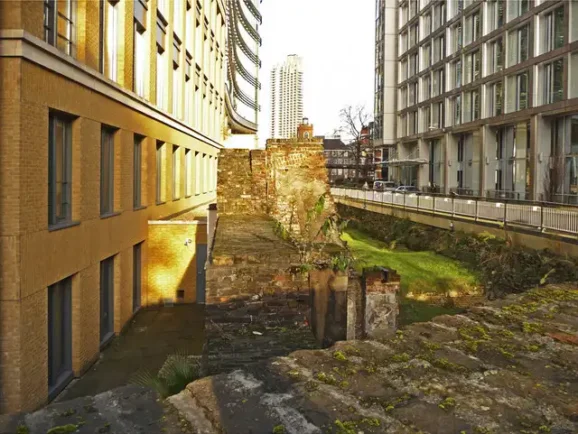
The remains beside Noble Street formed part of the western side of the Roman fort that occupied the north-western corner of Londinium.
The fort was built between about AD 120 and 150. It covered approximately 12 acres, measured about 200 metres along each side and had room for as many as 1,000 soldiers. When London Wall was built later in the second century, the fort’s northern and western defences were thickened and incorporated into the city wall. The structure continued to be repaired and altered during the medieval period. Later houses and other buildings used the ancient wall as foundations.
Bombing during the Second World War destroyed many of those buildings and exposed parts of the earlier masonry. Excavations during the 1940s and 1950s revealed the relationship between the fort and the later city defences. At the southern end of the Noble Street site, the two structures separate. The fort wall turns east through a right angle, while the later city wall turns west.
Around 80 metres of Roman and medieval walling survives in the area, together with parts of two internal fort turrets and the foundations of a later bastion. The tallest standing section is largely medieval, although Roman facing stones and part of a bonding-tile course survive above garden level opposite Oat Lane. The remains sit among later property walls, vegetation and modern buildings, showing how the ancient defences were repeatedly absorbed into the growing City.
The outside remains can be viewed free from Noble Street. The fort’s western gate survives in a viewing chamber beneath London Wall. It can be visited only through selected pre-booked London Museum tours and is not open for routine public access.
London Museum
Where: Smithfield, London EC1 9AG
Nearest station: Farringdon
Getting there: Continue west from Noble Street towards Smithfield Market
Opening: 28 November 2026
Current access: Not yet open
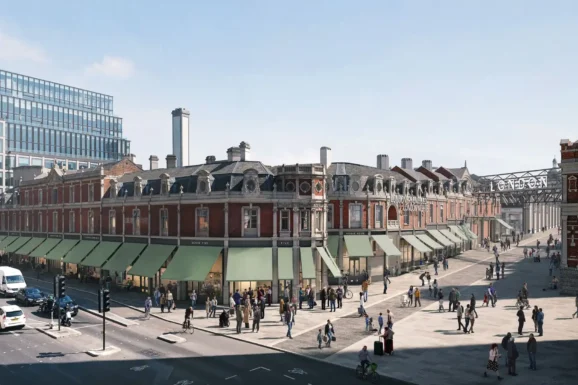
London Museum is the new home of the collection formerly displayed at the Museum of London’s Barbican building. Its free permanent galleries will open inside Smithfield’s restored Victorian General Market on 28 November 2026, the museum’s 50th anniversary.
The building has been out of public use for more than 30 years and has undergone a decade-long restoration. The museum’s Roman collection will tell the story of Londinium through objects recovered from beneath the modern city.
Among the exhibits will be writing tablets found during excavations for Bloomberg’s headquarters. Preserved by the waterlogged ground around the Walbrook, they record names, business dealings and messages written by some of the earliest Londoners whose words survive. The tablets form part of the Bloomberg Collection, a group of more than 14,000 Roman objects donated to the museum. A Roman floor mosaic and sections of painted wall plaster will also return to public view after around 2,000 years.
The permanent historical displays will occupy cavernous subterranean galleries beneath the restored market. Admission to the permanent galleries will be free. London Museum is closed to visitors until 28 November 2026. Farringdon, served by the Elizabeth line, Thameslink and the Circle, Hammersmith & City and Metropolitan lines, is the nearest station.
READ MORE: Jung Chang on London, exile and the mother who made Wild Swans possible. The international bestselling author of Wild Swans speaks to The European about her new book Fly, Wild Swans, her life in London with her brother, and the debt she owes to her late mother.
Do you have news to share or expertise to contribute? The European welcomes insights from business leaders and sector specialists. Get in touch with our editorial team to find out more.