Global fraud summit told AI scams and sextortion are driving industrial-scale crime

John E. Kaye
- Published
- News, Technology
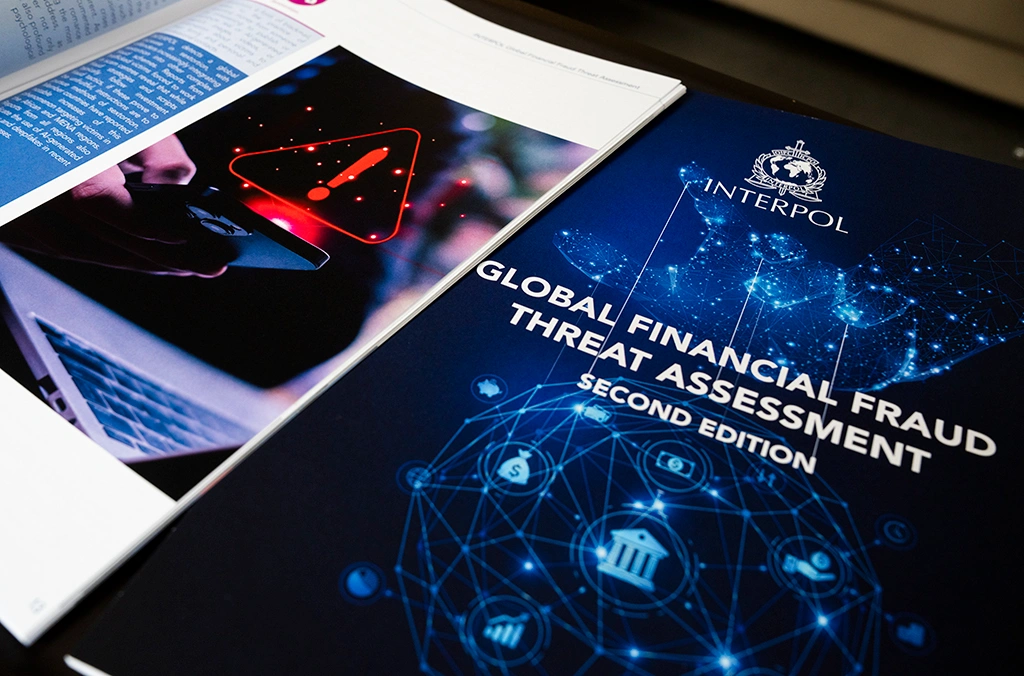
INTERPOL and the UN are bringing together more than 1,300 officials, police, tech firms and private-sector leaders this week amid growing alarm over AI-enhanced fraud, worldwide scam centres and the mounting human cost of financial crime
More than 1,300 officials, police, tech firms and private-sector leaders gather for the Global Fraud Summit today as INTERPOL warns that AI-enhanced scams, sextortion and worldwide scam centres are accelerating financial crime on an industrial scale.
The two-day summit, held on 16 and 17 March and jointly organised by INTERPOL and the United Nations Office on Drugs and Crime, comes alongside the release of INTERPOL’s 2026 Global Financial Fraud Threat Assessment.
The report says financial fraud has become one of the world’s fastest-growing and most damaging forms of transnational crime, with direct links to organised crime, cybercrime, human trafficking and, in parts of Africa, terrorist financing.
INTERPOL estimates global losses from financial fraud reached US$442 billion in 2025 and ranks the worldwide threat as high, with further escalation expected over the next three to five years.
It says criminal networks are using artificial intelligence, cheap digital tools and specialist money-laundering partners to expand operations across multiple jurisdictions.
Among the assessment’s most worrying findings is that AI-enhanced fraud is now estimated to be 4.5 times more profitable than conventional methods.
According to INTERPOL, so-called ‘agentic AI’ systems can autonomously run major parts of a fraud campaign, from reconnaissance and credential harvesting to target selection, ransom calculations and tailored messages to victims.
Dark web marketplaces are also selling voice and face cloning tools created from only seconds of genuine audio or video, allowing criminals to impersonate trusted contacts or public figures with growing realism.
The report says sextortion is increasingly being used within romance and investment scams, with deepfakes and AI-generated content helping offenders adapt their tactics. Workers trafficked into scam centres have reported being told to switch to sextortion when other fraud methods fail.
INTERPOL says scam centres, once seen mainly as a South East Asian problem, now represent a global criminal model. It also warns that hybrid fraud tactics are becoming more common, with investment scams, impersonation fraud and romance schemes combined in layered operations that can target victims repeatedly. Those who lose money may later be approached by fake recovery agents, bogus law firms or sham investigators and defrauded again.
The organisation says financial fraud now sits among the top five global crime threats facing law enforcement.
INTERPOL has now launched Operation Shadow Storm, a new international task force funded by the UK Home Office aimed at targeting the criminal networks behind large-scale fraud.
The initiative will reportedly focus on the infrastructure supporting scam centres and the organised crime groups linking online fraud with cybercrime and human trafficking for forced criminality.
INTERPOL says the operation will draw on its global policing network and tools such as the I-GRIP stop-payment mechanism to help authorities identify fraudulent transactions and intervene before stolen money disappears across borders.
Valdecy Urquiza, its Secretary General said: “Enabled by artificial intelligence, low-cost digital tools and increased global criminal collaboration, we are witnessing the industrialization of fraud.”
Urquiza said stronger cooperation between law enforcement, the private sector and public awareness efforts would be central to tackling the threat.
He added: “It is vital to remember that the cost of financial crime is not just money – it is people’s life savings, their dignity, and in the worst case, their life.”
READ MORE: ‘How AI agents are supercharging cybercrime‘. AI agents capable of acting on their own are being deployed to scan networks, launch attacks, and bypass traditional security systems. Steve Durbin of the Information Security Forum explains how this technology is reshaping the cyber threat landscape — and what organisations need to do to stay ahead.
Do you have news to share or expertise to contribute? The European welcomes insights from business leaders and sector specialists. Get in touch with our editorial team to find out more.
Main image: INTERPOL
TOP STORIES
-
 France calls in army after riots sweep cities
 -
An Italian affair – Stanley Johnson takes London's society set on the Silk Road
-
Himalayan mountainside moved 40cm before avalanche killed 1,451 in Nepal, scientists reveal
-
Scientists and engineers quitting jobs as AI changes roles ‘beyond recognition’, study finds
-
UK profit warnings hit near two-year high as businesses struggle with rising costs
-
Microsoft pulls out of major UK AI data centre project amid power grid delays
-
Russia takes control of more European corporate assets amid Ukraine tensions
-
EU leaders resist calls to delay carbon rules as energy costs soar
-
‘A big step forward’ – PM Andy Burnham hails plans for Great British Railways HQ in Derby
-
UK economy grows just 0.1 per cent as construction falls and services stall
-
Germany risks losing €155bn a year under tighter AI data rules, new study warns
-
Pope Leo XIV diagnosed with lung cancer after surgery in Rome
-
France faces freezer meltdown as hackers strike supermarket chains
-
Bumble shares soar 50% amid $1bn takeover talks
-
China slump drives Volkswagen to sharpest quarterly fall in more than four years
-
Hollywood mega-powerhouse created as Paramount completes Warner Bros Discovery takeover
-
Gamers face gridlock as latest Grand Theft Auto download 'nears two days'
-
Samsung profits soar ninefold to record £61bn amid AI chip boom
-
New Springer books put the UN’s struggling sustainability goals to the real-world test
-
Europe’s solar boom set for two-year slowdown after record growth
-
Let it pea. Musicians turn vegetables into instruments at Beatles' Abbey Road studios
-
Golden naked Trump statue unveiled at European Parliament
-
Jaguar puts controversial rebrand on the road with £130K 1,030PS Type 01
-
Deepfakes and identity fraud drive new wave of post-hire background checks
-
Spain crowned Europe’s top retirement destination