‘Lost’ zip design could give space exploration a lift

John E. Kaye
- Published
- News, Technology
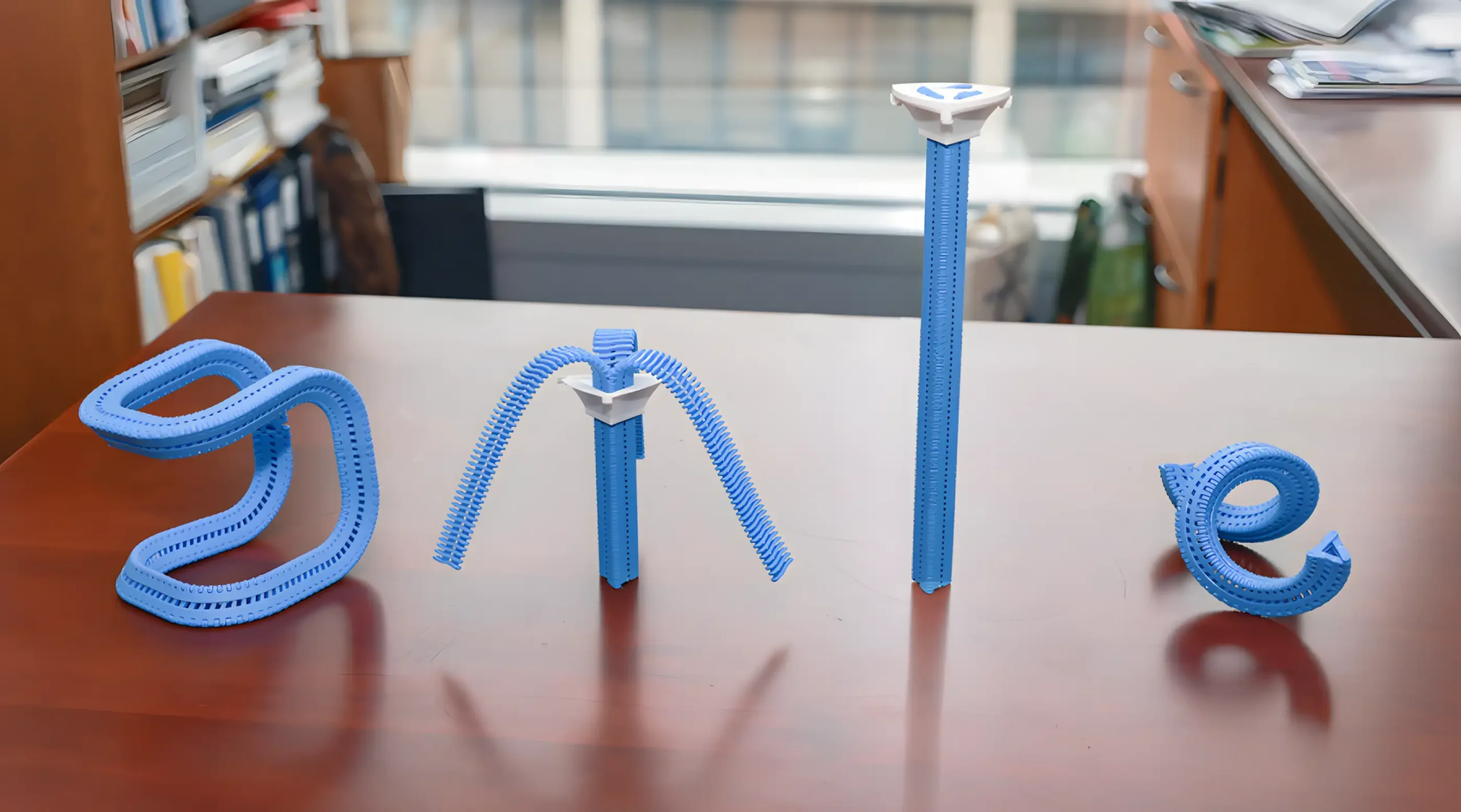
MIT researchers have revived a rejected three-sided zip design first proposed four decades ago, creating a fastener that can turn flexible strips into strong structures for possible use in spacecraft, robotics, tents and medical supports
A forgotten zip design from 40 years ago could one day help transform space exploration after MIT researchers brought the abandoned concept to life.
Researchers say their new three-sided fastener could help spacecraft grab rock samples, while also opening up possible uses in tents, robots and medical supports back on Earth.
The design, known as the ‘Y-zipper’, allows flexible strips to lock into a load-bearing form in seconds.
Unlike an ordinary zip, which fastens two sides together, the Y-zipper locks three separate strips into a triangular structure that can support weight and hold together under pressure.
The concept was first put forward 40 years ago by William Freeman, now an MIT professor, who patented the design and stored the prototype in his garage after the original proposal was rejected.
Experts have now revived the Y-zipper using 3D printing and digital design tools, turning the old concept into a working device that can be opened and closed by hand or using motorised actuation.
According to MIT, the design has already been used in prototypes including tent frames that can be packed flat and zipped into place, a wrist support that can be loosened during the day and tightened at night, a quadruped robot with adjustable leg height, and a kinetic flower installation that “bloomed” as the structure closed.
In one test, a tent that would normally take up to six minutes to pitch alone could be put up in 1 minute 20 seconds using the Y-zipper.
But researchers say the device – which withstood 18,000 cycles of opening and closing in tests before finally snapping – could also be used in space.
Its three separate sides could act like “tentacles”, reaching around an object before closing together.
Once zipped, those three sides would lock into a stronger form that could help grip, support or secure nearby rock samples.
MIT researcher Jiaji Li said: “A regular zipper is great for closing up flat objects, like a jacket, but Freeman ideated something more dynamic. Using current fabrication technology, his mechanism can transform more complex items.
“We’ve developed a process that builds objects you can rapidly shift from flexible to rigid, and you can be confident they’ll work in the real world.”
The work was published in the proceedings of the 2026 CHI Conference on Human Factors in Computing Systems in a paper by Jiaji Li, Xiang Chang, Mingming Li, Dingning Cao, Maxine Perroni-Scharf, Jeremy Mrzyglocki, Takumi Yamamoto, William Freeman and Stefanie Mueller.
READ MORE: Breitling launches £9,500 Artemis II watch as Moon crew returns to Earth. The luxury watchmaker has released a 450-piece Cosmonaute edition to mark NASA’s record-setting Artemis II mission, which ended with a Pacific splashdown on Friday after the first crewed journey around the Moon in more than 50 years.
Do you have news to share or expertise to contribute? The European welcomes insights from business leaders and sector specialists. Get in touch with our editorial team to find out more.
Main image: A prototype of MIT’s Y-zipper, a three-sided fastener that can turn flexible strips into load-bearing structures. Credit: MIT.
TOP STORIES
-
 France calls in army after riots sweep cities
 -
An Italian affair – Stanley Johnson takes London's society set on the Silk Road
-
Himalayan mountainside moved 40cm before avalanche killed 1,451 in Nepal, scientists reveal
-
Scientists and engineers quitting jobs as AI changes roles ‘beyond recognition’, study finds
-
UK profit warnings hit near two-year high as businesses struggle with rising costs
-
Microsoft pulls out of major UK AI data centre project amid power grid delays
-
Russia takes control of more European corporate assets amid Ukraine tensions
-
EU leaders resist calls to delay carbon rules as energy costs soar
-
‘A big step forward’ – PM Andy Burnham hails plans for Great British Railways HQ in Derby
-
UK economy grows just 0.1 per cent as construction falls and services stall
-
Germany risks losing €155bn a year under tighter AI data rules, new study warns
-
Pope Leo XIV diagnosed with lung cancer after surgery in Rome
-
France faces freezer meltdown as hackers strike supermarket chains
-
Bumble shares soar 50% amid $1bn takeover talks
-
China slump drives Volkswagen to sharpest quarterly fall in more than four years
-
Hollywood mega-powerhouse created as Paramount completes Warner Bros Discovery takeover
-
Gamers face gridlock as latest Grand Theft Auto download 'nears two days'
-
Samsung profits soar ninefold to record £61bn amid AI chip boom
-
New Springer books put the UN’s struggling sustainability goals to the real-world test
-
Europe’s solar boom set for two-year slowdown after record growth
-
Let it pea. Musicians turn vegetables into instruments at Beatles' Abbey Road studios
-
Golden naked Trump statue unveiled at European Parliament
-
Jaguar puts controversial rebrand on the road with £130K 1,030PS Type 01
-
Deepfakes and identity fraud drive new wave of post-hire background checks
-
Spain crowned Europe’s top retirement destination