World’s robotics leaders to gather in Germany in race to put AI to work

Ian Copeland
- Published
- News, Technology
From humanoid factory workers to robots that learn new tasks, some of the biggest names in artificial intelligence and robotics are heading to Germany next week to tackle the obstacles standing between experimental machines and widespread industrial use
Some of the world’s leading robotics and AI firms will gather in Germany next week for a major international conference aimed at bringing humanoid robots out of the laboratory and into everyday industrial use.
The Advanced Robotics Conference 2026 (ARC) will bring together technology developers, manufacturers and researchers to examine how the latest generation of intelligent machines can be made reliable, safe and affordable enough for widespread commercial deployment.
Nine different robotic systems will be demonstrated, including humanoid machines from Chinese manufacturers Unitree and AGIBOT, four-legged robots, mobile platforms and intelligent robotic arms.
Hosted by German engineering group FEV, the two-day event will examine physical AI, which allows machines to interpret and respond to their surroundings, and the technical advances needed to make increasingly autonomous robots practical for factories and other workplaces.
Among those taking part are experts from NEURA Robotics, Hugging Face, Schaeffler, Infineon Technologies, Humanoid, Synapticon, Wandelbots, Enchanted Tools, Sereact and the Fraunhofer Institute for Manufacturing Engineering and Automation.
The programme will cover robots capable of learning new tasks, advances in sensors and control systems, and the challenge of integrating intelligent machines into existing industrial operations.
Europe’s ability to compete in the developing global humanoid robotics market will also be examined at the event held in Aachen on 25 and 26 November.
Dr Dominik Lückmann, the chief innovation officer at FEV Group, said: “The value of a robot ultimately depends on its ability to perform a specific task reliably and at an economically viable cost.
“To achieve this, artificial intelligence, hardware, and system integration must work together seamlessly.”
Investment in humanoid robotics has surged, with $2.65 billion invested in start-ups worldwide in 2025, according to figures reported by the International Federation of Robotics.
But despite the investment, commercial adoption remains limited, with manufacturers still confronting problems involving cost, reliability, dexterity and safety.
Many advanced humanoid systems remain in development or are undergoing industrial trials, experts say.
Lückmann added: “With ARC, we bring together developers, suppliers, and end users to discuss the key challenges that need to be overcome for the widespread adoption of humanoid robotics.”
READ MORE: GrayMatter Robotics opens 100,000-sq-ft AI robotics innovation centre in California. A new US$85 million innovation hub in California aims to make “physical AI” — robots that can learn and adapt to complex manufacturing tasks — the next frontier of industrial automation, as US firms race to reshore production and close the skills gap in advanced manufacturing.
Do you have news to share or expertise to contribute? The European welcomes insights from business leaders and sector specialists. Get in touch with our editorial team to find out more.
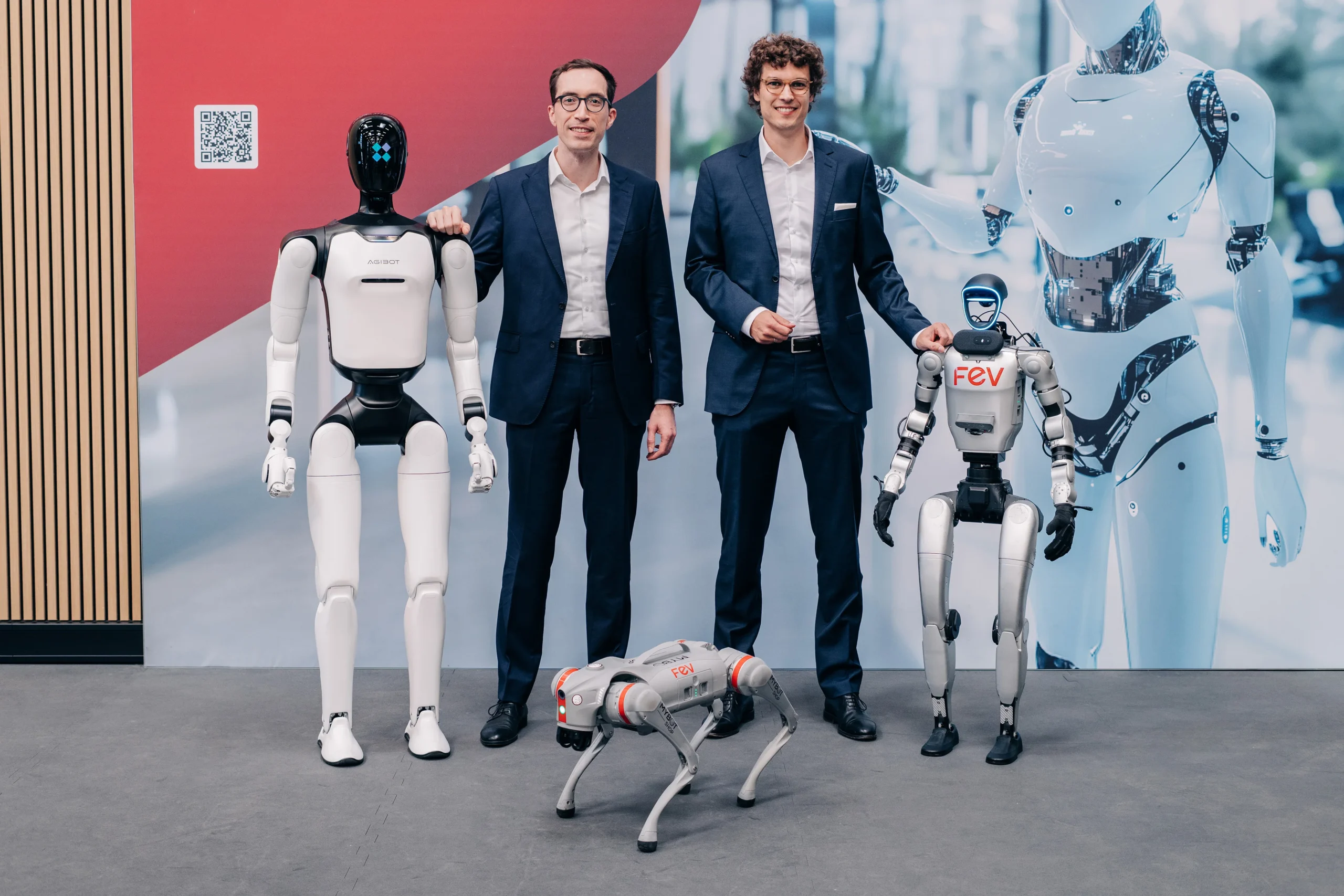
Main image: FEV’s Dominik Boemer (left), Senior Manager Advanced Robotics, and Dr Dominik Lückmann, Chief Innovation Officer, alongside advanced robotic systems. The German engineering group will host international technology leaders in Aachen next week to explore how humanoid robots and artificial intelligence can be deployed more widely in industry. Credit: FEV
TOP STORIES
-
 The sky’s the limit for flying cars but expert warns of deadly risks
-
Meet the seven Anthropic founders worth $23bn each after record-breaking stock market debut
-
World's robotics leaders to gather in Germany in race to put AI to work
-
Britain's most expensive seaside resort dominates £2m property sales
-
Beavers return to Loch Ness after 500 years
-
Swiss data centre to heat homes using waste energy from AI servers
-
Uzbekistan attracts $44.1bn in foreign investment and loans in nine months
-
Serko raises revenue forecast as Booking.com business travel bookings surge
-
Air India and Airbus unveil India's first corporate green aviation fuel scheme
-
Best Western loyalty scheme to be scrapped in major hotel rewards shake-up
-
First class delivery: China's postal service puts humanoid robots to work across eight cities
-
AI set to transform university librarians' jobs as 95% predict surge in demand
-
Washington Dulles unveils new concourse as $20bn airport expansion takes off
-
The European Autumn 2026 edition – out now
-
WATCH: Greenpeace drops giant David Attenborough boulder into North Sea – on site of £12bn windfarm
-
Himalayan nations demand urgent action as UN warns of irreversible glacier losses
-
6,000 march against ‘monstrous’ AI data centres as Scotland faces building boom
-
Shop till Ai drop? AI agents set to buy for us as tech boss warns of retail revolution
-
Specs appeal: Welsh Parliament bans smart glasses
-
European motoring legends behind Mercedes, BMW and McLaren to enter Hall of Fame
-
Putin 'plotting to break NATO without firing a shot', Latvian military analyst warns
-
British AI chip startup hits £5bn valuation as government backs bid to challenge global tech giants
-
World's biggest military airshow moves to ‘Britain’s Area 51’ after Iran war disruption at RAF Fairford
-
Lisa Nandy threatens crackdown on entertainment industry after David Walliams allegations
-
UK and European experts demand tougher AI laws as Australia considers criminal penalties after OpenAI breach