GrayMatter Robotics opens 100,000-sq-ft AI robotics innovation centre in California

Marco Ryan
- Published
- News, Technology
A new US$85 million innovation hub in California aims to make “physical AI” — robots that can learn and adapt to complex manufacturing tasks — the next frontier of industrial automation, as US firms race to reshore production and close the skills gap in advanced manufacturing
GrayMatter Robotics has opened a new 100,000-square-foot headquarters and innovation centre in Carson, California, described as the most advanced “physical AI” robotics hub in the United States.
The US$85 million expansion marks a major step in the Los Angeles-based company’s growth, bringing more than 100 new high-skilled jobs in artificial intelligence, robotics, and manufacturing engineering, with plans to add hundreds more in the coming years.
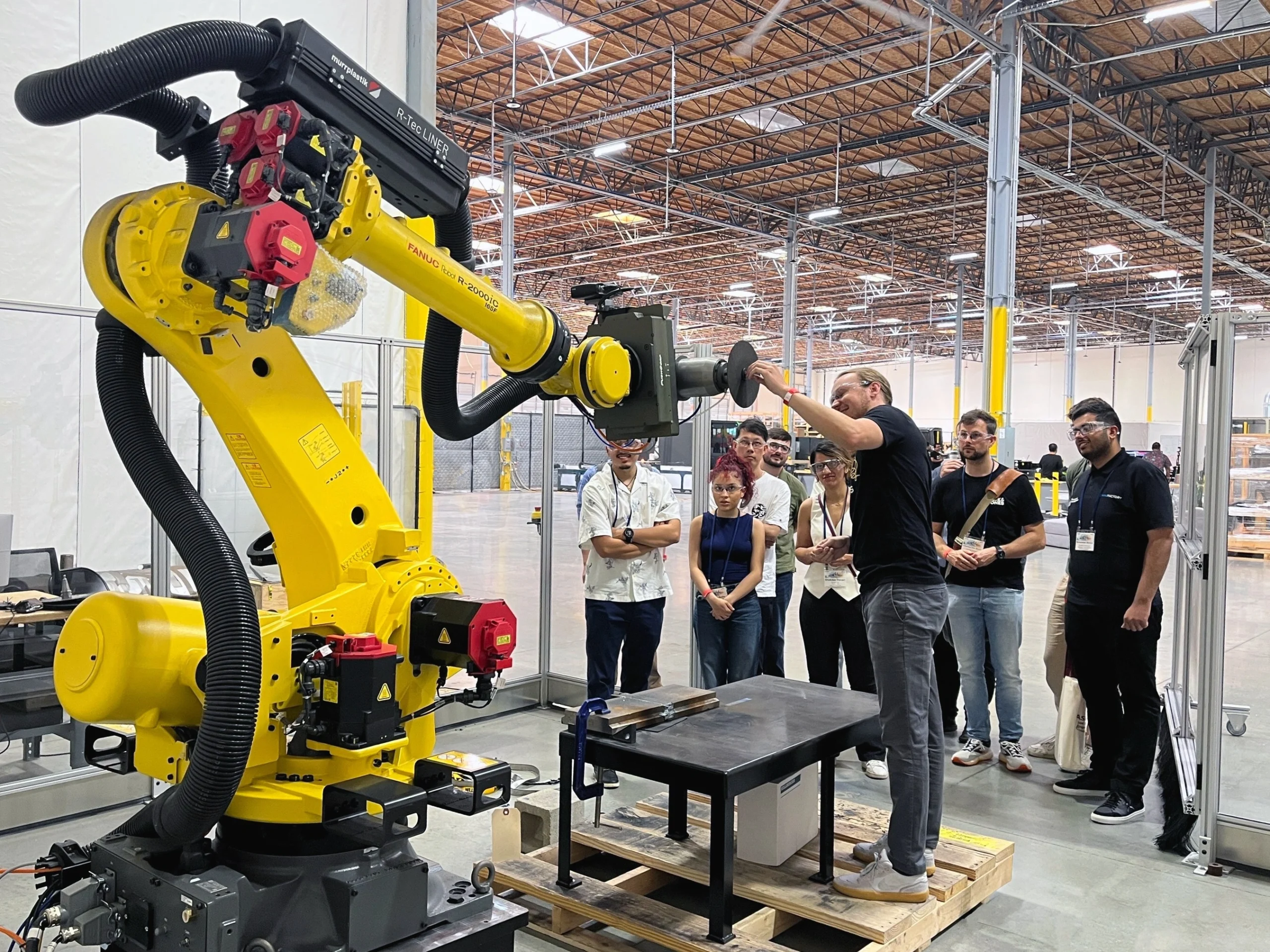
The state-of-the-art facility features over 25 robotic cells performing live manufacturing operations, allowing visitors and customers to see AI-driven automation in action.
Each robot can scan an object it has never encountered before, programme itself in less than a minute, and begin working to aerospace-grade precision, a process GrayMatter calls “physical AI”.
“This facility represents more than just a headquarters — it is our commitment to bringing advanced manufacturing back to American soil and to the South Bay region specifically,” Ariyan Kabir, CEO and co-founder of GrayMatter Robotics, said. “We chose Carson for its proximity to aerospace, marine, and other manufacturing clusters, access to world-class port infrastructure, and most importantly, its skilled workforce. This is where the factories of the future are being built.”
The company’s proprietary GMR-AI™ technology uses physics-informed algorithms to enable robots to understand forces, materials and tool behaviour without manual programming.
Chief Scientist and co-founder Satyandra K. Gupta said: “While a language model can write you an essay, our physical AI can autonomously figure out how to finish a never-before-seen aerospace component to aerospace-grade specifications. That’s AI operating in the physical realm with real-world consequences.”
Fast Company recently named GrayMatter Robotics one of the Most Innovative Companies in Robotics and Engineering 2025, recognising its role in bringing automation to “high-mix” manufacturing environments where each part differs.
Backed by major investors including Wellington Management, the company has developed partnerships with FANUC — whose robotic platforms underpin GrayMatter’s systems — and 3M, whose abrasives technology is integrated into its surface-finishing cells.
“The opening of GrayMatter Robotics’ new headquarters reflects their growth and demonstrates their commitment to reshaping industrial automation,” Mike Cicco, President and CEO of FANUC America, said.
Alejandro Martinez, President of 3M’s Abrasive Systems Division, added: “By combining 3M’s expertise in abrasive products and processes with GrayMatter’s intelligent automation solutions, we can deliver enhanced value through consistent and quality results to our shared customers.”
The Carson facility will also serve as a workforce-development centre, hosting student tours and technical workshops, as part of what the company calls a “manufacturing renaissance” in Southern California.
“Five years ago, what we’re doing was considered impossible,” Kabir added. “Today, it’s transforming manufacturing. Five years from now, physical AI will be as fundamental to production as digital automation is today. This facility is where we’re building that future.”
READ MORE: ‘GITEX GLOBAL 2025 to spotlight AI’s expanding role in future-critical sectors’. The world’s largest technology and AI event returns to Dubai this month for its 45th edition, bringing together more than 6,800 companies and 2,000 startups from 180 countries to showcase breakthroughs in biotech, quantum computing, semiconductors and data infrastructure.
Do you have news to share or expertise to contribute? The European welcomes insights from business leaders and sector specialists. Get in touch with our editorial team to find out more.
Main image: GrayMatter Robotics’ new headquarters features more than 25 robotic cells actively performing real manufacturing operations on current and prospective customer and partner parts. Credit: GrayMatter Robotics
TOP STORIES
-
 North Korean agents are infiltrating Western businesses by posing as employees, security chief warns
 -
Route 66 turns 100 next month – and there’s never been a better excuse for Europeans to hit the road
-
Serbia erupts in celebration as student protesters end Vučić’s 14-year grip on power
-
Two killed as Storm Boelo batters Britain with 85mph winds and leaves 90,000 homes without power
-
Man arrested on suspicion of arson after fire destroys Hitler’s Eagle’s Nest retreat
-
Britain faces higher winter energy prices as reliance on European electricity imports grows
-
Andy Burnham to make special Gogglebox appearance for Stand Up To Cancer
-
WPSL Golf targets £120 million valuation as billionaire-backed corporate deals and other commercial deals drive explosive global growth
-
Hackers could bring Britain’s essential services to a standstill, security chief warns after global website shutdowns
-
We’re talking to almost twice as many people on the phone as a decade ago, study finds
-
TalkTalk sells majority stake in Telecom Acquisitions as founder Nigel Barnett regains control
-
Company closures soar ahead of tax rises as new Budget looms
-
An Italian affair – Stanley Johnson takes London’s society set on the Silk Road
-
Himalayan mountainside moved 40cm before avalanche killed 1,451 in Nepal, scientists reveal
-
Scientists and engineers quitting jobs as AI changes roles ‘beyond recognition’, study finds
-
UK profit warnings hit near two-year high as businesses struggle with rising costs
-
Microsoft pulls out of major UK AI data centre project amid power grid delays
-
Russia takes control of more European corporate assets amid Ukraine tensions
-
EU leaders resist calls to delay carbon rules as energy costs soar
-
‘A big step forward’ – PM Andy Burnham hails plans for Great British Railways HQ in Derby
-
UK economy grows just 0.1 per cent as construction falls and services stall
-
Germany risks losing €155bn a year under tighter AI data rules, new study warns
-
Pope Leo XIV diagnosed with lung cancer after surgery in Rome
-
France faces freezer meltdown as hackers strike supermarket chains
-
Bumble shares soar 50% amid $1bn takeover talks