Jung Chang’s brother Zhang Pu steps out from the long shadow of Wild Swans with his first English-language novel, a haunting Tibetan love story set against the unrest in Lhasa and the private grief of a family still shaped by China’s history, writes John E. Kaye
Zhang Pu has spent much of his literary life close to a book that changed the way millions of readers saw modern China. His sister Jung Chang’s Wild Swans turned one family’s private history into an international publishing phenomenon, and Zhang helped carry that story into Chinese by translating it for readers beyond the mainland.
“Wild Swans changed the life of our family,” Zhang tells me from his home in central London. “For many years, our own story had belonged only to us, and suddenly it belonged to readers all over the world. I was proud of my sister, and I was moved by the courage it took to write with such honesty about our mother, our grandmother and the China they lived through.
“Translating it into Chinese was very personal for me. It meant carrying those voices back into the language in which that life had been lived.”

This week, Zhang steps out of the Wild Swans spotlight with his first English-language novel. A Tibetan Girl Called Ata, written under his pen name Xiao Hei, is published in Britain by Bamboo Scroll Books.
He shared the book with The European less than a fortnight after the death of his mother, Xia Dehong, also known as Bao Qin, who died in Chengdu on April 15.
Bao Qin was one of the three women at the heart of Wild Swans, alongside Jung Chang and Jung’s grandmother.
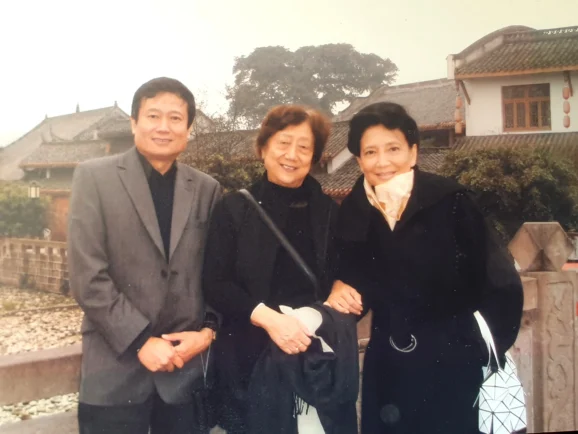
“I spoke to her about A Tibetan Girl Called Ata not long ago,” Zhang says. “She was pleased that it was coming out in English. She knew how much the story meant to me, and she was happy that readers outside China would now be able to read it.”
Like Wild Swans, Zhang’s book is a powerful and poignant tour de force that uses private lives to tell a larger story about modern China and the unrest in Lhasa, tracing the damage caused when politics enters the family, the bedroom and the most intimate choices people make.
Whereas Jung Chang’s book followed three generations of women through the upheavals of the 20th century, Zhang’s work narrows the focus to one doomed relationship between a Han Chinese man, Han Ge, and a Tibetan woman called Ata.
The pair meet in Chengdu in the spring of 2008, when a routine antiques deal in a Tibetan bar becomes the start of an obsessive and unequal love affair. He is a divorced Han Chinese trader with money, contacts and an instinct for risk, while she is a young Tibetan singer whose beauty, nerve and fierce independence quickly unsettle his confidence. What begins with a deal for a gilded Buddha statue soon becomes a courtship shaped by desire, family mistrust and the fraught politics between Han Chinese and Tibetan life.

The early chapters are bristling with energy and realism thanks to Zhang’s vivid descriptions of Chengdu and its teahouses, card tables, late meals, bars, gossip, favours and the small embarrassments of traditional courtship. Han Ge moves through this world with the confidence of a Han Chinese man used to reading and understanding the people he deals with. Ata, however, is a mystery. She runs a shop selling Tibetan lamps and handicrafts near the Marquis Wu Temple, sings in Tibetan bars, flirts with nerve and humour, and remains tied to family, faith, butter tea, Buddhist beads and the authority of her Master Teacher. She has learned to live in a Chinese city without being absorbed by it, and the Tibetan identity that draws Han Ge towards her is also what he struggles to understand and cannot, in the end, protect.
“I realized that Ata had already become quite the Chengdu girl: she liked hanging around in bars, knew all about Italian designer handbags and French cosmetics, could name pop stars and movie stars,” Han Ge says of her. “Still, in my view, Ata had lost none of her underlying nature. She wore Buddha beads on her wrist and an amulet hanging at her chest, and she still loved to eat tsampa and drink butter tea.”
The romance gathers pace through pursuit, teasing messages, meals, quarrels and sudden tenderness, as the prejudices around Han Ge and Ata start to intensify. Her family distrusts a wealthy older Han man entering their lives, and his friends talk about Tibetans with crude contempt. “I’ve heard the Tibetans only take a bath twice in their life,” one says. “How will you bear that smell of goats and butter? If it’s marriage you’re after, must you go for a raw-meat-eating Tibetan barbarian?”
Han Ge himself describes Han and Tibetan people in Chengdu as being separated by “an invisible high wall”, living in their own circles except when contact is unavoidable.

As the story moves towards its finale, the barrier between Han Ge and Ata becomes harder to cross. The unrest around Lhasa draws Ata’s family into danger, and her loyalty to her brother places her directly in harm’s way. Han Ge tries to protect her with money, contacts and influence, only to find that none of them can match the force of official suspicion. The closer he comes to Ata’s world, the more clearly he sees how little power he has inside it.
A Tibetan Girl Called Ata is clearly rooted in lived experience, with Zhang himself describing fiction as a “re-creation of reality” and using the novel to give human shape to the fear, prejudice and political pressure surrounding Han-Tibetan relations. It draws directly on the Lhasa unrest of 2008, when protests and riots were followed by arrests and a security crackdown, and on the uneasy reality of Han and Tibetan communities living close to one another in Chengdu.
Further background is provided by two writers who know the territory well. Xinran, author of The Good Women of China, writes in her introduction that the novel returns to “the pain and hope buried in the history and realities of Han-Tibetan relations”, while translator Esther Tyldesley’s note explains the gulf between many Han Chinese assumptions about Tibet and the suspicion faced by Tibetans, especially those whose faith connects them to the Dalai Lama. She also points to the Ministry of State Security, described as having “far-ranging powers and virtually no outside supervision”, a detail that helps explain the fear closing in on Ata’s family.
Jung Chang lends her own blessing, praising her brother’s “clear and lively style” and noting the popularity he has already won in the Chinese-speaking world. “I hope this book will find resonance among English-speaking readers,” she writes.
Speaking yesterday, Zhang said the novel had grown from his belief that love can cross many barriers, and that politics can still destroy what people most want to protect.
“Love can bring two people together across language, custom and history,” he told me. “Ata and Han Ge truly love each other, yet they live in a world where fear and prejudice are stronger than their wishes. I wanted to show the beauty of that love, and also the tragedy of a society that will not let it survive.”
A Tibetan Girl Called Ata by Zhang Pu, writing as Xiao Hei, is translated by Esther Tyldesley and published by Bamboo Scroll Books. It is the first of his three Chinese-language novels to appear in English and is out now in all good bookstores and on Amazon.
READ MORE: ‘The European Reads: DUTY: The True Story of W/O Norman Cyril Jackson VC‘. Hailed by leading military historians as one of Britain’s greatest war heroes, Flight Engineer Norman Cyril Jackson earned the Victoria Cross after climbing onto the wing of a blazing Lancaster over Germany in 1944 to save his crew. Here, The European examines Duty: The True Story of W/O Norman Cyril Jackson VC, the powerful new biography written by Jackson’s son David, which sets out the full story of that night and the life behind the medal.
Do you have news to share or expertise to contribute? The European welcomes insights from business leaders and sector specialists. Get in touch with our editorial team to find out more.