The latest instalment in Omara Williams’ monthly stargazing series charts March’s equinox skies, guiding readers through the five brightest northern stars — from Vega’s steady ascent to Rigel’s fierce blue glare — alongside the key lunar encounters and planetary highlights to watch as spring begins
As March unfolds with its vibrant colours, the Vernal Equinox heralds the arrival of spring in the Northern Hemisphere. This time of year marks a moment when daylight and darkness find balance, with day and night nearly equal in length. As the chill of winter recedes, we can revel in the warmth of milder evenings, perfect for relaxing and stargazing beneath a canopy of twinkling stars.
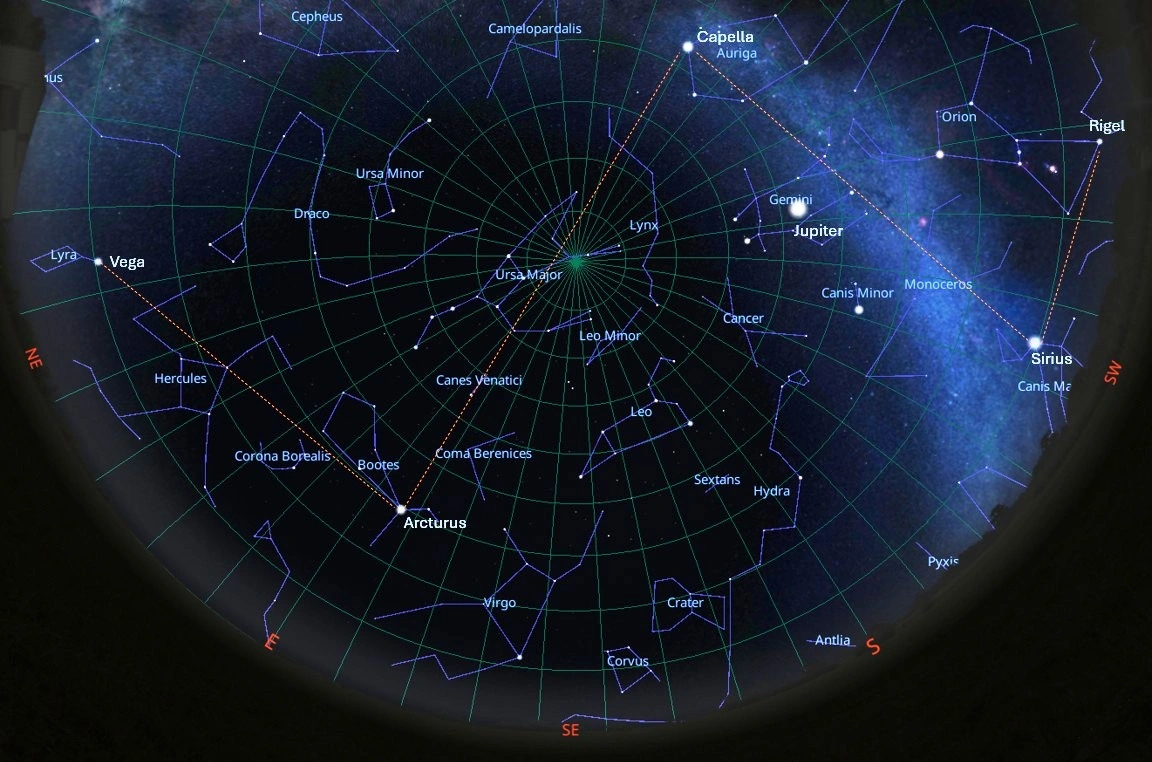
On clear nights, we are treated to a spectacular view of the five brightest stars in the Northern Hemisphere, stretching across the sky from the eastern to the western horizon. These celestial gems—Vega, Arcturus, Capella, Sirius, and Rigel—shine like diamonds scattered throughout the night sky, each pulsating with its own distinctive hue and luminosity.
This month, we will highlight these magnificent stars, exploring their fascinating nature and unique characteristics that set them apart. Each star has its own story to tell, and we will uncover the brilliance and significance that make them truly remarkable. By understanding these stars, we can deepen our connection to the cosmos and enhance our admiration and curiosity about the universe.
Vega in Lyra
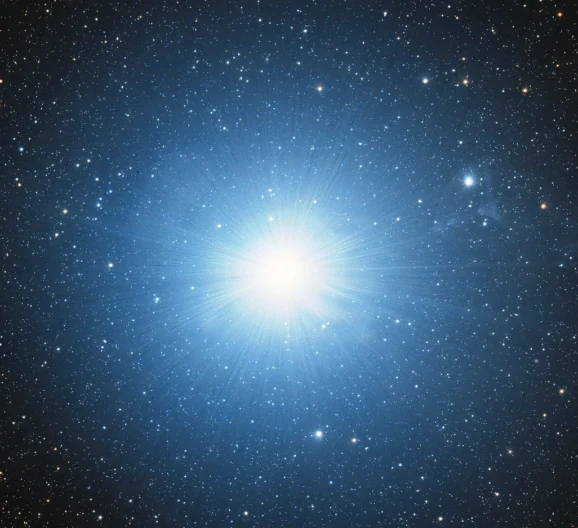
Vega, the brightest star in the Lyra constellation, is a massive, hot, and luminous white-blue star that twinkles brightly, low in the northeastern sky during March. As the days progress, Vega rises higher in the sky, leading the ascent of the Summer Triangle’s other stars, Deneb and Altair.
Vega is the third-brightest star in the northern celestial hemisphere, following Sirius and Arcturus. It is relatively close to Earth, at just 25 light-years, and was the first star (other than the Sun) to be photographed in 1850. As one of the most studied stars by astronomers, Vega is considered the next most important star in the sky after the Sun. For many years, it served as the primary reference point for calibrating the brightness scale of stars.
Vega used to serve as the northern pole star approximately 12,000 years ago, and, due to the precession, or wobble, of the Earth’s axis, it will once again assume this significant role around the year 13,727 CE. The name “Vega” is derived from an Arabic phrase that translates to “the falling eagle” or “swooping vulture”, evoking imagery of majestic birds in flight. In Greek mythology, the constellation Lyra is steeped in legend, as it is closely associated with the lyre of Orpheus, the legendary musician whose melodies were said to charm all living things.
Arcturus in Boötes
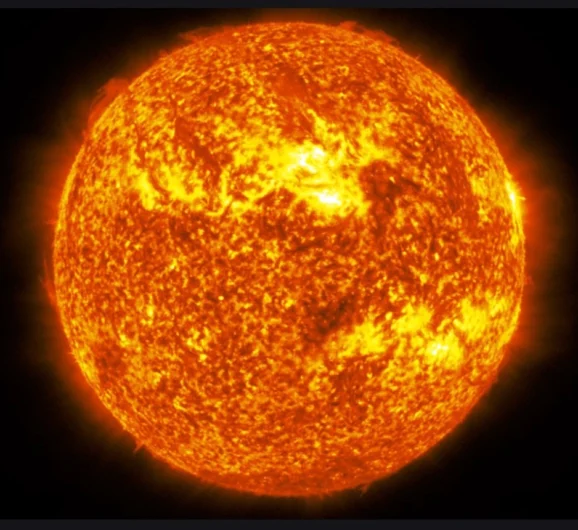
Fiery orange-red Arcturus is the standout star in the constellation of Boötes, the Herdsman. It is the second-brightest star in the northern celestial hemisphere after Sirius. An ageing, luminous giant, if it were at the centre of our solar system, its outer layers would partly extend into Mercury’s orbit. Sparkling in the southeastern sky, it is easily spotted by following the arc in the Big Dipper’s handle, away from its bowl.
Arcturus is located approximately 36.7 light-years away from Earth. In 1635, it became the first star, other than the Sun, to be observed in daylight using a telescope. Much later, in 1933, scientists directed the light from this bright star, using four telescopes and photoelectric cells, to illuminate a panel that signalled the opening of the Chicago World’s Fair. The light that triggered the cells had left Arcturus in 1893, around the time of the previous Chicago fair.
The name “Arcturus” is derived from the ancient Greek word “Arktouros”, which translates to “Guardian of the Bear.” This name reflects its position in the sky, where Arcturus appears to follow the constellations Ursa Major and Ursa Minor (the Great Bear and the Little Bear) around the north celestial pole. In Greek mythology, Boötes was the son of Demeter, the goddess of agriculture. After he helped the humans by showing them how to plough the land, the gods honoured him by placing him in the sky, near the Big Dipper.
Capella in Auriga
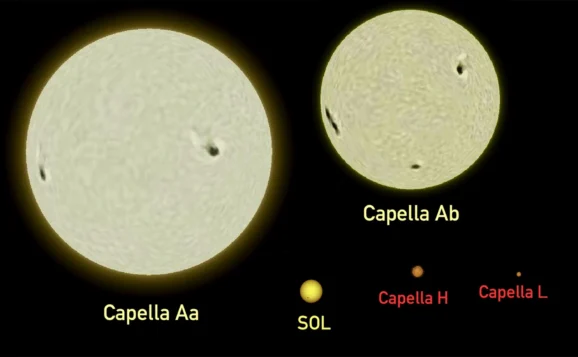
Capella is a dazzling object in the night sky with a fascinating structure. While it appears to be a single star to the naked eye, it is actually a complex system of four stars arranged in two binary pairs. Shining brightly high in the western sky during March, this circumpolar yellowish star, which never sets, is the brightest in the constellation of Auriga, the Charioteer. It ranks as the fourth-brightest star in the northern celestial hemisphere, following Sirius, Arcturus, and Vega.
This unique star system’s four stars are:
· The Giant Pair (Aa and Ab): These two yellow giants orbit each other closely, similar to the distance between Venus and the Sun.
· The Red Dwarf Pair (H and L): This fainter pair orbits the giant pair at a tremendous distance of nearly 1 trillion miles. They are small, cool stars with very low luminosity.
The two main stars in the system are so close together that ordinary equipment cannot visually distinguish them; they can only be separated using advanced technology, such as Cambridge University’s Optical Aperture Synthesis Telescope (COAST). This telescope first captured images of the two individual stars in September 1995, making Capella the first astronomical object resolved with this technology.
The name “Capella” and its association with a goat have deep roots in ancient culture. In Greek mythology, it represents the goat Amalthea, who nursed the infant god Zeus. When Zeus accidentally broke one of Amalthea’s horns, he transformed it into the “horn of plenty” (cornucopia), filling it with good things. The constellation Auriga is often depicted as a charioteer holding Capella and her kids, a reference to the small nearby triangle of stars known as “The Kids” asterism.
Sirius in Canis Major
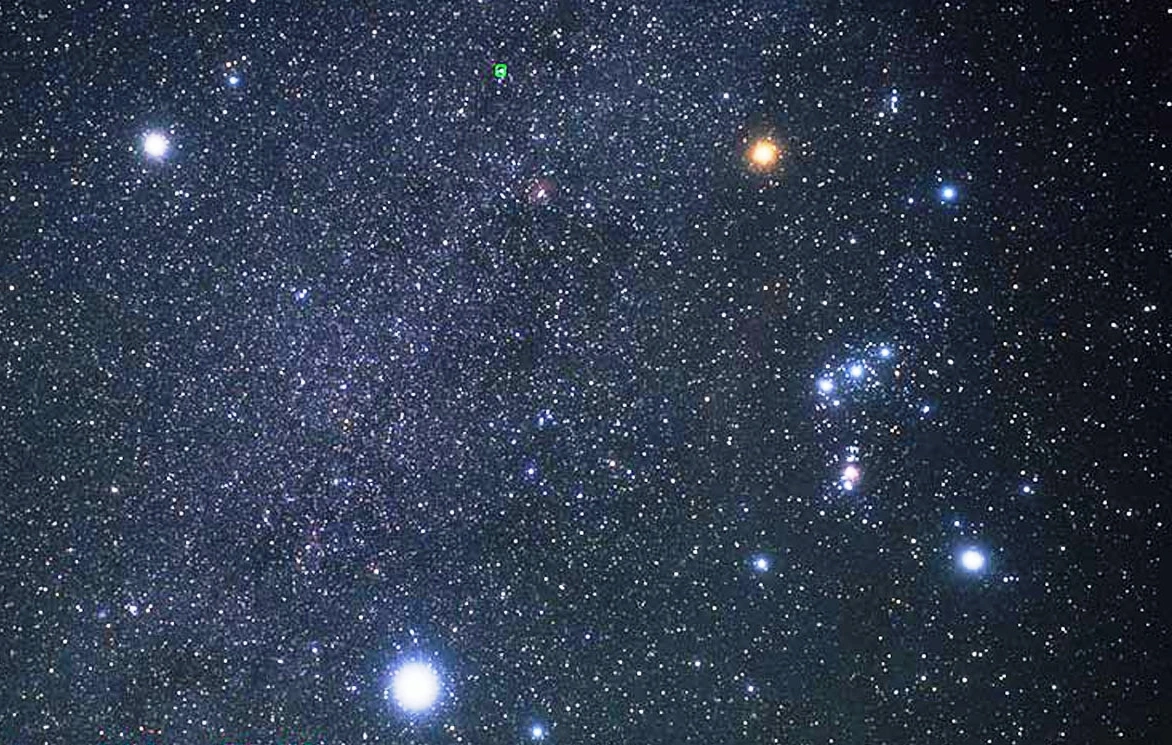
The brightest star in the night sky, Sirius, shines with vivid colours as it hangs low on the southwestern horizon. As its light passes through Earth’s dense atmosphere, it diffracts, as light does through a prism, creating a stunning display. Known as the “Dog Star” for its prominent position in the constellation Canis Major, the Great Dog, Sirius is a beacon of beauty, illuminating the night sky with its extraordinary presence.
Located 8.6 light-years away, it is one of Earth’s closest stellar neighbours. Still, even with our fastest spacecraft, it would take over 150,000 years to reach Sirius. It’s not a single star but a binary system consisting of Sirius A, a luminous, twice as massive as our Sun, and Sirius B, a faint white dwarf, roughly the same size as Earth, and the second white dwarf star ever discovered.
Sirius has played a significant role in the myths and calendars of various civilisations for thousands of years. In Ancient Egypt, its first sunrise appearance of the year coincided with the life-giving annual flood of the Nile River. In Ancient Greece, the star’s emergence in the summer sky marked the “dog days” of summer, a period of intense heat that the Greeks believed was caused by Sirius. For Polynesians, Sirius was an important navigational star across the Pacific Ocean and marked the start of the winter season.
Rigel in Orion
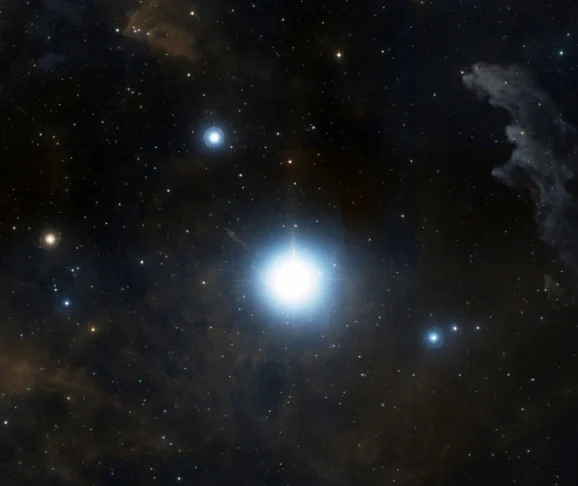
Shining low in the southwestern sky, Rigel is a young, hot blue supergiant and the brightest star in the constellation Orion, the Hunter. It ranks as the fifth-brightest star in the northern celestial hemisphere. Located 860 light-years away, Rigel is one of the most luminous stars in our galaxy, emitting light with the power of more than 120,000 suns.
What may seem like a single point of light is actually a multiple-star system:
· Rigel A: This is the brilliant blue supergiant that stands out as the primary star in the system. Due to its immense mass, Rigel A has a relatively short lifespan and will explode into a spectacular supernova within the next few million years. During this event, it will temporarily become the second-brightest object in Earth’s night sky, after the Moon. Following the explosion, its core will collapse, forming either a neutron star or a black hole.
· Rigel B: A nearby binary pair of blue-white main-sequence stars, known as Rigel Ba and Bb, which orbit each other every 10 days.
· Rigel C: Another blue-white main-sequence star that orbits Rigel B every 63 years.
These companion stars are much fainter and difficult to observe because of the intense glare from Rigel A.
The name “Rigel” is derived from Arabic and means “the left foot of the Jauzah” (the Central One), a direct reference to its position in the constellation Orion the Hunter, marking his left foot or heel. In the 20th and 21st centuries, Rigel’s identity as a brilliant and distant sun has made it a popular setting in science fiction, mentioned in Adams’ The Hitchhiker’s Guide to the Galaxy and in Roddenberry’s Star Trek, amongst others.
From its role in marking the foot of Orion the Hunter in ancient skies to its portrayal as home to alien civilisations in our most creative tales, Rigel’s rich cultural history underscores humanity’s enduring fascination with this luminous star. It stands as a testament to our quest for knowledge and our desire to understand not only the universe around us but also our place within it.
Night Sky Events in March
March is an exciting month for stargazing, featuring a remarkable lineup of celestial events. This month offers a total lunar eclipse, a unique opportunity to witness the northern lights, and impressive lunar conjunctions, where the Moon and bright stars align closely, creating breathtaking views. Jupiter, the gas giant, remains a brilliant beacon in Gemini, visible for much of the night in the southern sky.
March 3 – Full Moon(Worm Moon).
Look towards the eastern sky to see the Moon rise after 6 p.m. This full Moon is known as the Worm Moon, as March marks the beginning of spring when earthworms emerge from their winter slumber. A total lunar eclipse will be visible from North America, the Pacific, Australia, and East Asia; however, it will not be visible in Europe or Africa. Sadly, this time, we won’t have the opportunity to witness the “blood moon”, the magnificent reddish-orange glow as the Moon passes behind Earth’s shadow.
March 6 – The Moon near Spica.
Look towards the southeastern sky after 10 p.m. to see the waning gibbous Moon rising below and to the left of Spica, the brightest star in the Virgo constellation. The Moon and Spica shine together until the Moon sets in the early hours of the morning.
March 10 – The Moon near Antares.
The waning gibbous Moon and Antares, the brightest star in the Scorpio constellation, will rise together low in the southern sky after 2 a.m. The Moon will appear to the right of Antares. However, in other regions of the world, such as Antarctica and New Zealand, the Moon will pass in front of Antares, resulting in a lunar occultation.
March 11-24 – Prime Northern Lights Window.
As solar activity approaches its peak, the conditions for spectacular aurora viewing are ideal, especially with the upcoming “equinox effect” and the new Moon on March 19. During the equinoxes, the Earth’s axis is aligned side-on to the Sun, allowing solar wind to more easily enter our atmosphere. This alignment results in more frequent and intense light displays that dance across the night sky. It’s the perfect opportunity to travel to northern latitudes and experience the breathtaking colours and ethereal beauty of these auroras.
March 20 – Vernal (Spring) Equinox.
Today marks the astronomical beginning of spring in the Northern Hemisphere, a time when day and night are nearly equal in length. The Sun is directly over the equator, so both hemispheres receive almost equal amounts of sunlight. The spring equinox signifies the arrival of longer days, warmer temperatures, and blooming flowers. This season is celebrated worldwide through various traditions and festivals, each uniquely reflecting the joy and renewal that spring brings.
March 26 – The Moon near Jupiter and Castor and Pollux.
The waxing gibbous Moon enters the Gemini constellation tonight, below the bright stars Castor and Pollux and above Jupiter. This impressive gathering of these four celestial objects creates a stunning sight, beautifully illuminating the southern sky throughout the evening.
March 28 – The Moon near Regulus and the Beehive star cluster.
The waxing gibbous Moon shines brightly to the left of the Beehive star cluster in the Cancer constellation and to the right of Regulus, the brightest star in the Leo constellation. The trio is high in the southern sky after 8 p.m. and moves westward until the Moon sets around 4 a.m.

Omara Williams is a nuclear and software engineer whose multi-award-winning debut science-fiction novel, The Space Traveller’s Lover, shot to international bestseller status. Outside of her literary pursuits, she enjoys stargazing and chasing total solar eclipses.
READ MORE: Explore more from Omara Williams: Catch up on the full Stargazing with Omara Williams series here and discover what to watch in every month’s night sky.
Do you have news to share or expertise to contribute? The European welcomes insights from business leaders and sector specialists. Get in touch with our editorial team to find out more.
Main image: The March night sky and the five brightest stars in the Northern Hemisphere: Vega, Arcturus, Capella, Sirius, and Rigel. Image created using Stellarium Software. All images: Supplied