You’ve probably never heard of Gavin Inskip, but if you’ve watched Big Brother, Strictly or Who Wants to be a Millionaire, he’s been right there in the studio. The European’s Dr Stephen Simpson meets the invisible man of British television
Gavin Inskip might not be a household name, but for more than two decades, he’s been the backbone of some of Britain’s biggest and best-loved television shows.
Strictly Come Dancing, Big Brother, The X Factor, Who Wants to Be a Millionaire, The Great British Bake Off’s Extra Slice, Loose Women, The Voice UK: Gavin’s been there, keeping the audience entertained until the cameras roll.
“The best known TV presenter you may never have heard of,” his website jokes. And it’s true. But while he humbly describes his warm-up work as just a “little bit within the big cogs” of studio production, he’s just as important to their success as the shows’ stars. When the audience’s energy dips, when there’s breaks in filming or when things go wrong, it’s Gavin who keeps everything together.
He started out in radio at 16, volunteering at a local Essex station before taking on paid work while studying Media Communication and Production at college. But the solitary nature of radio proved limiting: “I had to be around people,” he says.

After a few years on air, including stints at Essex FM and Capital’s South Coast station Power FM, Gavin transitioned to TV. From the late ‘90s to early 2000s, he gained experience in many areas of TV, from being a floor manager and producer to making a rare on-screen appearance as a presenter of Channel 5’s long-running pre-school show Milkshake!
But it was in warm-up that he found his calling. “I realised all the skills I’d picked up — hosting, timing, reading a room — came together in television. I understood how a studio worked and what presenters needed. I knew how to keep the energy up and the audience focused.”
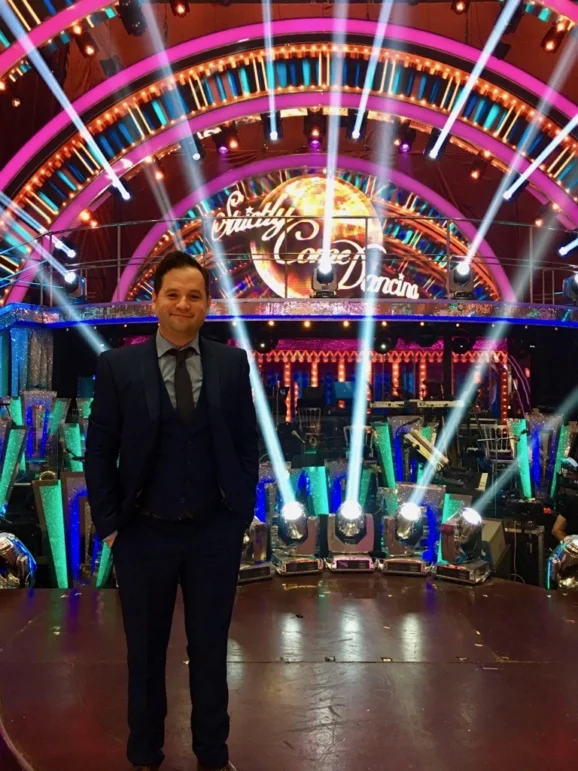
His earliest gigs were modest, acting as a warm-up for daytime panel shows, sometimes unpaid. But they were a valuable training ground for what would come later. “You learn fast,” he says. “There’s no script, no safety net — just you, a mic, and a studio full of people expecting a good time.”
His breakthrough came in 2017 with Big Brother, then airing on Channel 5. “That was the turning point,” he says. “It was the first time I did warm-up regularly, week in and week out. It gave me the confidence that I could really do this.”
From there, the floodgates opened and he’s since worked on virtually every prime-time show you could mention, from The Voice UK, The X Factor, and Strictly Come Dancing, to Who Wants to Be a Millionaire?, Loose Women and celebrity-filled spin-off shows such as Love Island: Aftersun, Big Brother’s Bit on the Side, The Great British Bake Off: An Extra Slice.

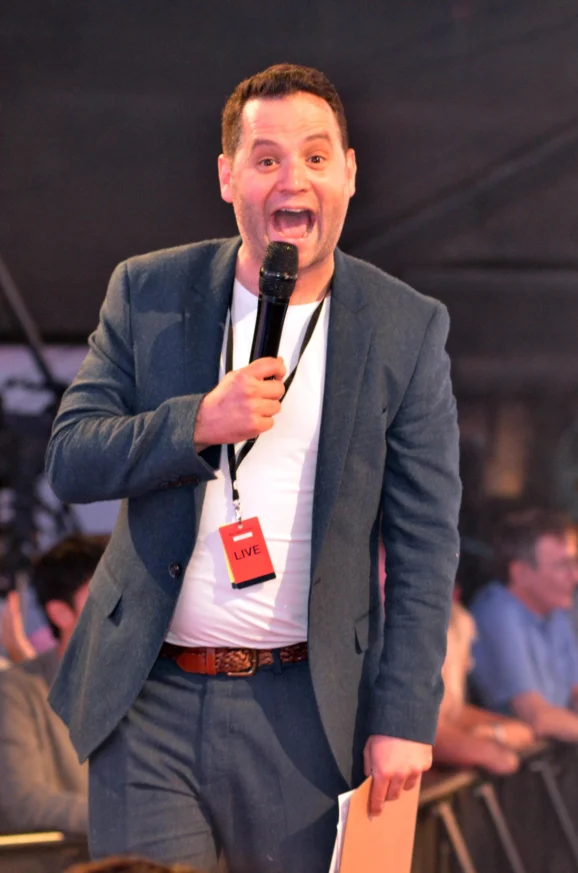
But what does a warm-up artist actually do? “I’ve always seen it as being the audience’s presenter,” he says. “The host looks after the viewers at home, but the audience need looking after too. I keep them informed, entertained and energised.”
That means Gavin constantly needs to be thinking on his feet, filling long gaps between filming with jokes or interaction. “I’ve had shows drag on for over eight hours,” he says. “My record is eight and a half.”
“It’s not about being the funniest person in the room,” he adds. “It’s about being flexible. You’ve got to read the mood, sense when people are flagging, and adjust what you’re doing. One moment you’re doing a bit of crowd work, the next you’re calming everyone down before a serious segment. You’re the glue.
“Before I go on, I pace the set. Not in a panicky way. It’s just my head running through what I might say. I have go-to bits, but the best stuff always comes spontaneously.”
And if his mind ever goes blank? “You have that little voice in your head going ‘I’ve run out of stuff.’ But you just keep talking, and the ideas come. You buy time, keep them smiling.”

Long shoots can be bearable or brutal depending on the production team, Gavin says. “You can tell a good show by how smoothly it runs. Strictly’s a monster of a production, but it’s a joy because the crew are so sharp. It’s like a ballet backstage.”
Big Brother also holds a special place in his heart. “Great people. Great energy. I loved it.” He’s also particularly fond of Who Wants to Be a Millionaire? “Clarkson’s great to work with and they’re a slick team. The faster a show records, the better the crew.”
But for Gavin, nothing beats the buzz of live television. “Live shows are the easiest. You know exactly how long they’ll run. You go in, do your bit, and the show’s done in an hour. You’re riding the same wave as the audience at home. That’s what I love.”
Another show where the energy is particularly infectious is The Great British Bake Off: An Extra Slice, the companion show to The Great British Bake Off, hosted by comedian Jo Brand. “The audience watches the episode together, like a secret viewing party, before we film,” says Gavin. “There’s a buzz because they know who’s going to leave before the public does.”
Not every memory is fond, however. “There was one game show,” Gavin recalls. “where the audience had to jump up and down on a seat to pump something up. Unfortunately, one guy didn’t quite make it to the toilet in time. And the chairs were white.” He pauses, then adds, “When I left the studio and saw that upturned white chair in the skip outside. … yeah, that image stays with you.”
He’s proudest of his stint at Channel 5, his first ‘proper’ job in television, where he stayed for nine years from 2000 to 2009. He initially worked in the Children’s Programming department on pre-school programme Milkshake! and The Core, aimed at older children, before moving on to the presentation department as a continuity announcer. Looking back, he sees this as the last great era of traditional TV.
“I’m so grateful that I was there for that period because that won’t exist again at another TV channel. That was the last period of TV being big.
“TV has shifted. Attention spans are shorter, social media’s everywhere and big production budgets are shrinking. Some brilliant producers I know are out of work.”
Given this, Gavin thinks it’s important for those looking to enter the TV industry today to ensure they diversify. It’s been his ability to adapt — not only doing TV warm-up but presenting at corporate events, hosting quiz nights, and even being the voice of the Coco Pops monkey in adverts for the cereal for the past 13 years — that’s helped him weather the changes.
“I think people need to stop thinking like, ‘I’m this role, that’s all I do.’ You’ve got to think, what skills do I have, and where else can they take me? I’ve spread myself thin — maybe too thin in some cases — but I’ve stayed afloat because of that.”
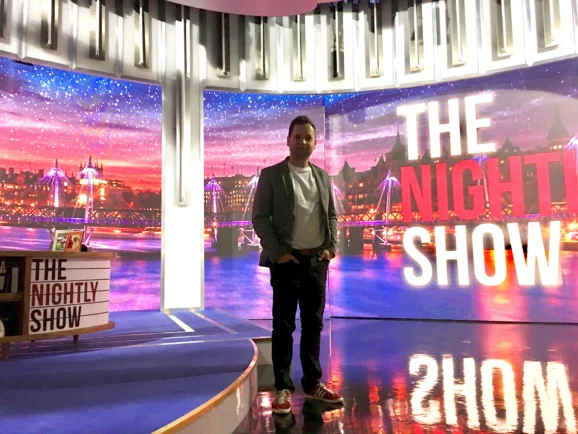
But if he had one wish, Gavin would love to be back in front of the camera, hosting a chat show. “To host a proper UK late-night show — part sketch, part chat, part madness like my old radio shows, but on telly. — that would be magic,” he says. “It’s never really worked here, but I still think it could. We’ve got the talent.”

Dr. Stephen Simpson is an internationally acclaimed mind coach, TV and radio presenter, hypnotherapist, TEDx speaker, bestselling author, business consultant, and Fellow of the Royal Society of Medicine. With nearly 40 years as a practicing physician and extensive experience in elite performance coaching, mental health, hypnosis, and NLP, he has worked with top athletes on the PGA European Golf and World Poker Tours. Dr. Simpson holds an MBA from Brunel University and has served as Regional Medical Director for Chevron, contributing to global health initiatives with leaders like Bill Clinton and Bill Gates. He hosts popular shows such as “Zen and the Art of NLP,” and his YouTube channel boasts over 260 videos and 350,000 views. His latest book, “The Psychoic Revolution,” encapsulates his innovative methods for achieving peak performance.
Images: Courtesy Gavin Inskip