As Uzbekistan pursues World Trade Organisation accession and deeper access to global capital, John E. Kaye speaks to Max Johnson, the new Supervisory Board member at ANORBANK, about banking reform, digital finance and the country’s changing financial sector
In 2005, as a young undergraduate, Max Johnson set out on a journey that would shape his understanding of Central Asia. Travelling overland from Istanbul to Urumqi, he followed a route that had first captured his imagination in the pages of Peter Hopkirk’s The Great Game.
The journey carried him through cities and landscapes where the legacy of old trade routes still formed part of daily life, from crowded markets and religious architecture to the languages, customs and commercial instincts of a region long shaped by exchange.
It was on this journey that Johnson first discovered Uzbekistan, a country rich in history, culture and commercial energy. The impression stayed with him long after he returned home.
“From the bustling bazaars of Tashkent to the turquoise domes of Samarkand, Uzbekistan carried the weight of history and radiated a sense of promise, as though it were quietly preparing for a future that had not yet fully arrived,” he told The European.
“I could not have predicted then that Uzbekistan would later come to play such an important role in my life.”
Last year, Johnson was appointed to the Supervisory Board of ANORBANK, Uzbekistan’s first fully digital bank and one of the country’s most prominent fintech-led financial institutions, alongside Stéphanie Rivoal, a former French diplomat who served as France’s Ambassador to Uganda and has worked extensively in complex international environments.
Their appointments come at a time when Uzbekistan’s banking sector is under growing international scrutiny as the country liberalises its economy, seeks deeper access to global capital and continues its push towards WTO accession. For banks like ANORBANK, independent oversight is becoming a more important part of the country’s wider effort to build trust in its financial institutions.
The question of trust reaches deep into the region’s commercial history. Long before Samarkand’s markets were supported by modern banks, Silk Road commerce depended on credit instruments as well as coins, with confidence between distant parties forming the basis of trade. The Suftaja, an early Islamic-era bill of exchange, enabled claims to be transferred across long distances and unfamiliar markets without physical settlement.
Modern capital markets face their own version of the same problem, with confidence needed between parties separated by geography, regulation and political risk. Since 2016, Uzbekistan has sought to answer that question through capital market liberalisation, stronger investor protection and a more open currency regime. Foreign-exchange surrender requirements have been abolished in favour of currency convertibility, breaking with decades of administrative allocation.
Unlike Kazakhstan, whose 1990s liberalisation coincided with the global integration of its hydrocarbon and mining sectors, Uzbekistan is entering reform from a different starting point. Since the collapse of the Soviet Union, the country has shifted from a cotton-dependent economy to one defined by scale, diversity, and growing integration across energy, logistics, and digital services.
“Uzbekistan occupies a distinctive position in Central Asia,” Johnson said. “It is not as dependent on remittances as some smaller economies, nor as concentrated around a single resource base as others. It has the demographic scale and productive capacity to support growth through both domestic demand and exports.
“The reforms under way – from currency openness and de-monopolisation to judicial reform and wider economic liberalisation – have reoriented the country towards global markets and attracted growing international confidence.
“These are fundamental shifts in how the economy functions and how institutions interact with citizens and businesses.”
One of the most striking transformations is digitalisation. Whereas two decades ago the region felt more defined by tradition and physical infrastructure, Uzbekistan today is rapidly becoming a digital-first nation. The youthful population are eagerly adopting online banking, electronic ID systems, digital government services, and remote education platforms as essential parts of everyday life.
This digital shift has profoundly influenced the financial sector. What was once dominated by traditional branch models has evolved into a landscape where mobile banking, remote onboarding, instant payments, and data-driven lending define the competitive edge.
Financial inclusion has surged, with the percentage of adults holding a bank account nearly doubling compared with 2017 and the number of active online banking users increasing almost fivefold in just five years. These figures point to social and economic empowerment as well as technological adoption. Individuals and businesses that once operated largely in cash-based systems now have tools to save, transact, invest and grow with greater transparency and security.
The country’s “Uzbekistan 2030” strategy has fostered this innovation, expanding internet accessibility and encouraging fintech development. Other ambitious development goals under the programme include mobilising US$250 billion of investment, lifting renewables to half of electricity generation and raising potential PPP portfolio commitments to 34 per cent of GDP by 2030.
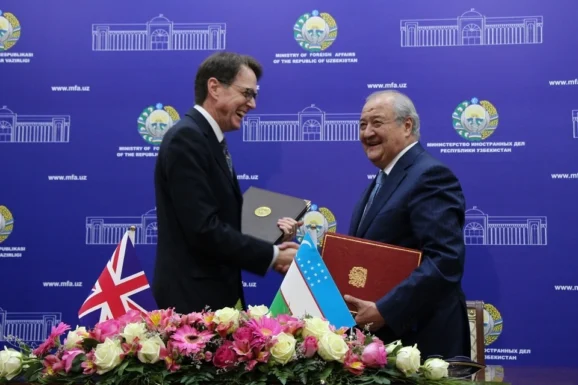
The UK has been among the Western countries most active in strengthening diplomatic and economic ties with Uzbekistan. This has included a new UK-Uzbekistan Partnership and Cooperation Agreement, UK-backed delegations such as the Infrastructure Trade Mission to Uzbekistan in February 2026, and the London Stock Exchange’s growing role as a venue for Uzbek issuance over the past six years.
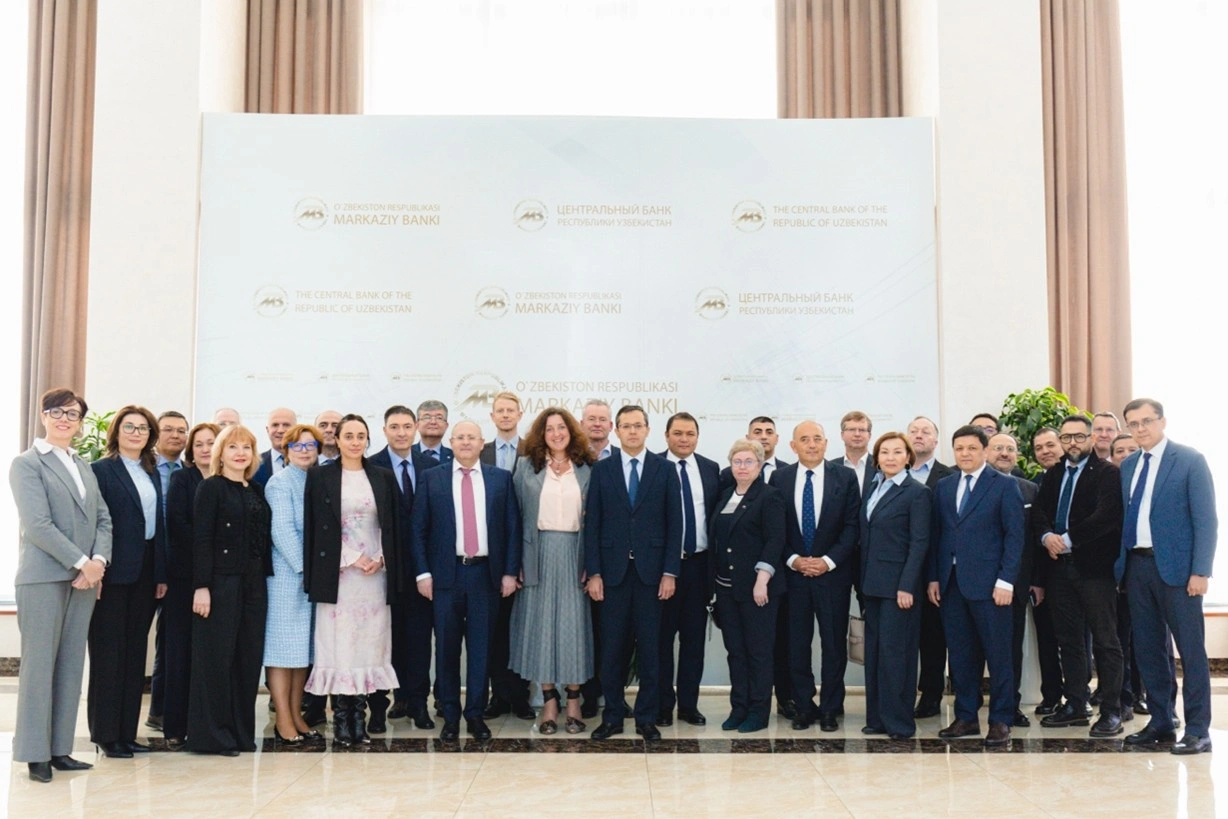
Meanwhile, Uzbekistan is also aligning its domestic banking regulation with international standards as part of its wider economic integration agenda, including progress towards World Trade Organisation accession. The Central Bank is implementing prudential frameworks consistent with Basel Committee and other international standards, while also pressing commercial banks to strengthen asset quality and improve the management of non-performing loans. That agenda was reflected in a March 11, 2026 meeting at the Central Bank with independent members of commercial-bank supervisory boards.
“As the country’s first fully digital bank, it has helped broaden access to financial services and shown how innovation can work in a market undergoing rapid change” – Max Johnson
Washington’s recent critical-mineral engagement is also demonstrative of Uzbekistan’s growing strategic relevance within Eurasia, as its reserves of rare earths, gold, uranium, lithium, and copper move into the focus of major powers. Mining SOEs are already partnering with foreign private capital, with state-owned Navoiyuran and France’s Orano operating through the Nurlikum Mining joint venture to industrialise the South Djengeldi uranium deposit.
The state has set out minority stake sales for major SOEs, including two minerals’ groups (NMMC and AMMC), which would create a tradable valuation benchmark for future equity and project-finance structures.
Elsewhere, Uzbekistan has also emerged as a strategically important transit corridor for trans-Eurasian trade, especially following the war in Ukraine. As trans-Caspian gateways struggle with capacity demand, Uzbekistan is reducing friction through both hard corridors and digital clearance. Large returns could be captured from transit digitalisation, with an investable pipeline now visible in European Bank for Reconstruction and Development-backed rail operating systems and road public-private partnerships (PPPs) such as Tashkent-Andijan, where tolls and traffic are managed digitally.
A similar pattern is visible in energy, where expanding generation capacity is placing pressure on Uzbekistan’s electricity grid and making targeted upgrades an important area for investment. The renewable energy sector is being supported heavily by multilateral institutions seeking to increase reliable baseload capacity and support an ambitious project pipeline. This build-out is increasingly tied to digitisation, with smart metering and mobile payments helping to make revenues more predictable while giving households and businesses more flexible access to credit.
“ANORBANK’s role needs to be understood in the context of Uzbekistan’s wider reform story,” Johnson explains. “As the country’s first fully digital bank, it has helped broaden access to financial services and shown how innovation can work in a market undergoing rapid change.
“Digital banking is particularly important in a country where access has historically varied between urban and rural communities. Alongside its core banking operations, ANORBANK has supported initiatives to expand financial literacy and improve access to banking services across communities.”
Reflecting on the distance between the Uzbekistan he encountered as a student traveller and the country he sees today, Johnson says the change feels substantial but rooted in qualities he noticed from the start. The ambition, creativity and openness he sensed in 2005 have become part of a wider national transformation, as Uzbekistan strengthens its institutions, expands digital access and deepens its links with global markets.
“In many ways, the Uzbekistan I see today feels like the country I glimpsed then beginning to come into full view. Its history remains central to its identity, but its future is now being built with real confidence.”
Further Information
Produced with support from ANORBANK. To find out more about its digital banking services and work to expand access to financial services in Uzbekistan, visit anorbank.uz
READ MORE: Digitalization, financial inclusion, and a new era of banking services: Uzbekistan’s road to WTO membership. As Uzbekistan advances toward WTO membership, digitalisation is reshaping its banking system and widening access to finance. Max Johnson, a member of ANORBANK’s Supervisory Board, explores how reform, innovation and a young, connected population are propelling the country into a new era of financial inclusion.
Do you have news to share or expertise to contribute? The European welcomes insights from business leaders and sector specialists. Get in touch with our editorial team to find out more.
Main image: Stéphanie Rivoal, pictured on the far left, and Max Johnson, pictured towards the centre in the back row, with banking officials and independent supervisory board members at the Central Bank of Uzbekistan during a March 2026 professional meeting on banking-sector asset quality and the management of non-performing loans. Credit: Central Bank of Uzbekistan.