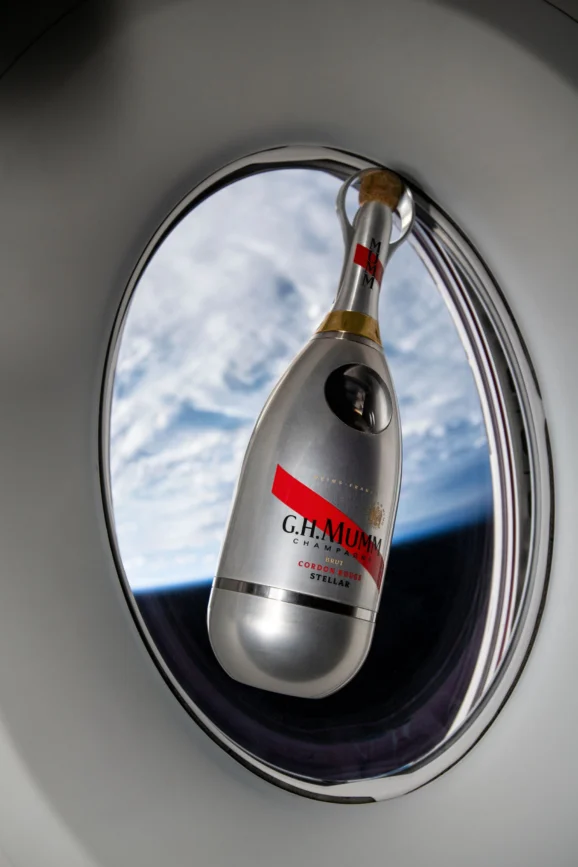
Mumm has taken champagne where no cork has popped before – into space. Its Cordon Rouge Stellar cuvée, crafted for zero gravity and nine years in the making, has completed a historic mission aboard Axiom Space’s Ax-4 flight, returning to Earth in perfect condition
It’s fizz – but not as we know it.
A French champagne house has launched the world’s first bubbly made for zero gravity, blasting it into space on a history-making mission.
Mumm Cordon Rouge Stellar – nine years in the making – took off from Florida on 25 June 2025 as part of Axiom Space’s Ax-4 mission, returning to Earth 15 July in “perfect” condition.
Its bottle, built from glass, stainless steel and aeronautical-grade aluminium, was designed to survive the punishing journey while still pouring perfectly in weightless conditions.
The project began in 2017, with Mumm teaming up with space designer Octave de Gaulle, France’s national space agency CNES, and astronaut Jean-François Clervoy, a veteran of three NASA missions.
A prototype first appeared in 2018, followed by a second model in 2022 built to meet CNES specifications for safety and tasting in zero gravity. Final tests took place on a parabolic flight this March before its real debut in orbit.
Mumm said its cellar master Yann Munier won’t pop the cork for another five months to give the champagne time to settle after the stresses of launch and re-entry.
Speaking yesterday César Giron, CEO of Maison Mumm, said: “Over and above its contribution to space exploration, the significance of this project lies in what champagne represents – shared values, an enduring art de vivre, a symbol of our culture – and in the possibility of recreating it in an entirely new environment.”
Sébastien Barde, the Deputy Director of Exploration and Human Spaceflight at CNES, added: “The Mumm Cordon Rouge Stellar project is a concrete example of the importance of considering conviviality and shared rituals in space.
“For CNES, these human dimensions are essential to the success of long-duration missions. By supporting projects like this one, we are exploring ways to improve the psychological well-being of crews and address the cultural challenges of human space exploration.”
In 1904, Mumm’s Cordon Rouge label travelled with Commandant Charcot, the first Frenchman to lead an Antarctic expedition, making it the first champagne to toast the Polar Circle.
Main image, courtesy Mumm