Britain must shape AI future or be left at its “mercy and whim”, Liz Kendall warns

John E. Kaye
- Published
- News
The Technology Secretary said the UK needed greater control over artificial intelligence as ministers prepare a new hardware plan and expand support for domestic firms
Britain must seize greater control over artificial intelligence or risk being left at the “mercy and whim” of a future shaped elsewhere, Liz Kendall has warned.
In a speech at the Royal United Services Institute, the Technology Secretary said the government wanted to reduce strategic dependence in key parts of the AI economy as the technology becomes increasingly concentrated in the hands of a small number of firms.
Just five companies now control 70 per cent of global AI compute, up from about 60 per cent a year ago, she said.
“The choice isn’t between a world that has AI and one that does not,” Kendall added. “It is a choice between a world where we shape our AI future, based on our own interests and values, or where we are left at its mercy and whim.”
The government has already launched Sovereign AI, a £500 million programme intended to back British AI companies as they start up, scale up and compete globally.
Ministers say the scheme will combine direct investment with wider state support, including access to supercomputing, faster visa routes for research talent, backing from the British Business Bank and government procurement.
But Kendall said Britain now needed to go further in areas where strategic dependence could leave the country exposed, including through a new AI Hardware Plan to be unveiled at London Tech Week in June.
The speech also pointed to a wider state-backed push to strengthen domestic capability, including £400 million ringfenced by the Ministry of Defence to support British innovation and £100 million for ARIA’s scaling compute programme, half of it for a scaling inference lab to help start-ups test new AI hardware.
Kendall said the global AI chips market was growing at 30 per cent a year and could be worth US$1 trillion in the early 2030s, arguing that Britain was well placed to compete in new, faster and more energy-efficient AI hardware.
“If Britain could secure just 5% of this market it would bring fifty billion dollars in revenue to the UK with tens of thousands of high paid jobs in tech,” she said.
“There are those who say this race is already lost. That it is too late to challenge the dominance of the US or China in AI chips. But I do not accept such defeatism.”
Britain also needed to cut its reliance on others in the areas that matter most, while continuing to work with overseas investors and allies. “For Britain, AI sovereignty is about reducing over dependencies and increasing resilience in key national strategic priorities,” Kendall said.
That approach, she added, would make the UK “a keystone in the global tech architecture – an indispensable partner”.
Tuesday’s speech also cast AI as a matter of national security as well as economic policy, with Kendall arguing that closer work with allies would be part of Britain’s response. “Today the defining currency is AI,” she said. “And the countries which harness AI will not only lead the race to cure diseases, discover new materials and create trillion dollar companies … but also build far more powerful militaries.”
She pointed to existing technology partnerships with Germany, France, Canada and Japan, as well as further cooperation on AI security and model evaluation.
Kendall also rejected calls to slow development. “We’ve already heard calls, including in Parliament, to ‘Pause AI’,” she said. “I think doing so would be a double betrayal.”
“It would send a message that Britain is closed to new ideas and new opportunities. That a country so rich in talent, innovation and enterprise has put an ‘out of office’ sign on its front door.”
READ MORE: Europe launches ‘anti-kill switch’ cloud shield as Trump fears grip Brussels. Four European tech firms have unveiled a new sovereign recovery system as fresh polling shows most Europeans believe the U.S could one day pull the plug on vital digital services
Do you have news to share or expertise to contribute? The European welcomes insights from business leaders and sector specialists. Get in touch with our editorial team to find out more.
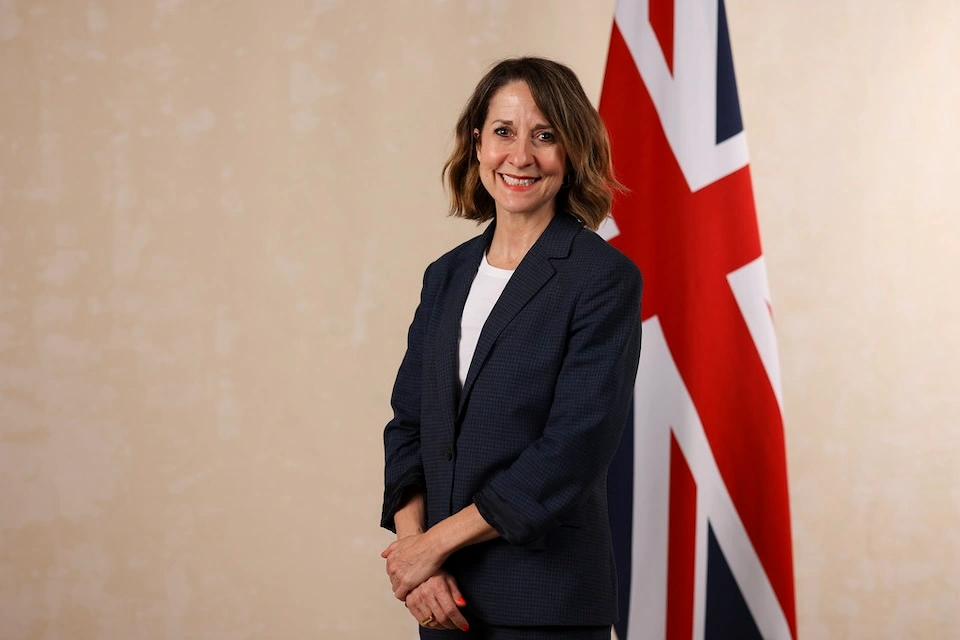
Main image: Technology Secretary Liz Kendall, who used a speech at RUSI to call for greater UK control over artificial intelligence. Credit: Department for Science, Innovation and Technology handout
TOP STORIES
-
 An Italian affair – Stanley Johnson takes London's society set on the Silk Road
 -
Himalayan mountainside moved 40cm before avalanche killed 1,451 in Nepal, scientists reveal
-
Scientists and engineers quitting jobs as AI changes roles ‘beyond recognition’, study finds
-
UK profit warnings hit near two-year high as businesses struggle with rising costs
-
Microsoft pulls out of major UK AI data centre project amid power grid delays
-
Russia takes control of more European corporate assets amid Ukraine tensions
-
EU leaders resist calls to delay carbon rules as energy costs soar
-
‘A big step forward’ – PM Andy Burnham hails plans for Great British Railways HQ in Derby
-
UK economy grows just 0.1 per cent as construction falls and services stall
-
Germany risks losing €155bn a year under tighter AI data rules, new study warns
-
Pope Leo XIV diagnosed with lung cancer after surgery in Rome
-
France faces freezer meltdown as hackers strike supermarket chains
-
Bumble shares soar 50% amid $1bn takeover talks
-
China slump drives Volkswagen to sharpest quarterly fall in more than four years
-
Hollywood mega-powerhouse created as Paramount completes Warner Bros Discovery takeover
-
Gamers face gridlock as latest Grand Theft Auto download 'nears two days'
-
Samsung profits soar ninefold to record £61bn amid AI chip boom
-
New Springer books put the UN’s struggling sustainability goals to the real-world test
-
Europe’s solar boom set for two-year slowdown after record growth
-
Let it pea. Musicians turn vegetables into instruments at Beatles' Abbey Road studios
-
Golden naked Trump statue unveiled at European Parliament
-
Jaguar puts controversial rebrand on the road with £130K 1,030PS Type 01
-
Deepfakes and identity fraud drive new wave of post-hire background checks
-
Spain crowned Europe’s top retirement destination
-
More than half of UK professionals report workplace burnout