NASA is preparing to send four astronauts beyond Earth orbit and around the far side of the Moon in a 10-day mission designed to prove its new rocket and spacecraft can safely carry humans into deep space
NASA is poised to launch Artemis II, a 10-day crewed mission that will carry astronauts around the Moon and back, marking the first time humans have travelled beyond low Earth orbit since the Apollo era ended in 1972.
The flight forms part of the United States space agency’s Artemis programme, which aims to return astronauts to the lunar surface and establish a long-term presence in lunar orbit through the planned Lunar Gateway station as a staging post for future missions to Mars.
Artemis I, launched in 2022 without a crew, successfully tested the Space Launch System rocket and Orion capsule in a lunar fly-by.
For Artemis II, NASA will use the 98-metre Space Launch System (SLS), the most powerful rocket the agency has built.
The core stage carries super-cooled liquid hydrogen and oxygen propellants, while two solid boosters provide the majority of thrust during the first phase of flight.
Once in orbit, the boosters separate and the Orion crew capsule continues towards the Moon. NASA says the SLS is capable of sending astronauts and cargo to the Moon in a single launch, though the programme has been costly, with estimates placing total development and infrastructure spending at close to $50bn before the first test flight.
During the mission, astronauts will first test life-support, navigation and communication systems in Earth orbit before moving into a high-Earth trajectory where they will manually pilot Orion.
They will then travel into deep space, circling the Moon and passing approximately 4,600 miles beyond its far side before returning to Earth for a Pacific splashdown.
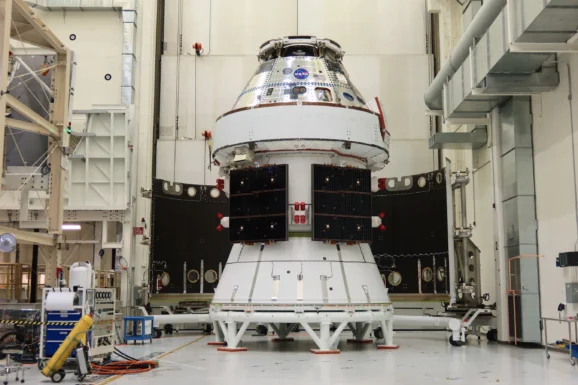
The performance of Orion’s systems in this environment is considered essential preparation for Artemis III, currently targeted for the middle of 2027, which aims to land astronauts on the lunar surface.
The four-person crew consists of three American astronauts and one Canadian. They entered a health stabilisation quarantine programme in late January to minimise the risk of illness before launch.
The earliest possible launch date is 8 February, although this depends on the completion and assessment of a “wet dress rehearsal” simulating the full countdown sequence and fuelling of the rocket.
This test was delayed by unusually cold weather in Florida, and NASA has indicated that weather conditions, including temperature, wind, precipitation, lightning, cloud cover and solar activity, remain critical factors in determining whether a launch can proceed.
Additional launch windows are scheduled across February, March and April should conditions force further delays.
READ MORE: ‘NASA takes possession of Orion capsule set to pave way for first Moon landing in 50 years‘. NASA has taken possession of the Orion spacecraft that will fly astronauts on the Artemis II mission — a critical test flight that will pave the way for the first human landing on the Moon in more than half a century.
Do you have news to share or expertise to contribute? The European welcomes insights from business leaders and sector specialists. Get in touch with our editorial team to find out more.
Main image: NASA’s Space Launch System (SLS) rocket and Orion spacecraft, secured to the mobile launcher, are seen at Launch Pad 39B, Saturday, Jan. 17, 2026, at NASA’s Kennedy Space Center in Florida. NASA’s Artemis II test flight will take Commander Reid Wiseman, Pilot Victor Glover, and Mission Specialist Christina Koch from NASA, and Mission Specialist Jeremy Hansen from the CSA (Canadian Space Agency), around the Moon and back to Earth no later than April 2026. Credit: NASA/Joel Kowsky