What started as medical-device manufacturing has diversified in value: more than 30 life-sciences multinationals now base business support services, R&D and analytics in Costa Rica
In 2000, medical devices made up just five per cent of Costa Rica’s exports. Twenty-five years later they account for 48 per cent of the goods it ships abroad, and the multinationals that built that industry are now providing the corporate services that run the business behind the factory floor. For four decades CINDE, the private agency that promotes foreign direct investment in the country, has watched those firms arrive, establish and expand.
For a European reader the appeal rests on four strengths that rarely come together in one place. The first is dual-sector depth: the country that builds Class II and III medical devices also runs sophisticated finance, analytics and engineering centres, so a manufacturer moving into services finds both capabilities already proven next door. The second is talent: Costa Rica holds one of Latin America’s deepest pools of bilingual professionals, with English widely used across technical and managerial roles, alongside engineers and quality teams already fluent in both U.S FDA requirements and EC standards. The third is resilience: decades of unbroken democracy and steady, diversified growth give investors a stable base in an otherwise volatile region. The fourth is geography: operations run from Costa Rica sit in or near U.S time zones, a few hours’ flight from North American headquarters, letting a European parent serve its largest growth market from one hub.
From devices to functions
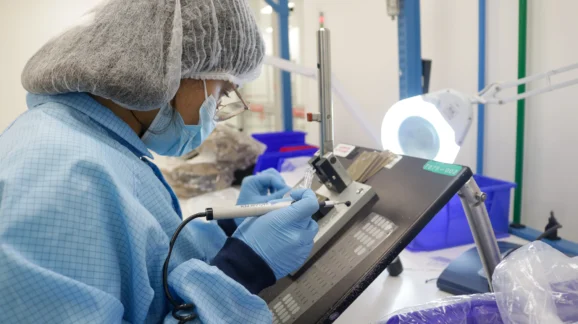
The medical-device record in Costa Rica is well documented. In 2000, the country had eight life-sciences firms, fewer than 1,500 workers and US$288m in device exports. By 2025 it counted more than 100 firms, 63,778 employees and US$10.9bn in exports, or 48 per cent of all goods sold abroad. It hosts 18 of the world’s 35 largest MedTech companies and ranks as Latin America’s second-largest device exporter, having diversified from disposables to Class II and III therapeutic and diagnostic products. That trajectory built a workforce versed in FDA audit cycles, EC standards and ISO 13485 quality systems. When companies asked whether the same people could run regulatory, finance and analytics functions, the answer was a track record rather than a pitch.
The services sector did not arrive fully formed. Knowledgeintensive services exports grew from US$0.2bn in 1999 to US$9.3bn in 2024, a 16.9 per cent annual rate, as companies entered with one function, proved it and widened their scope: IT support became software development, finance processing became planning and analysis, HR administration became talent strategy. Today 60 per cent of the country’s service centres are multifunctional, spanning finance, HR, engineering, procurement and advanced analytics at once.
More telling is where these operations now sit inside their parent companies. Industry shorthand tracks a progression from Helper to Shaper to Leader, from executing processes at arm’s length to holding a seat in strategic decisions. A growing number of Costa Rican centres have moved into the upper tiers, visible in what they hire for: in 2025 life-sciences firms were recruiting AI specialists, senior finance professionals, digital-sales architects and R&D engineers, not volume headcount.
The convergence in practice
More than 30 life-sciences companies now run services or corporate functions in Costa Rica alongside manufacturing or R&D, among them Baxter, Hologic, Boston Scientific, Stryker, Freudenberg, Edwards Lifesciences.
European companies are in the mix too. Denmark’s Coloplast handles customer service, medical records, collections and bidding, and IT, a function that began inside its manufacturing site. Britain’s Smith & Nephew bases higher-order corporate work in the country, from talent acquisition, tax and legal to supply chain, regulatory and FP&A. Their presence shows the shift is not confined to U.S-headquartered firms. Several have anchored CFOlevel functions and centres of excellence.
“What we do is intentional,” says Ana María Romero, Investment Advisory Manager at CINDE. “We see it more and more: once a company has proved its manufacturing here and built trust in the workforce, it starts moving global services processes to the same base. A centre might begin with a single process, and our job is to help it evolve into the next, and the next, until the company is running parts of its core operations from Costa Rica. Every step pulls the work closer to where the strategic decisions are made.”

The economics support high-complexity work rather than simple cost arbitrage. The free-tradezone regime, in place since 1990, offers up to eight years of zero income tax, no limits on profit repatriation, no VAT on services and no duties on imported inputs. Combined with 75 years of unbroken democracy, solid intellectual-property protection and the lowest FDI restrictiveness in Latin America, the risk profile is low. The talent pipeline is deep: more than 49,000 university graduates a year, a regional lead in AIengineering skills, the highest density of certified data centres per capita in Latin America, and 138 technical high schools feeding the sector with cybersecurity and, since 2025, artificial-intelligence tracks.

Why it holds
The investment data points the same way year after year. Reinvestments outpace new projects by a wide margin, the clearest sign a location has moved from attractive to trusted, though a maturing base will naturally see reinvestment dominate, so the pace of genuinely new entry is worth watching too. Across more than 400 multinationals it has advised, over 100 in life sciences and more than 250 in services, CINDE’s record suggests Costa Rica’s ability to perform is no longer the open question.
Further information
Produced with support from CINDE. To find out more about investing in Costa Rica and the country’s life-sciences and knowledge-intensive services sectors, visit www.cinde.org
READ MORE: ‘The end of IOC fatigue: why CISOs need to think in campaigns, not emails‘. Modern phishing campaigns evolve faster than traditional detection models can respond. To close the gap, CISOs must shift from analysing individual emails to understanding coordinated attack campaigns. Here, Cofense explains why campaign-based detection is becoming essential to phishing defence.
Do you have news to share or expertise to contribute? The European welcomes insights from business leaders and sector specialists. Get in touch with our editorial team to find out more.
Sources: CINDE (employment, graduates and investment data); Banco Central de Costa Rica (goods and services exports).