Artificial intelligence is spreading rapidly through modern organisations, yet many initiatives stall at the pilot stage. John E. Kaye explores how SDG Group’s new Gena Suite is designed to help companies turn AI ambition into operational capability
Artificial intelligence is reshaping how organisations operate, from accelerating decision-making to driving measurable productivity gains. Yet for many companies across Europe and beyond, the promise of AI remains stuck at the pilot stage, even as interest and investment continue to rise.
The 2025 AI Index Report by Stanford HAI found that 78 per cent of companies have initiated AI adoption, while Gartner reports that around 83 per cent of organisations plan to increase AI and generative AI funding in 2026, with an average intended budget increase of 38 per cent for the latter.
Even so, turning early experiments into systems that work reliably across an entire organisation remains difficult. While the average success rate for AI Proof-of-Concepts (PoCs) reached 55 per cent in 2024, many still fail to progress further. In fact, 92 per cent of enterprises experienced at least one PoC that did not move into production, often because of the technical and architectural demands of an enterprise-grade environment.
The challenge therefore lies in scaling AI beyond isolated use cases and integrating it into everyday operations. Moving from a single functional experiment to an enterprise-wide deployment requires a more robust and adaptable foundation.
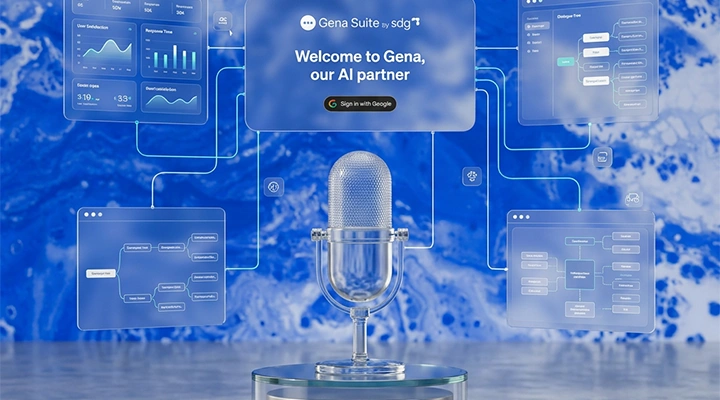
Gena Suite, part of Orbitae portfolio of solutions, has been created with precisely this challenge in mind. Designed as a modular ecosystem for enterprise AI deployment, it aims to help organisations move beyond experimentation and bridge the gap between promising pilots and stable, high-performance production environments.
Gena Suite is designed to help organisations move artificial intelligence projects from pilot stage into full operational deployment through what SDG Group describes as a 360-degree approach. Rather than functioning as a single-use tool, the platform’s components can be deployed simultaneously across IT, customer service, and operations, with the aim of allowing AI to operate as a unified layer of intelligence rather than a collection of disconnected systems.
In this sense, the platform is positioned as a way for organisations to move from pilot initiatives towards what SDG Group describes as a “production powerhouse”.
The platform’s modular architecture allows it to operate in any cloud environment, enabling organisations to expand capabilities without undertaking major system overhauls. For organisations seeking greater data sovereignty, Gena Suite can also be deployed on-premise, allowing companies to retain full control over infrastructure and proprietary intelligence without reliance on third-party providers.
A central feature of the platform is its library of preconfigured agent templates. These AI agents are designed to perform specific duties and can be deployed across different environments depending on organisational needs. According to SDG Group, they are intended to support businesses by optimising critical operational areas and enabling teams to focus on higher-value work.
Among these templates is the Work and HR Policy Agent, which autonomously handles employee queries relating to issues such as annual leave policies, expense procedures, and internal regulations. Its natural-language capabilities are designed to provide employees with fast and accurate responses, with the aim of improving efficiency and employee satisfaction.
The Recruitment Agent focuses on automating the hiring workflow, covering processes such as candidate sourcing, screening and interview scheduling. The system analyses CVs and can respond to detailed queries relating to skills, experience and competencies, allowing organisations to streamline recruitment processes.
Another template, the Performance Evaluation Agent, addresses the task of generating performance reports. The system is designed to produce documentation that is consistent, tailored to specific roles and aligned with corporate objectives, simplifying what is often a complex and time-consuming administrative process.
Adaptability is presented as a central characteristic of the platform. Gena Suite has been developed to meet the needs of organisations regardless of their scale or technological maturity. Its modular architecture allows the integration of conversational platforms alongside specialised technical components, enabling deployments to be configured to suit specific organisational requirements from the outset.
The platform’s structure is also designed to scale alongside organisational growth. In practice, this means the system can handle increasing volumes of data and operational complexity without requiring a fundamental redesign of the underlying platform. As a result, SDG Group positions the suite as suitable both for lean startups and for large global enterprises.
At an operational level, Gena Suite centralises interactions between users and AI agents so that they can function in an omnichannel deployment. Real-time dashboards provide leadership teams with oversight of platform performance and adoption, offering tools designed to support governance and strategic decision-making.
The platform’s preconfigured agent templates are intended to accelerate deployment while remaining adaptable to specific organisational needs. SDG Group argues that this approach avoids some of the limitations associated with rigid drag-and-drop tools by allowing greater flexibility in how AI capabilities are configured and deployed.
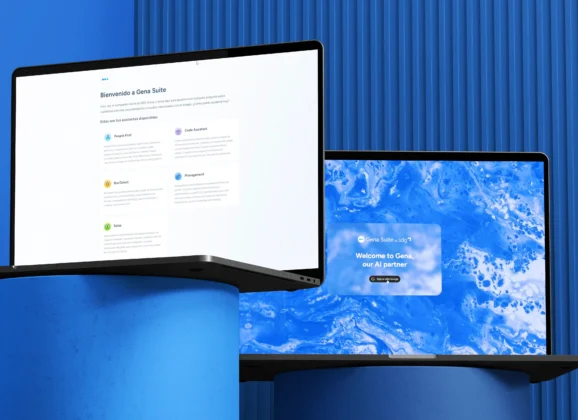
AI support can be accessed through a dedicated interface or through platforms that employees already use, including Microsoft Teams, Google Chat and Slack. Orbitae refers to this as a “consume everywhere” approach, designed to reduce friction by making AI assistance available across different devices and working environments.
From an infrastructure perspective, the platform has been built with flexibility and scalability in mind. It can be deployed across multiple environments and regions, whether hosted on Amazon AWS, Microsoft Azure, Google Cloud Platform (GCP) or on-premise servers. This vendor-neutral architecture is intended to support long-term scalability and operational resilience while avoiding dependency on a single cloud provider.
Automated testing mechanisms are also integrated into the platform in order to safeguard reliability as the system evolves. These processes are designed to verify that updates maintain consistent performance and that the platform remains stable even under heavy operational demand.
For business leaders, SDG Group asserts that this combination of visibility, adaptability and resilience allows artificial intelligence capabilities to expand alongside the organisation rather than becoming another isolated technology initiative.
More broadly, the company presents Gena Suite as a platform intended to reduce the technical barriers typically associated with enterprise AI adoption. Through its modular architecture and flexible deployment options, the system is designed to allow organisations of different sizes and sectors to integrate AI into their operations more easily.
SDG Group has offices in the UK, Spain, Italy, the Netherlands, Portugal, the United States, the Middle East, and Mexico. David Dias Piquero, Head of Global Innovation at SDG Group, said: “As the AI landscape matures, the ability to turn AI into operational performance while keeping enterprise reliability will become a turning point for many organisations. Gena Suite has been developed to help businesses move towards enterprise AI readiness.”
Further information
Produced with support from SDG Group. To find out more about SDG Group and Orbitae, visit www.sdggroup.com/en
READ MORE: ‘Why leadership matters when implementing AI‘. Organisations are investing heavily in AI, yet few are turning experimentation into measurable business value. Steve Durbin, Chief Executive of the Information Security Forum, argues that success depends on leadership staying closely involved in priorities, guardrails and results.
Do you have news to share or expertise to contribute? The European welcomes insights from business leaders and sector specialists. Get in touch with our editorial team to find out more.