Air India and Airbus unveil India’s first corporate green aviation fuel scheme

John E. Kaye
Air India and Airbus are hoping to kick-start India’s green aviation fuel industry with a pioneering scheme that would see businesses bankroll cleaner flights in return for carbon savings
Air India and Airbus unveiled plans for India’s first voluntary corporate sustainable aviation fuel (SAF) programme yesterday.
The two companies signed a feasibility study agreement to develop the scheme, which would allow businesses to help fund cleaner jet fuel and claim associated carbon savings against their emissions targets.
SAF, made from renewable or waste-derived materials, can substantially reduce lifecycle emissions compared with conventional jet fuel.
But limited production and higher costs have hampered its adoption.
The proposed programme aims to boost demand by encouraging companies outside aviation to help finance its use, potentially supporting domestic fuel production.
This would allow companies to reduce their reported carbon footprint without their employees necessarily travelling on flights using the greener fuel.
Tewolde Gebremariam, Air India’s chief executive, said: “Achieving aviation’s decarbonisation goals will require collective action across the ecosystem.
“Through this collaboration with Airbus, we are exploring a credible mechanism that enables corporates to support SAF adoption and reduce the emissions associated with business travel.
“Expanding demand for SAF is essential to scaling production and building a sustainable aviation ecosystem in India, and we are pleased to help lead that effort.”
Similar schemes have operated overseas for several years. United Airlines launched its Eco-Skies Alliance in 2021, allowing corporate customers to contribute towards the cost of SAF, while Lufthansa has also introduced corporate purchasing arrangements.
But the Air India-Airbus initiative would be the first voluntary corporate SAF programme of its kind in India, where aviation companies are seeking to expand access to alternative fuels.
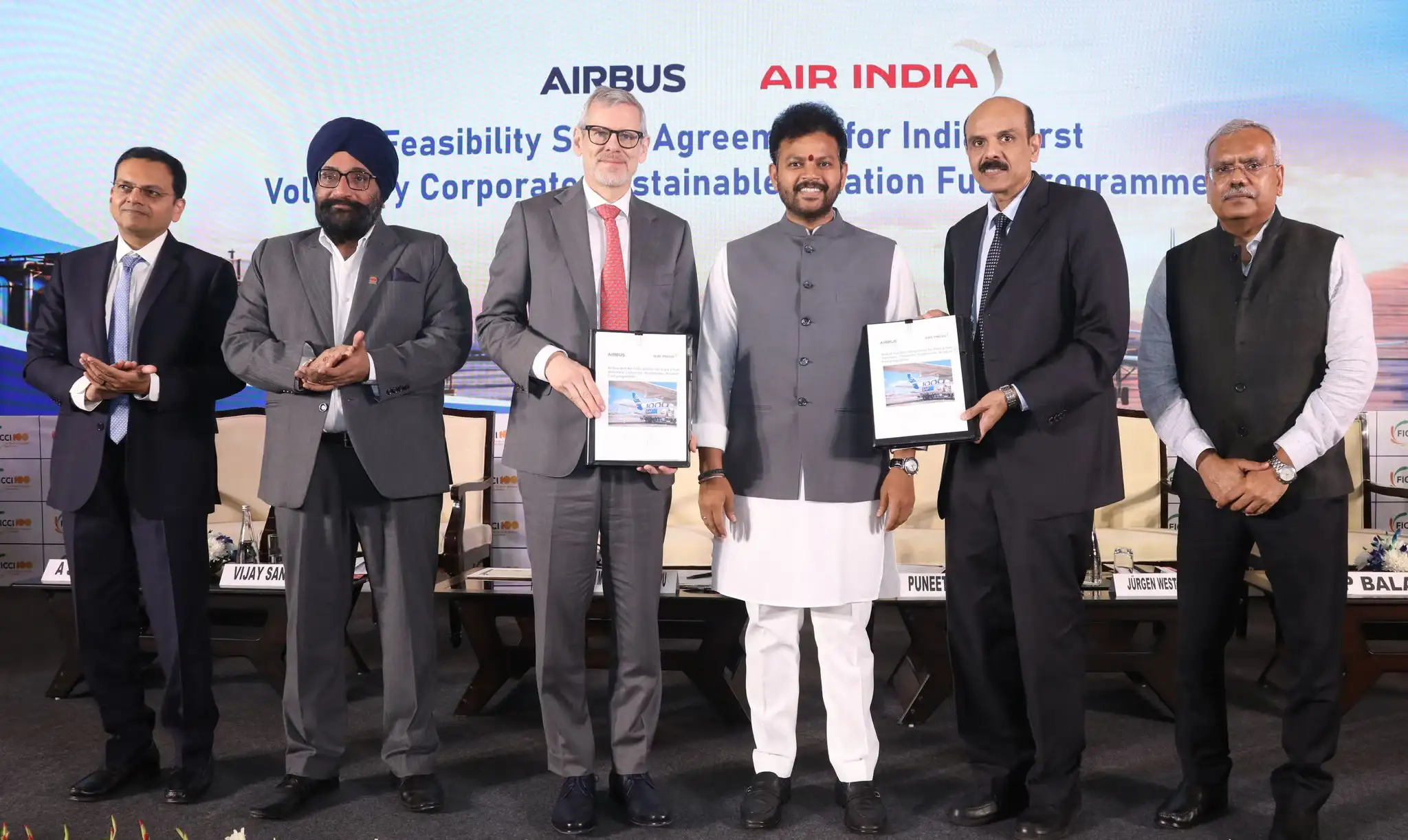
The agreement was signed yesterday by Jürgen Westermeier, President and Managing Director of Airbus India and South Asia, and Air India executive P Balaji, in the presence of Civil Aviation Minister Rammohan Naidu Kinjarapu.
Westermeier said: “The collaboration with Air India is a crucial stepping stone to accelerate SAF adoption in the region. Decarbonising aviation demands collective, industry-wide action, and we welcome other corporates to join the programme.”
Air India is also renewing its fleet, with 600 aircraft on order, including 350 from Airbus, as part of efforts to reduce fuel consumption and emissions.
READ MORE: Passenger jet flies on fuel made from waste CO₂ in aviation breakthrough. Engineers have turned waste carbon dioxide into jet fuel that has already helped power a commercial passenger flight, in a breakthrough that could help airlines cut emissions without replacing existing aircraft.
Do you have news to share or expertise to contribute? The European welcomes insights from business leaders and sector specialists. Get in touch with our editorial team to find out more.
Main image: Vijay Sankar, President-Elect, FICCI; A S Sahney, Chairman, IOCL; Jürgen Westermeier, President and MD, Airbus India & South Asia; Shri Rammohan Naidu Kinjarapu, Honourable Minister of Civil Aviation, Government of India, P Balaji, Group Head – GRC & Corporate Affairs, Air India and Puneet Kansal, Addl Secy, MOCA. Credit: Air India
TOP STORIES
-
 Serko raises revenue forecast as Booking.com business travel bookings surge
-
Air India and Airbus unveil India's first corporate green aviation fuel scheme
-
Best Western loyalty scheme to be scrapped in major hotel rewards shake-up
-
First class delivery: China's postal service puts humanoid robots to work across eight cities
-
AI set to transform university librarians' jobs as 95% predict surge in demand
-
Washington Dulles unveils new concourse as $20bn airport expansion takes off
-
The European Autumn 2026 edition – out now
-
WATCH: Greenpeace drops giant David Attenborough boulder into North Sea – on site of £12bn windfarm
-
Himalayan nations demand urgent action as UN warns of irreversible glacier losses
-
6,000 march against ‘monstrous’ AI data centres as Scotland faces building boom
-
Shop till Ai drop? AI agents set to buy for us as tech boss warns of retail revolution
-
Specs appeal: Welsh Parliament bans smart glasses
-
European motoring legends behind Mercedes, BMW and McLaren to enter Hall of Fame
-
Putin 'plotting to break NATO without firing a shot', Latvian military analyst warns
-
British AI chip startup hits £5bn valuation as government backs bid to challenge global tech giants
-
World's biggest military airshow moves to ‘Britain’s Area 51’ after Iran war disruption at RAF Fairford
-
Lisa Nandy threatens crackdown on entertainment industry after David Walliams allegations
-
UK and European experts demand tougher AI laws as Australia considers criminal penalties after OpenAI breach
-
BBC loses bid to throw out Trump's $10bn defamation lawsuit over doctored Panorama speech
-
AI-generated CVs spark hiring crisis as a third of employers lose confidence in job applicants
-
MPs back calls for ‘Black English’ and ‘Asian English’ options on census
-
Nvidia hires top US lawyer to investigate CEO's alleged affair with Chinese spy
-
EXCLUSIVE – Comic Relief confirms David Walliams is no longer an honorary trustee and has ‘no formal association’ with charity
-
Why Airbnb and Uber take off in some cities but flop in others, according to scientists
-
Michael Jackson's Thriller jacket, Princess Diana's dresses and $3m Banksy painting go under the hammer