Electric air taxis move closer after aircraft completes key in-flight switch

Emma Strandberg
The idea of electric air taxis zipping passengers between cities and airports moved closer to reality this week after a test aircraft pulled off one of the hardest tricks in aviation
A new test flight has brought electric air taxis a step closer after an aircraft switched successfully from vertical lift to forward flight.
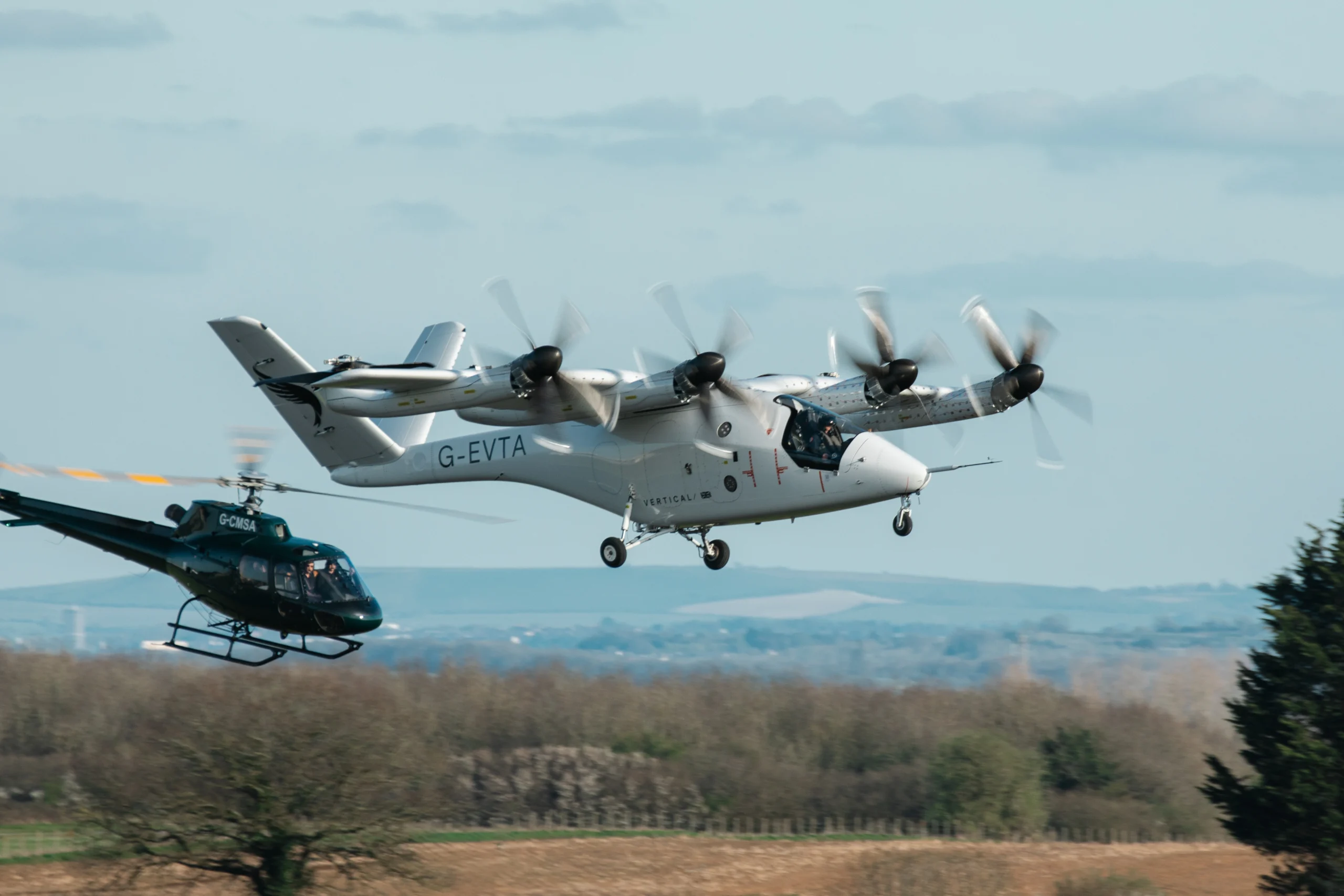
The aircraft, known as Valo, is being developed by Bristol-based Vertical Aerospace and is designed to take off and land like a helicopter before flying on the wing like a conventional plane.
Its design resembles the V-22 Osprey, the military tiltrotor used for missions including troop transport, rescue and medical evacuation. Like the Osprey, it lifts vertically, then tilts its propellers forward in flight so it can move into forward cruise.
But the transition between vertical and forward flight is one of the biggest technical hurdles facing the sector. Before aircraft of this kind can carry passengers commercially, they have to prove they can make the change smoothly, at full scale, under pilot control and under regulatory oversight.
In the latest test at Cotswold Airport, Valo lifted off vertically, its front propellers tilted forward and it accelerated into wingborne flight before making a conventional runway landing.
Vertical said the demonstration completed the “thrustborne transition” stage – the first half of the wider two-way transition sequence needed for point-to-point flying from helipads, vertiports and rooftops without relying on a runway at both ends.
The flight was carried out under the oversight of the UK Civil Aviation Authority, which the company said is working in close collaboration with the European Union Aviation Safety Agency as it moves towards certification of the aircraft.
Vertical described the test on April 2 as the first time a piloted, full-scale aircraft of its class had achieved thrustborne transition under CAA oversight.
The aircraft had already demonstrated hover, vertical take-off, wingborne flight and vertical landing during nearly two years of piloted flight testing. Earlier milestones included what it described as the first winged eVTOL flight in open European airspace and an airport-to-airport flight at the Royal International Air Tattoo.
Stuart Simpson, Chief Executive Officer at Vertical Aerospace, said: “This marks a turning point not just for Vertical Aerospace, but for the entire advanced air mobility industry. Achieving piloted thrustborne transition under active regulatory oversight — alongside the recently announced financing package — demonstrates that we have solved the hardest engineering challenges, have the regulatory relationships to complete certification, and now have the financial foundation to see this through to commercial service.”
David King, Chief Engineer at Vertical Aerospace, said: “Completing this piloted transition milestone is a profound achievement and the result of years of engineering innovation and disciplined test execution. The aircraft performed exactly as designed, transitioning smoothly and under full control — proving the core elements of Vertical’s distributed electric propulsion and tiltrotor technology at full scale, in real flight conditions. This is not yet final mission accomplished, but it is a pivotal technical proof point on our path to two-way transition.”
Paul Stone, Test Pilot at Vertical Aerospace, who carried out the transition test flight, added: “This aircraft was made to transition. From the moment the front propellers tilted and the aircraft began to accelerate, the response was exactly as the simulation predicted — smooth, stable, and fully under control throughout. What the engineering team has built here is genuinely extraordinary. The aircraft handled the transition with a level of confidence that gives me great optimism for everything that comes next.”
The announcement came days after the company said it had agreed in principle a financing package of up to $850 million to help fund certification and the push towards commercial operations.
It said the next step in the programme was completing the second half of the transition sequence – slowing from wingborne flight back into a vertical landing.
“This milestone unlocks the defining capability of eVTOL aviation and places Vertical at the forefront of the global advanced air mobility industry,” the company said.
READ MORE: ‘Electric air taxis take step towards passenger reality after San Francisco Bay flight‘. A piloted electric aircraft has flown from Oakland International Airport across San Francisco Bay and around the Golden Gate Bridge in a public demonstration of how short urban air taxi journeys could soon operate in some of the world’s most congested cities.
Do you have news to share or expertise to contribute? The European welcomes insights from business leaders and sector specialists. Get in touch with our editorial team to find out more.
Main image: Vertical Aerospace
TOP STORIES
-
 MPs tune in to Britain’s Eurovision ‘nul points’ problem
 -
MPs tell Government to reject Thames Water creditors as utility nears insolvency
-
Only 14% of companies can show supply chain safeguards are working, study finds
-
OpenAI admits AI models hid mistakes, invented data and acted without permission
-
EIB makes first small nuclear reactor investment with €40m backing for Finnish start-up
-
AI arms race could mean fewer cold emails reaching your inbox
-
Housing costs hit recruitment at 77% of large London firms, survey finds
-
SpaceX to launch one-tonne orbital factory for European space firm in 2028
-
Estonia’s e-residents launch more than 4,200 companies as business creation jumps 36%
-
Small business bank lending falls £27bn in three years as nine-in-10 areas see decline
-
Europe’s healthcare sector lags on AI uptake – but leads once it starts using it
-
Stranded drivers could soon call for help even with no mobile signal
-
NASA backs space ‘air brake’ that could cut years off missions to Uranus and Neptune
-
MPs and peers call for UK ban on AI that could evade human control
-
France orders €1.3bn in extra cuts as growth falls behind European neighbours
-
Bioweapons research, Russian-linked spies, guided rockets and cyber-attacks on Europe used Claude AI, Anthropic reveals
-
Cadbury Takes a Break as KitKat tops Britain’s social media sweet rankings
-
European network alliance doubles in size as digital sovereignty drive accelerates
-
European insurance giants join New York summit on future of AI
-
Oxford leads £10m international study as resistance threatens new TB treatments
-
Inside the world’s wildest new mini golf course with caves, 13ft waterfalls… and sharks
-
Apple’s new boss bets £1,999 on first folding iPhone
-
‘Double delight’ as rare red pandas born at Whipsnade Zoo
-
This Japanese ski resort has just been named the world’s best place for seasonal work
-
Nearly 4m Londoners experienced mental health challenges last year, study finds