Nigeria’s startup scene takes global stage as Lagos hosts inaugural GITEX NIGERIA

John E. Kaye
- Published
- News
West Africa’s biggest technology and startup showcase brought more than 650 companies to Lagos, where ministers and business leaders described Nigerian entrepreneurs as “architects of the digital future”
The first edition of GITEX NIGERIA closed in Lagos on Thursday after four days that organisers say placed a global spotlight on the country’s emerging entrepreneurs and its ambition to build a US$1 trillion digital economy.
Held in Abuja and Lagos between 1 and 4 September under the patronage of President Bola Ahmed Tinubu, the event was supported by the Federal Ministry of Communications, Innovation and Digital Economy, the National Information Technology Development Agency (NITDA), Lagos State Government and organised by KAOUN International.
The European was an official media partner.
Deputy Governor of Lagos State, Dr Kadri Obafemi Hamzat, told attendees that the event’s impact was already visible. “GITEX NIGERIA sends an inspirational message to every Nigerian: that many positive things are transpiring across our country and opportunities are here,” he said. “We see many young citizens and entrepreneurs, with enormous innovative minds, making a real difference – generating interest, raising capital, and overcoming challenges by bringing their ideas to life and delivering tangible impact.”
More than 650 startups from 27 countries and 29 sectors took part, with a programme that included innovation hub showcases, investor sessions and curated meetings between startups, corporates, governments and international partners. Organisers called it Nigeria’s most globally diverse investor programme to date.
Bosun Tijani, Minister of Communications, Innovation and Digital Economy, linked the event to wider government plans to fund 75 new research projects for startups and academics. He said: “The opportunity and responsibility lies with all of us to build a resilient, innovative, and globally connected ecosystem, one that ensures that Nigeria not only keeps pace with the digital future but also shapes it.”
Local and international organisations also contributed, among them NITDA, Lagos State, FATE Foundation, CcHUB Africa, Orange Corners, the United Nations Development Programme and the American Business Council.
NITDA’s Director General Kashifu Inuwa Abdullahi said: “Across Africa and around the globe, future-oriented partnerships are the lifeblood of thriving startup ecosystems and digital economies. By uniting ambitious organisations from instrumental sectors in the emerging digital economy, we demonstrate how collaboration fuels innovation, accelerates transformation, and empowers Nigerians and Africans to shape their digital future.”
The Supernova Challenge, billed as the world’s leading pitch competition for early-stage companies, made its regional debut in Lagos as part of the event. Contestants from across Africa competed for a US$22,000 prize pool across six categories.
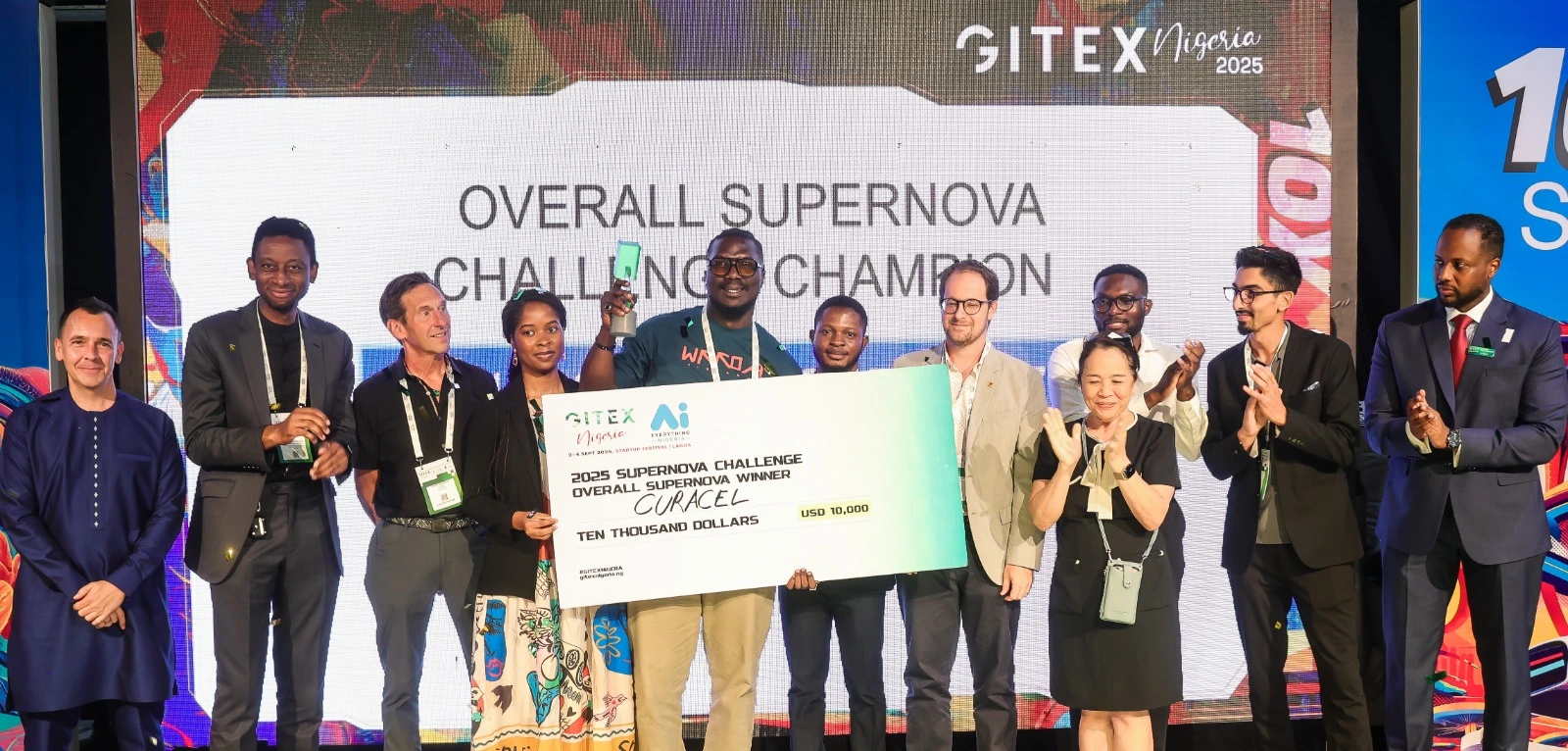
Nigerian healthtech startup Curacel won the overall champion’s award and the US$10,000 first prize for its AI-driven health insurance solution. “Placing first at the GITEX NIGERIA Supernova Challenge gives us more visibility and fuels our expansion across Europe, Middle East and Africa, as well as North America,” said Abdul-Jabbar Momoh, the company’s vice-president. “Most importantly we are going to keep on impacting lives in Africa and around the world by deploying solutions to move health insurance distribution.”
Other winners included Build Africa (AI category), InCash (digital finance), Hadiya (creative economy and martech), Acecore (agritech and energy), Kara (mobility and smart cities), and HiPrep (disruptor award). Each received US$2,000.
Organisers said the turnout reinforced Nigeria’s role as a hub for West African innovation and underlined the country’s determination to build a competitive digital economy.
Main image: Winners take the stage: Nigerian health-tech startup Curacel celebrates after being named Overall Supernova Challenge Champion at GITEX Nigeria 2025 in Lagos, securing the $10,000 grand prize. Photo: Supplied
TOP STORIES
-
 Estonia’s e-residents launch more than 4,200 companies as business creation jumps 36%
 -
Small business bank lending falls £27bn in three years as nine-in-10 areas see decline
-
Europe’s healthcare sector lags on AI uptake – but leads once it starts using it
-
Stranded drivers could soon call for help even with no mobile signal
-
NASA backs space ‘air brake’ that could cut years off missions to Uranus and Neptune
-
MPs and peers call for UK ban on AI that could evade human control
-
France orders €1.3bn in extra cuts as growth falls behind European neighbours
-
Bioweapons research, Russian-linked spies, guided rockets and cyber-attacks on Europe used Claude AI, Anthropic reveals
-
Cadbury Takes a Break as KitKat tops Britain’s social media sweet rankings
-
European network alliance doubles in size as digital sovereignty drive accelerates
-
European insurance giants join New York summit on future of AI
-
Oxford leads £10m international study as resistance threatens new TB treatments
-
Inside the world’s wildest new mini golf course with caves, 13ft waterfalls… and sharks
-
Apple’s new boss bets £1,999 on first folding iPhone
-
‘Double delight’ as rare red pandas born at Whipsnade Zoo
-
This Japanese ski resort has just been named the world’s best place for seasonal work
-
Nearly 4m Londoners experienced mental health challenges last year, study finds
-
Card fraud accounts for more than one-in-three UK identity fraud cases
-
Breast cancer campaigners target Burnham at PMQs over £20m research fund
-
Europe leads world in quantum research despite deep industry scepticism
-
Australia plans social media algorithm ‘off switch’ in move Europe could follow
-
European central banks move gold out of U.S as 'geopolitical risks' mount
-
Volkswagen plans another 50,000 job cuts in sweeping overhaul
-
Uber launches UK’s first autonomous ride-hailing service in London
-
Hackers could plunge Britain into darkness in less than two minutes, report warns