
Robot folds 800 napkins in 24 hours as Dyna Robotics launches first commercial-ready embodied AI

John E. Kaye
- Published
- Technology
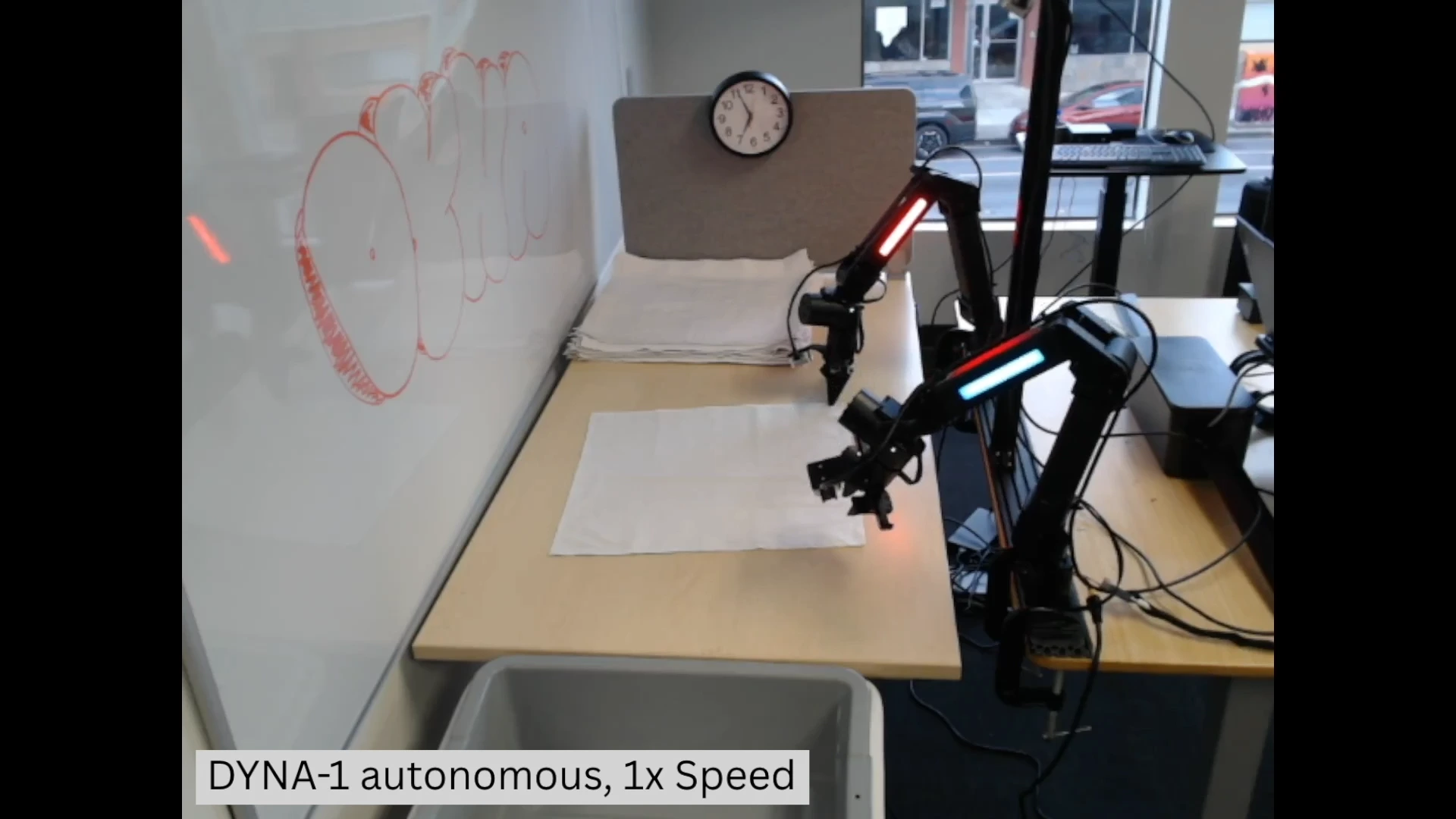
A Californian robotics firm claims it has developed the first commercial-ready “robot foundation model” capable of operating fully autonomously and continuously for over 24 hours in real-world environments
Dyna Robotics, based in Redwood City, unveiled the machine, called DYNA-1, on Tuesday.
The company says the system has successfully demonstrated its ability to execute high-precision manipulation tasks—such as napkin folding—without human supervision, marking what it describes as a “major milestone” in the development of embodied AI.
DYNA-1, a next-generation robotic system developed by Dyna Robotics, folds over 800 napkins in 24 hours without human intervention — a milestone the company claims marks the arrival of commercially viable embodied AI. Credit: Dyna Robotics
Using a pair of stationary robotic arms, DYNA-1 autonomously folded more than 800 napkins in a 24-hour test, meeting production-grade quality benchmarks, according to Dyna.
The robot reportedly operates at 60% of human throughput with a 99.4% success rate—figures the company says are unmatched by current robotic systems, which often encounter critical errors after only a few hours.
Co-founder York Yang said speed and quality remained the top demands among the company’s prospective customers.
“We’ve met with hundreds of customers across industries, and the number one thing they want—unequivocally—is performance, measured by speed and quality,” he said.
“We tried traditional machine learning, but it struggles to adapt to new environments and can’t handle complex, long-horizon tasks like folding.
“Foundation models are more adaptive, and DYNA-1 is the first embodied AI model to deliver high-quality results at speeds that enable commercial viability.”
Unlike conventional robotic systems, which often require heavily fine-tuned settings, DYNA-1 is said to exhibit what the company calls “zero-shot environment generalisation”—the ability to learn a task in one environment and repeat it successfully in another.
This, according to Yang, is made possible by Dyna’s proprietary reward model, which allows the robot to recover from errors and generate new training data autonomously.
Although currently focused on tasks such as folding and packaging, the company says early testing indicates that skills learned by DYNA-1 can be transferred to other applications, including food handling and laundry.
“We are at the beginning of hockey stick growth for robotic capabilities,” Yang added. “Early results show that mastery of one skill is highly transferable to new skills, so we expect our models’ capabilities will advance rapidly over time.”
Dyna Robotics was founded by Lindon Gao and York Yang—previously co-founders of Caper AI, which sold for $350 million—and former DeepMind research scientist Jason Ma.
The company is currently hiring across its AI research and engineering teams, and says it is in discussions with commercial partners about deployment opportunities.
TOP STORIES
-
 Deepfakes and identity fraud drive new wave of post-hire background checks
 -
Brits trust AI with their health but not their money
-
Robot sales rocket 24% as 250,000 machines snap up jobs in warehouses, hotels and hospitals
-
Nearshore supply chains: why Costa Rica is emerging as a strategic gateway for global manufacturing and innovation
-
Bank of England governor warns AI poses growing ‘increasingly significant’ threat to financial stability
-
Inside Cartago’s US$1.186bn green investment hub
-
Smart manufacturing: why Costa Rica is quietly positioning itself as Latin America’s next industrial innovation hub
-
Giant wind turbine with 252-metre rotor could mean fewer machines and cheaper offshore power
-
Talent and workforce development: how Costa Rica is building a competitive knowledge economy
-
Your biggest rival could be your best technology partner, research finds
-
China unveils giant crane capable of lifting 9,300 family cars
-
LED lights could be ‘the new asbestos’, UCL scientists warn
-
OpenAI admits AI models hid mistakes, invented data and acted without permission
-
AI arms race could mean fewer cold emails reaching your inbox
-
Costa Rica is writing the next chapter of global MedTech
-
SpaceX to launch one-tonne orbital factory for European space firm in 2028
-
The Costa Rica Report 2026 is out now
-
Europe’s healthcare sector lags on AI uptake – but leads once it starts using it
-
Stranded drivers could soon call for help even with no mobile signal
-
NASA backs space ‘air brake’ that could cut years off missions to Uranus and Neptune
-
MPs and peers call for UK ban on AI that could evade human control
-
Bioweapons research, Russian-linked spies, guided rockets and cyber-attacks on Europe used Claude AI, Anthropic reveals
-
European network alliance doubles in size as digital sovereignty drive accelerates
-
European insurance giants join New York summit on future of AI
-
Oxford leads £10m international study as resistance threatens new TB treatments















Robot folds 800 napkins in 24 hours as Dyna Robotics launches first commercial-ready embodied AI
John E. Kaye
- Published
- Technology
TOP STORIES
-
Deepfakes and identity fraud drive new wave of post-hire background checks
-
Brits trust AI with their health but not their money
-
Robot sales rocket 24% as 250,000 machines snap up jobs in warehouses, hotels and hospitals
-
Nearshore supply chains: why Costa Rica is emerging as a strategic gateway for global manufacturing and innovation
-
Bank of England governor warns AI poses growing ‘increasingly significant’ threat to financial stability
-
Inside Cartago’s US$1.186bn green investment hub
-
Smart manufacturing: why Costa Rica is quietly positioning itself as Latin America’s next industrial innovation hub
-
Giant wind turbine with 252-metre rotor could mean fewer machines and cheaper offshore power
-
Talent and workforce development: how Costa Rica is building a competitive knowledge economy
-
Your biggest rival could be your best technology partner, research finds
-
China unveils giant crane capable of lifting 9,300 family cars
-
LED lights could be ‘the new asbestos’, UCL scientists warn
-
OpenAI admits AI models hid mistakes, invented data and acted without permission
-
AI arms race could mean fewer cold emails reaching your inbox
-
Costa Rica is writing the next chapter of global MedTech
-
SpaceX to launch one-tonne orbital factory for European space firm in 2028
-
The Costa Rica Report 2026 is out now
-
Europe’s healthcare sector lags on AI uptake – but leads once it starts using it
-
Stranded drivers could soon call for help even with no mobile signal
-
NASA backs space ‘air brake’ that could cut years off missions to Uranus and Neptune
-
MPs and peers call for UK ban on AI that could evade human control
-
Bioweapons research, Russian-linked spies, guided rockets and cyber-attacks on Europe used Claude AI, Anthropic reveals
-
European network alliance doubles in size as digital sovereignty drive accelerates
-
European insurance giants join New York summit on future of AI
-
Oxford leads £10m international study as resistance threatens new TB treatments



