COVID-19 impact will see UK investors move to safer retail deposits
John E. Kaye
- Published
- News

According to GlobalData, a leading analytics company, retail investors in the UK will gravitate towards deposits and away from riskier high-yielding assets
GlobalData’s report, ‘COVID-19 Sector Impact: Retail Savings & Investments – The UK’, discloses that equity balances are expected to fall by 18% in 2020 alone while retail deposit balances grow by 5%. While the decline for equities is made up for in the following years, the higher growth and large initial size of the retail deposits market shows the extent to which investors are set to turn towards safer assets.
Katherine Long, Banking and Payments Analyst at GlobalData, comments: “Higher deposit growth is also likely to benefit both incumbent and challenger banks. Already, retail savings platforms Raisin and Hargreaves Lansdown reported a surge in activity in March with savers looking for short-term, fixed-rate deposits.
“Their offers of deposit protection potentially above the usual £85,000 limit as well as interest rates of up to 2% make them a tempting case for consumers who are still nervous to invest. Additionally, with base rates lowered to just 0.1%, banks will be able to take advantage of consumer nervousness by simply offering a safe place for customers to store their money.”
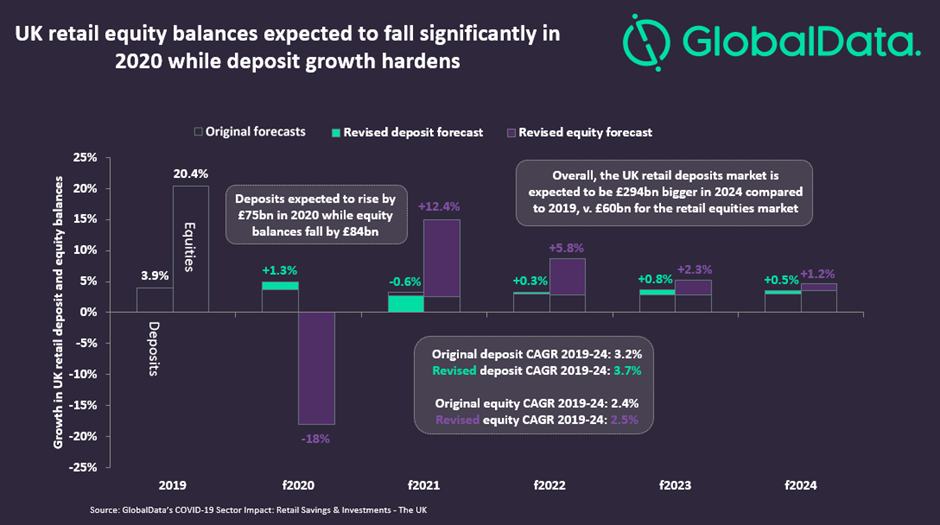
In contrast, global stock markets have fallen drastically, The FTSE All-Share Index for example now down 24% after having recovered somewhat from the initial slide, but still volatile. The value of UK pensions, too, according to XPS Pensions, is down 8.4% in one quarter and expected to fall further, a reminder of how exposed pension funds are to the stock market.
Long concludes: “However, rather than prove a short-term phenomenon, the disruption has reversed the recent trend of retail investors looking for higher-yielding assets, instead seeking to bolster their safety net in deposits.”
For more information visit: www.globaldata.com
For more Daily news follow The European Magazine

Sign up to The European Newsletter
RECENT ARTICLES
-
Germany bucks Europe’s high-growth surge as continent sees strongest expansion in five years -
Women turning to entrepreneurship to fight age bias at work, study shows -
Lithuania launches ‘Investment Highway’ to cut major project approval times from three years to three months -
Islamic Development Bank and London Stock Exchange Group launch study on ‘development traps’ facing emerging economies -
Europe’s HyDeal eyes Africa for low-cost hydrogen link to Europe -
Complex questions still need people, not machines, researchers find -
Study links CEO political views to recognition of women inventors -
GrayMatter Robotics opens 100,000-sq-ft AI robotics innovation centre in California -
UAE breaks ground on world’s first 24-hour renewable power plant -
WomenIN Festival 2025 unveils expanded programme in partnership with FNB -
ITFC extends $30m financing to Uzbekistan’s Hamkorbank -
New £2.5 million Rolls-Royce Phantom marks model’s centenary -
UK faces surge in major cyber attacks, NCSC warns -
Historian warns climate denial is causing “immense harm” as humanity nears a “major crunch point -
The European Autumn 2025 edition out now -
Study finds creative storytelling boosts confidence and career prospects for young people -
Global development banks agree new priorities on finance, water security and private capital ahead of COP30 -
South African students develop tech concept to tackle hunger using AI and blockchain -
Global startup expo enters final day in Dubai as Expand North Star marks a decade of innovation -
Bleisure boom turning Gen Z work travel into ‘life upgrade’ -
Automation breakthrough reduces ambulance delays and saves NHS £800,000 a year -
AI found to make people 15% more likely to lie, study warns -
Global aerospace composites market to triple by 2034 as demand for lighter, greener aircraft accelerates -
ICIEC to host 15th AMAN Union Summit as Islamic finance eyes closer trade integration -
Matching words and images helps charities raise more money, study finds