The first dogfight between an AI fighter jet and a human piloted aircraft has taken place at supersonic speeds in the United States – but who won remains a mystery
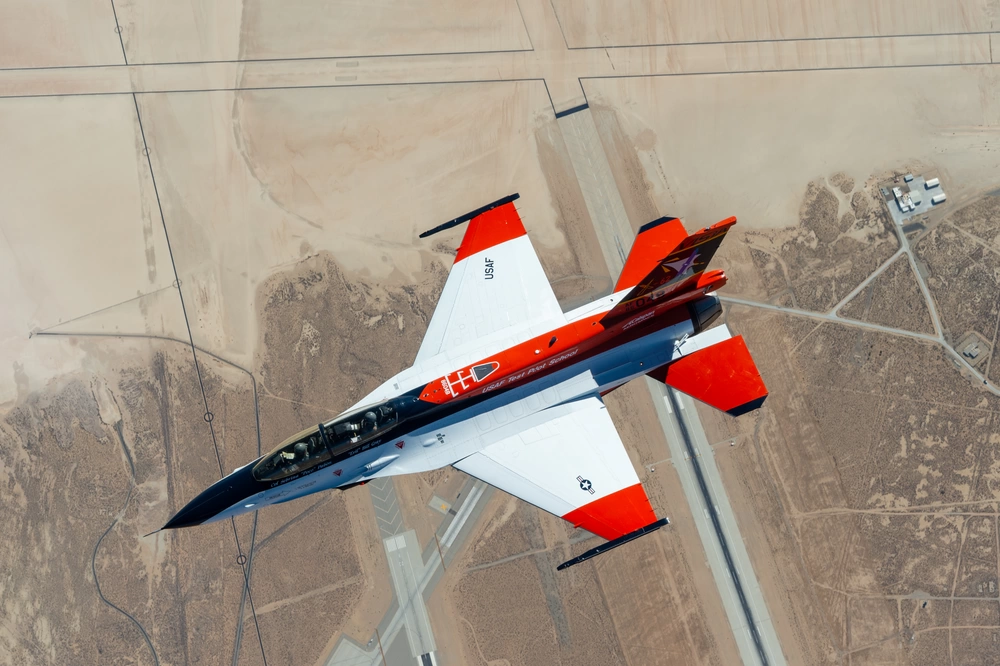
A manned F-16 went up against a X-62A VISTA (Variable In-flight Simulator Test Aircraft) in what the US Air Force describes as a “distant dream up until now”.
The two jets flew at nearly twice the speed of sound and got as close as 600 metres of each other during the historic drill above Edwards Air Force Base in California.
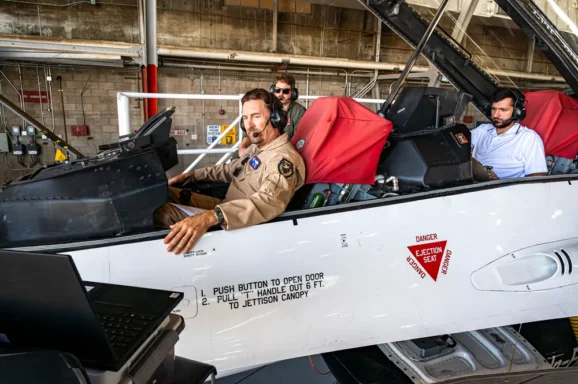
Footage released by the US Defense Advanced Research Projects Agency (DARPA) shows the aircraft practising a variety of dogfighting manoeuvres at speeds of up to 1,200mph.
DARPA said the exercise was carried out to evaluate the effectiveness of aircraft AI in a “real-world setting” following computer simulations held in 2020.
At that time, so-called ‘AI agents’ defeated human pilots in all five virtual match ups.
Lt. Col. Ryan Hefron, of DAPRA, said the result represents a “transformational moment in aerospace history” but would not reveal which aircraft won the dogfight.
He added: “Things are progressing as well or faster than we had hoped. But unfortunately, we can’t provide more detail.”
The latest test was held in secret last September and revealed for the first time last week.
According to the USAF, the dogfights began with a series of defensive manoeuvres before switching to offensive, Top Gun-like “high-aspect, nose-to-nose engagements” where the aircraft got as close as 2,000 feet at 1,200 miles per hour.
Test pilots had been on board the X-62 and had the power to turn off the AI, but they didn’t need to during the dogfights.
The X-62A VISTA’s AI relied on machine learning algorithms, which were created by DARPA and the USAF in collaboration with private partners including Johns Hopkins University, MIT’s Computer Science and Artificial Intelligence Laboratory, and the secretive Lockheed Martin Skunk Works.
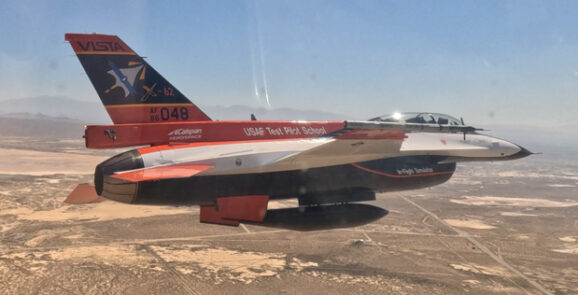
Secretary of the Air Force, Frank Kendall, said “The potential for autonomous air-to-air combat has been imaginable for decades, but the reality has remained a distant dream up until now.
“In 2023, the X-62A broke one of the most significant barriers in combat aviation.
“This is a transformational moment, all made possible by breakthrough accomplishments of the X-62A ACE team.”
Bill Gray, the Test Pilot School’s chief test pilot, added: “It’s very easy to look at the X-62A ACE program and see it as under autonomous control, it can dogfight, but that misses the point.
“Dogfighting was the problem to solve so we could start testing autonomous artificial intelligence systems in the air.
“Every lesson we’re learning applies to every task you could give to an autonomous system.”
DARPA and the US Air Force Test Pilot School will continue testing the AI, which will provide lessons for future tests and programs.
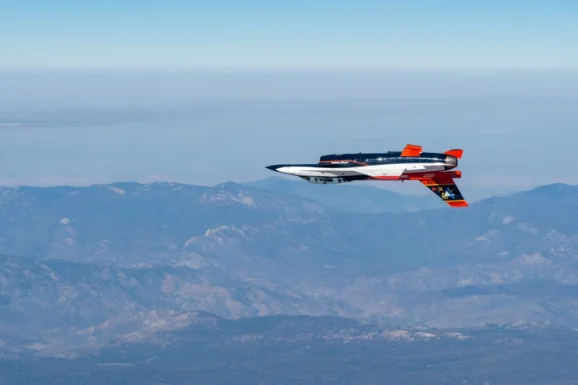
Main image © Air Force photo by Kyle Brasier